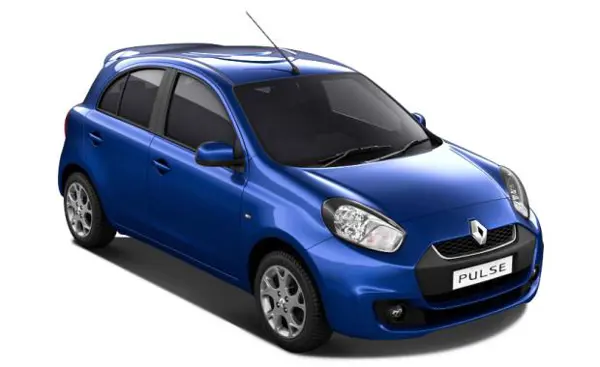
Renault Pulse (2017)

General information and overview
The Renault Pulse (2017) is a diesel-powered compact hatchback based on the Nissan Micra platform, enhanced with sportier styling and a richer feature set to appeal to Indian buyers seeking practicality with added flair. Its 1.5-liter K9K diesel engine produces adequate power with a smooth, lag-free performance and a 5-speed manual gearbox offering good control. Inside, the Pulse features climate control, keyless entry, electric ORVMs, and a decent infotainment system, positioning it above basic hatchbacks in comfort and convenience. The cabin is spacious enough for a small family, with ample legroom and sensible boot space. Safety includes driver airbags and ABS with EBD. The Pulse’s ride quality is tuned for urban roads, balancing compliant suspension with a stable highway presence. Though no longer in production, it remains appreciated for its drivability, fuel efficiency, and unique style in the Indian market.
The Renault Pulse (2017) is essentially an upmarket version of the Nissan Micra, designed to appeal to buyers looking for a compact hatchback with sporty styling and a feature-rich cabin. It comes equipped with a 1.5-litre diesel engine producing around 63 bhp and a 1.2-litre petrol option, both paired with a smooth 5-speed manual transmission. The Pulse features modern design cues like aggressive front grills, automatic headlamps, and electronically adjustable ORVMs, translating to a more premium feel than earlier Renault models. Inside, it offers reasonable space, supportive seats, and conveniences like keyless entry, auto climate control, Bluetooth connectivity, and a decent infotainment system, making it suitable for daily use and longer drives. Safety features include ABS with EBD and a driver side airbag. Despite being discontinued now, the Pulse stands out for its strong build quality, decent fuel economy, and a well-rounded package that fits the needs of Indian urban drivers who want a practical yet stylish hatchback.
Expert opinion and recommendation
The Renault Pulse (2017) stands out as a compact car with a strong mix of style, features, and driveability. I appreciate its aggressive, sporty design and comfortable interior, which offers decent space and some premium touches not common in its segment at the time. The 1.5-liter diesel engine delivers punchy performance with very smooth drivability and minimal turbo lag, making it confident for city and highway use. While the cabin noise is well controlled post 100 km/h, the suspension absorbs bumps nicely, ensuring a comfortable ride. Feature-wise, elements like electric ORVMs, climate control, and push-button start add to its appeal. However, it is priced slightly higher than some competitors, which may affect its value proposition considering Maruti’s stronghold in this segment. Overall, the Pulse offers a compelling option for buyers looking for a unique, feature-rich, and efficient diesel hatch without compromising driving enjoyment, though better after-sales could further its case.
Driving the Renault Pulse (2017) leaves a positive impression with its combination of style, features, and performance tailored for Indian roads. The 1.5-litre diesel engine offers a peppy and smooth drive with minimal turbo lag, making city commutes and highway overtaking effortless. Inside, the cabin provides decent space and comfort, along with features like keyless entry, automatic headlamps, and a good infotainment system that enhance daily usability. While the design is sporty and fresh, it complements the ruggedness expected in Indian conditions. The Pulse’s handling and suspension offer a balanced ride quality, suitable for both urban traffic and longer journeys. However, in this segment, the Pulse faces stiff competition from newer, more modern hatchbacks which offer better refinement and a stronger service network. Despite that, it remains a strong contender for buyers who prioritize robust build and practical features in a compact footprint.
Recent news and announcements
The Pulse was available with both petrol and diesel engines, with the 1.5-litre diesel engine being particularly praised for its driveability and performance. However, the petrol engine lacked ABS, which was a significant drawback. I believe adding ABS to the petrol variant could have improved its appeal.
Renault India has clarified that the Pulse and Scala models, although not listed on their website, have not been discontinued but will be produced on a made-to-order basis for customers who request them. This move is due to the low demand for these models in the Indian market. I think this strategy could help maintain customer satisfaction for those still interested in these cars.
Renault India stopped the production of the Pulse hatchback in July 2017 due to sluggish sales. The Pulse, which was essentially a rebadged Nissan Micra, saw only 1,759 units sold from June 2016 to May 2017. I believe the lack of significant updates and facelifts contributed to its poor sales performance.
Despite its good looks and driving pleasure, the Pulse struggled with resale value and had limited service centers, which were significant concerns for potential buyers. I think addressing these issues could have helped the car perform better in the market.
The Pulse received positive feedback for its interior space, boot space, and fuel efficiency, but critics noted that the cars ground clearance was not suitable for Indian roads. I believe improving the ground clearance would have made it more practical for local conditions.
Pricing details and changes
The Renault Pulse 2017 diesel variants were priced ex-showroom in India approximately between ₹6.0 lakh to ₹7.8 lakh depending on the variant and city. On-road prices, factoring in RTO, insurance, and taxes, could range from about ₹6.7 lakh to nearly ₹9.0 lakh in metro cities like Mumbai and Delhi. Though past its production lifecycle now, at launch and during its lifecycle, the Pulse was positioned slightly premium compared to rivals like the Swift and Tigor. This reflected its added features and diesel engine refinement. However, this positioned the Pulse in a tough spot against competitors with broader service networks and more modern tech. For a 2017 model today, expect pricing to reflect depreciation mostly in the ₹3-4 lakh range on resale markets, influenced by condition and city. If opting for a used Pulse, evaluate on-road cost of ownership including service availability as this impacts long-term satisfaction.
In India, the Renault Pulse (2017) was originally priced ex-showroom between roughly ₹4.5 lakh to ₹7.8 lakh depending on the variant and diesel or petrol engine choice. On-road prices varied from around ₹5.2 lakh to ₹8.8 lakh across metro cities, inclusive of taxes, insurance, registration, and handling charges. While the Pulse was priced at a slight premium compared to some competitors like the Tata Tiago or Maruti Suzuki Swift, it justified this with a richer set of features such as automatic climate control, keyless start, and electronic ORVMs in higher variants. However, given its discontinued status and Renault's relatively weaker dealership footprint in India, buyers needed to consider potential resale value and after-sales service as part of the overall ownership cost. The pricing reflected an attempt to position the Pulse as a premium compact hatchback alternative to the basic offerings, appealing to urban users looking for more amenities and a distinctive design.
Fuel efficiency information
For Indian road conditions, the Renault Pulse diesel shows strong fuel efficiency credentials, with its ARAI figure around 23 km/l in ideal conditions and real-world averages near 18-21 km/l in city and highway use. This makes it a very cost-effective choice for buyers mindful of running costs and mileage. Its efficient engine helps lower fuel expenses significantly compared to petrol variants, suitably balancing power and economy for urban commuting and longer trips.
The Renault Pulse diesel variant delivers an ARAI-certified mileage of approximately 23 kmpl, while the petrol variants offer between 18-21 kmpl depending on driving conditions. This makes it an economical choice for Indian buyers concerned about running costs. The fuel efficiency, coupled with a smooth 5-speed manual gearbox, helps in reducing overall expenditure on fuel. For city commuters and occasional highway drivers, the Pulse strikes a good balance between performance and mileage.
Specifications
- ARAI Mileage (Certified)
- 23.1 kmpl
- Boot Space
- 251 litres
- Engine cc (Displacement)
- 1461 cc
- Maximum Power
- 63.1 Bhp @ 4000 rpm
- Maximum Torque
- 160 Nm @ 2000 rpm
- Fuel Tank Capacity
- 41 litres
- Kerb Weight
- 1050 kg
Pros(4)
Awesome Looks
Vast Service Network
Good Value for Money
Good Mileage
Cons(1)
Doubtful Build Quality
Pricing Information
Ex-showroom prices across different cities
Ex-showroom price
User Reviews
Real experiences from Renault Pulse (2017) owners
Based on 0 rated reviews
Rating Distribution
No reviews found
Be the first to review Renault Pulse (2017)
User Discussions
Ask questions and get answers from the community
No questions yet
Be the first to ask a question about Renault Pulse (2017)
Popular Comparisons
See how Renault Pulse (2017) compares with other vehicles
No comparisons found
There are no popular comparisons available for Renault Pulse (2017) at the moment.
Comparisons will appear here as they become available.
All Variants
Explore all variants of Pulse (2017)
Renault Pulse Diesel RxL ABSCurrent
Renault Pulse Diesel RxL Option
Renault Pulse Diesel RxZ
Renault Pulse Diesel RxZ Option
Renault Pulse RXE
Renault Pulse RXL
Complete Specifications
Renault Pulse (2017)
- Car Variant
- 2017 Renault Pulse Diesel RxL ABS
- Availability Status in India
- Discontinued
- Car Type
- Hatchback
- Fuel Type
- Diesel
- Latest Price in India
- Renault Pulse Diesel RxL ABS price was INR 6.24 lakh before being discontinued.
- ARAI Mileage (Certified)
- 23.1 kmpl
- Official Tagline
- Life Needs a Pulse
- Overall Length
- 3805 mm
- Overall Width
- 1665 mm
- Overall Height
- 1525 mm
- Wheelbase
- 2450 mm
- Kerb Weight
- 1050 kg
- Turning Radius
- 4.65 metres
- Engine cc (Displacement)
- 1461 cc
- Maximum Power
- 63.1 Bhp @ 4000 rpm
- Maximum Torque
- 160 Nm @ 2000 rpm
- Engine Details
- 4 Cyl, in-line Diesel, 8V SOHC
- Number of Cylinders
- 4
- Mileage (City)
- 17 kmpl (approx.)
- Mileage (Highway)
- 20 kmpl (approx.)
- Alloy Wheels
- Tubeless Tyres
- Tyre Size
- 165/70 R14
- Electronic Brake Distribution (EBD)
- Anti-lock Braking System (ABS)
- Brake Assist
- Front Brakes
- Ventilated Disc
- Rear Brakes
- Drum
- Driver Seat Adjustment
- Manual
- Front Headrest (Adjustable)
- Music System
- Roof Antenna
- Trip Distance
- 2
- Door Ajar Warning
- Tachometer
- Front Fog Lights
- Follow Me Home Headlamps
- ORVM Turn Indicators
- Seating Capacity
- 5
- Boot Space
- 251 litres
- Fuel Tank Capacity
- 41 litres
- Luggage Lamp
- Reading Lamp
- Power Outlet
- Remote Fuel Filler
- Hands-free Bluetooth
- Air Conditioner
- Automatic AC
- Keyless Entry
- Power Steering
- Yes (Tilt)
- Rear Defogger
- Engine Start/Stop Button
- Rear Washer & Wiper
- Power Windows
- Rear Seat Belts
- 3
- Airbags
- 1
- Chrome Front Grille
- Body Coloured Bumpers
- Outside Rear-view Mirrors
- Tinted Glass
- Engine Immobilizer
- Central Locking
- Sunroof
Expert Verdict
Professional reviews and expert opinions on Renault Pulse (2017)
A new concept has entered Indian car market, it’s known as rebadging. It means selling a one car under different brand names. We have seen before, cars sharing platform and engines but that can’t be referred as rebadging because they are different in terms of body panels and interiors. Rebadged cars are almost identical to each other in every aspect. It’s the way of saving money and time for those auto giants which have multiple brands. It’s always costly and time consuming to develop a whole new car. In other international markets, it’s a regular practice but it’s new for Indians. The French car makers, Renault have introduced this concept in India. Renault has launched a hatchback known as Pulse which is nothing else than an altered version of its alliance Nissan’s Micra. After the failure of Logan in India, Renault aims to reach the largest segment of buyers in India with Pulse. Will this car set a new trend of badge engineering in India or will it be just another hatch to populate the segment, let’s find out.
Exterior
Nissan’s Micra has not much succeeded in our market and the major contributor to its failure is its styling. Majority of people feels that Micra looks cute and pretty. It feels more feminine and undoubtedly Indian buyers are mainly men so the car doesn’t appeal them much. Renault has taken care of this fact and they have added the manly character to Pulse which was badly missing in Micra. The way Renault has differentiated Pulse from Micra is commendable especially from its front. Pulse looks much more aggressive than Micra; the biggest changes are made to its headlights and bumper grille. The headlights are edgy and pointing which along with newly crafted bumper grille gives it a new dimension. The bonnet is similar to Micra ending much before the radiator grille.
Its big front bumper is specially revised to make it look aerodynamic. However its bumper grille resembles to the hexagonal grille used in Hyundai i10 as it also uses a lot of black color. There is a thin chrome finished lining which is in the middle of Renault’s big logo and its number plate. The small fog lights are now housed inside the air dam which looks very nice and charismatic. Nothing much has changed on the sides, the top model features body color door handles and side mirrors with no inbuilt turn indicators. Base model is available with R14 size of tyres while the top model has 15 inch alloy wheels which along with those noticeable wheel arches improve the side stance of this car. Rear of the car has simple boot gate and door handle fitted with stylish wiper and integrated spoiler with brake light. Tail lights are rearranged with clear lens. The rear bumper is also given the touch of black color with nice lines on it.
Whats different in Renault Pulse in comparison to Nissan Micra
Renault Pulse features New front and rear bumper, New head lights and tail lights, New round fog lamps, New steering wheel, New front grille and alloy wheels and Renault logo on hatch and front grille.
Whats same in Renault Pulse and Nissan Micra
Both are manufactured in same factory located in Chennai, Based on same V-platform to keep the costs down, Share same suspension, 5 speed gearbox, same petrol and diesel engines, instrument cluster and central console, front and rear seats, door handles and tyres, rear-view mirrors, doors, bonnet and hatch.
Fast Facts about Renault Pulse
- Renault Pulse is based on Nissan Micra’s Platform
- Unique 2+2 year warranty (first for a car in this class)
- The codename of Renault Pulse project was B58
- It shares most of the exterior and interior parts with Nissan Micra
- The engines are same which powers the Micra petrol and diesel
- Unveiled by Carlos Ghosn at 1st Indian Grand Prix in Noida
- Diesel engine’s displacement is 1.5 litre, 64 bhp power, 160 nm torque
- Petrol engine’s displacement is 1.2 litre, 75 bhp power, 104 nm torque
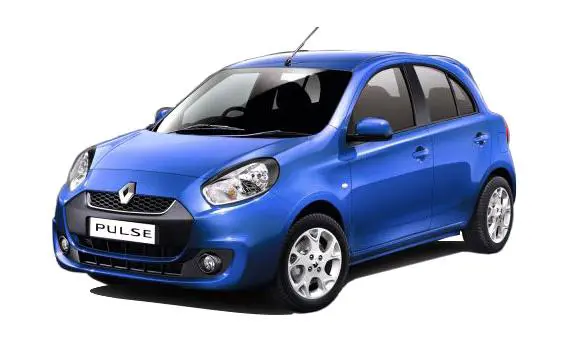
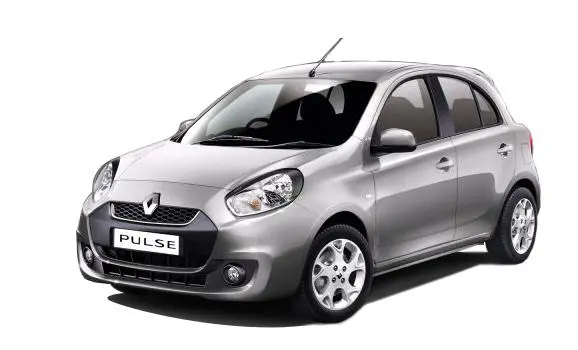
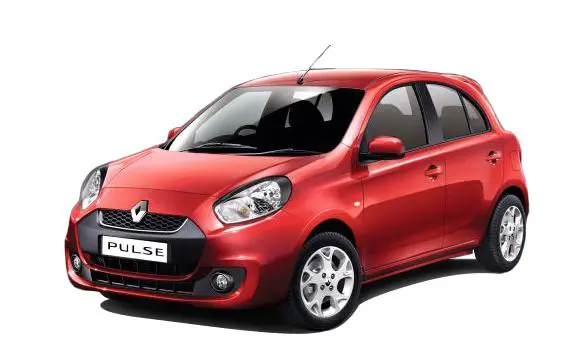
- Available in six shades: Champagne Gold, Metallic Grey, Metallic Red, Metallic Silver, Pearl White and Solid Black
- Is manufactured in India where Micra is manufactured
- Renault Pulse is the first small car to be awarded with a 5-star Euro NCAP rating
- Available in seven variants - RxE petrol, RxL petrol, RxZ petrol and four diesel variants: RxL, RxZ, RxL Option and RxZ Option
- The option variants of diesel comes with dual airbags - driver + passenger
Interior
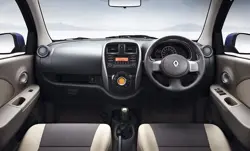
Renault Pulse is a carbon copy of Micra from inside. Except the color changes there is nothing new inside. Pulse uses dark grey shade inside. The familiar three spoke steering wheel now sports a big Renault logo on it with unique finishing on gear knob. Both steering wheel and gear knob are wrapped in leather which is nice to touch and hold. The quality of fabric and plastic used inside is very satisfactory. The door trims are fabricated inside with nice fit and finish. You will find a round shaped instrument cluster with a tachometer and on board trip computer. Interior styling is not a let-down but it doesn’t appeal you that much as some of its competitors looks very fresh and up market when compared to it.
Comfort and Convenience
Renault Pulse is a very comfortable car according to its size. Front legroom and headroom is optimum with tilt-able power steering. Driver’s seat is not height adjustable. The seats are very comfy especially the front seats although its rear seats offer less under thigh support. Front and rear seats get adjustable headrests. With full seating of five, rear passengers might find their shoulders rubbing to each other and tall passengers may complain about the headroom at the back. For your convenience, the car has front and rear power windows with one touch up and down function (driver side only). It also has auto fold/unfold mirrors by remote sense with electrically adjustable outside mirrors in top model. Similar to Micra, Pulse also has engine start/stop illuminated button with keyless entry and central locking. Its top model features a manual AC with heater and automatic climate control. For better visibility the car comes with follow me type headlights and rear defogger with timer. Other features include headlamp on, key off reminder, smart access key for all doors and key answer back function.
Dashboard and Storage
Renault Pulse has a familiar dashboard of Micra with different color. This dashboard is grey in color with most of the things on it being round in shape. For example round AC vents and circular Centre console. The plastic quality and texture on it feels premium. Centre console and AC vents are brushed with silver color to make it look different than Micra. We wish if Renault had repositioned the centre console as it looks boring in round shape. There is no storage space on this dashboard except a glove box. However door pockets are of good size with two front and one rear cup holders. It also has a bottle holder. Renault has managed to increase the boot capacity of Pulse in comparison to Micra. It has a boot capacity of 251 litres, which is quite acceptable for its segment. Rear seats do fold down but they don’t split.
Music System
Top model of Renault Pulse features an integrated music system in its central console. It’s a CD, MP3 player with radio and Aux-in port. It also has 4 speakers. There is no Bluetooth connectivity in it. Steering mounted controls are also absent which are expected at this price. There is a 12V accessory socket at its front for direct connectivity of your music gadgets.
Engine and Gearbox
Similar to Micra, Renault has also offered Pulse with two different engines and fuel options. The petrol motor is a DOHC 12 Valve, 3cylinder engine. This 1.2L engine is specially designed for this small car. It churns out a maximum power of 75 bhp at 6000 rpm and it manages to pull out a torque amount of 104 Nm coming at 4000 rpm. The K9K dci engine also powers this car. Many cars in the Renault-Nissan family use this engine. It’s a 1.5L, 4 cylinder common rail diesel engine. This engine has been tuned for this car in order to make it more fuel efficient. This engine produces relatively less power than other cars using this same engine. The maximum power and torque output of this engine is 64 bhp and 160 Nm which are achievable at 4000 and 2000 rpm respectively. Both engines are mated with 5-speed manual gearbox.
Acceleration and Performance
The 3cylinder petrol unit on this car is much better than what it looks on paper. This engine feels very refined and enthusiastic. The absence of one cylinder doesn’t affect much on its performance. Push the start button; press the throttle and the car feels ready to go. Due to 4 valves per cylinder and DOHC it feels very relaxed engine. Even when you rev hard this engine, it’s not much audible. It sounds much better than the 3 cylinder engine used in Polo as it makes less noise and Vibrations. The gearing is very accurate in this car and with its light weight, it has a big advantage. The power to weight ratio is very impressive and the car feels very responsive. Though it’s far behind the benchmark set by Suzuki’s K series and Hyundai’s Kappa2 engine but it’s certainly better than some of its competitors. It will take you just over 13 seconds to reach 100km/hour from standstill with this car and it can easily go pass the speed of 140km/hr. The diesel motor is also very refined and stable.
This engine has always been mated well with every car. Renault has tuned this engine for city driving and it’s quite evident as it low and mid-range offers much of its power. The light weight here also comes in to play and improves it performance. There is minimal turbo lag in this car and once pass 2000 rpm, it’s very smooth till 3000 rpm.After that there is not much power as the car starts to suffocate. Power delivery is very linear and allows you to push it hard but this engine is a bit noisy. It’s not as silent as Fiat’s Multijet engine but it’s less audible than others. Refinement level is very satisfactory. It’s a good city car as due to its light weight, you don’t feel the lack of power and torque but as soon as you hit the highways, the story changes. You will find it hard to run along the cars like Swift, Ritz and i20 as their high range is much powerful than Pulse. It does 0-100 in less than 17 seconds with a top speed of 145km/hr. It’s not the best in this department but these figures are quite respectable.
Mileage
The petrol engine will return you a mileage of around 13km/ltr in city while on highways it can return around 15-16km/ltr. The diesel engines is more fuel efficient and expect it to give a fuel efficiency of around 15km/ltr in city conditions and on highways it will give you around 18-19km/ltr. Both engines are fuel efficient and the figures seem to be in the favour of Renault Pulse.
Ride and Handling
Its steering with a turning radius of 4.6m is the best in its segment. It’s a perfect car in city traffic as it fits well everywhere, this steering is very responsive and light. Suspension is especially suited for this car and it works really well. Not much noise inside even after heavy bumps. There is minor body roll around corners as its light in weight and suspension is also on the soft side. But thanks to its wheelbase and R15 size of tyres, Renault Pulse manages well at high speeds and firmly holds the road.
Braking and Safety Features
Renault Pulse has disc brakes at its front with drum brakes at the back. It also comes equipped with ABS and EBD (top variants). The top variant features Driver side airbag with optional airbag for passenger side which means you have to pay more for that. Other safety features include immobilizer and speed sensing auto door lock.
Variants
Renault Pulse is available in seven variants - RxE petrol, RxL petrol, RxZ petrol and four diesel variants: RxL, RxL Option, RxZ and RxZ Option. The option variant of diesel Pulse comes with 2 airbags - driver + passenger.
Shades Available
Renault Pulse is available in six shades: Champagne Gold, Metallic Grey, Metallic Red, Metallic Silver, Pearl White and Solid Black.
Warranty
Renault offers Pulse with a unique 2+2 years warranty which is first in its class.
Verdict
We feel Renault has overpriced this car. Pulse also lacks many features which are expected at this price. Had it been priced smartly then things would have been interesting. Right now, at this price there are many other cars which are more powerful, refined and spacious offering many features. It loses out to king of its segment; Swift in almost every aspect. In fact Swift is cheaper than Pulse. It’s not strikingly different from Nissan Micra. So basically; Renault is asking you to spend more money on Micra for small cosmetic changes. With poor reputation and service network in India, we are afraid if Renault will be able to get the trusted and loyal buyers of Maruti Suzuki Swift. At this price we don’t think it’s a complete value for money car .Though it may appeal to those who don’t visually like Micra and want to try something different than Swift.
Related Cars
Compare Renault Pulse (2017) with these similar cars
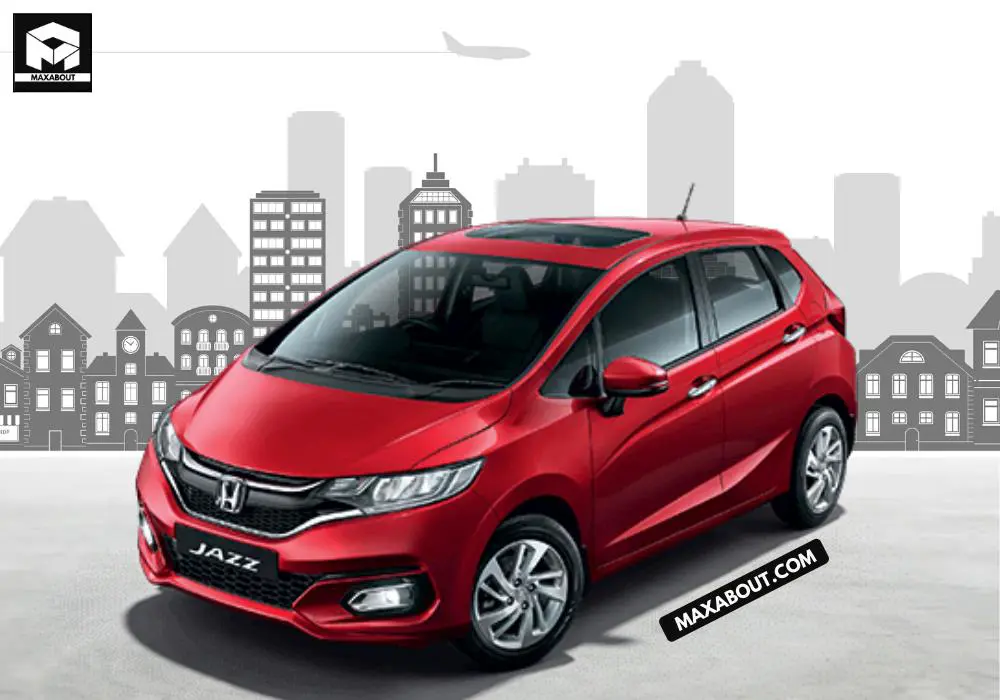
Honda Jazz Jazz VX CVT
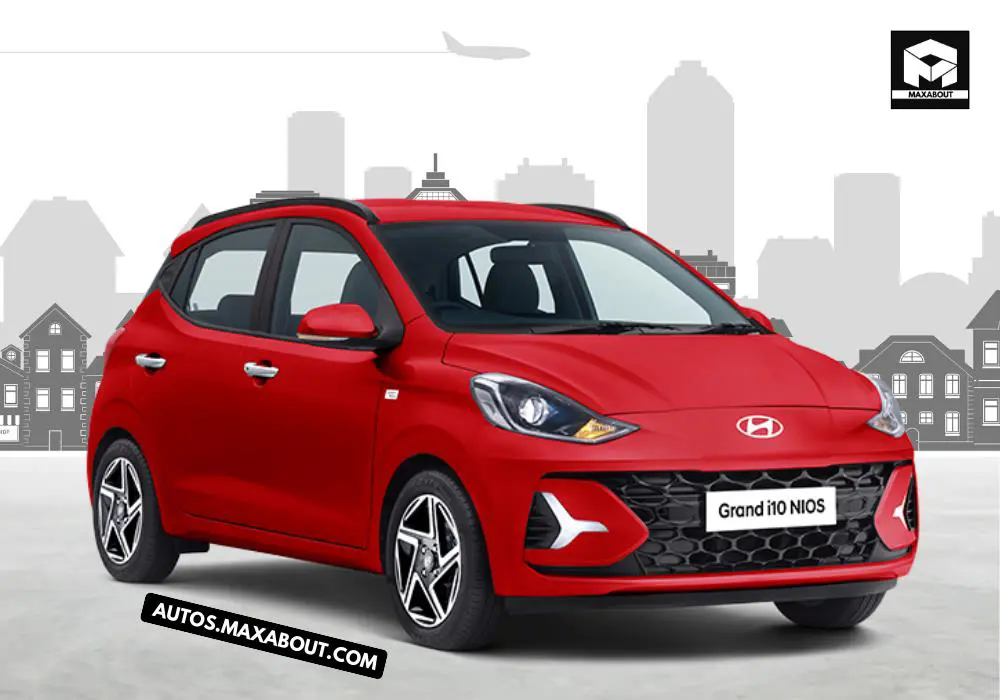
Hyundai Grand i10 Nios Grand i10 Nios Magna
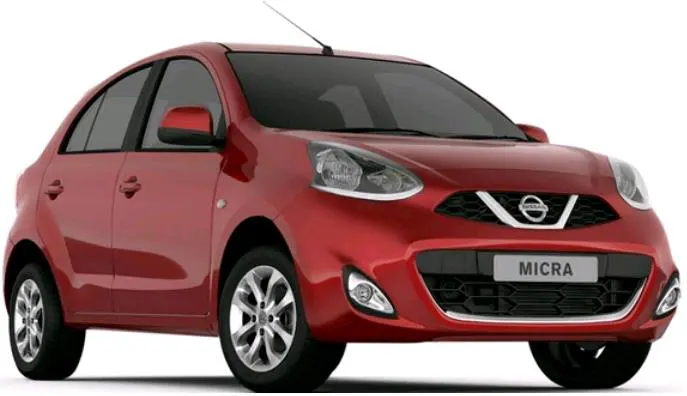
Nissan Micra (2020) Micra XL (O) Automatic
Tata Tiago Tiago XE
Ford Figo Figo Ambiente
Hyundai Elite i20 (2019) Elite i20 Diesel Asta
Tata Bolt (2019) Bolt Diesel XT
Maruti Swift (2019) Swift Diesel ZDi
Share real ownership experiences, ask questions, and help other buyers decide.
Earn reward points for every comment and get a chance to win ₹1,000 in our weekly lucky draw. Sign in with Google in one tap.
nice interior..!!!
nice car.............
nice.............
good features
interior nice
small but compact
it requires high maintenance cost.........
i like the look of the reanult
Good car, but about the after sales...service and maintenance...?
thnx, i like the review
Explore the color options available for Renault Pulse (2017)
Renault Pulse Metallic Silver
Silver
Cosmos Blue
Blue
Metallic Grey
Grey
Metallic Red
Red
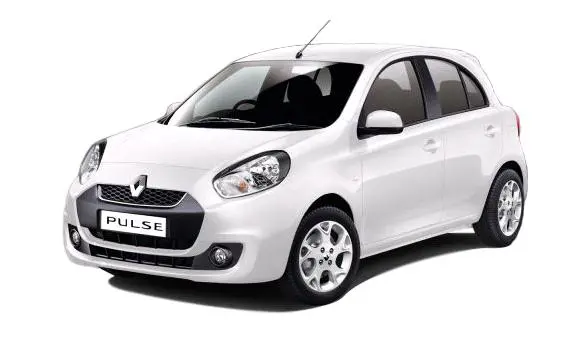
Pearl White
White
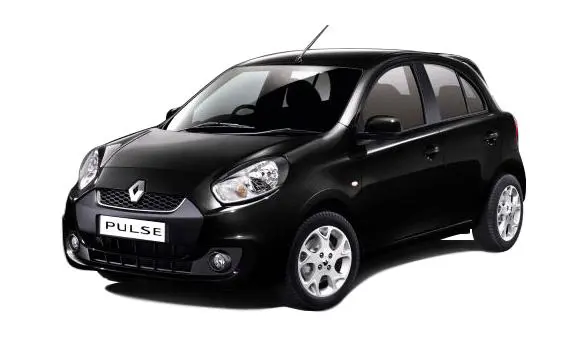
Solid Black
Black
Renault Pulse (2017) Images & Videos (7)
Watch reviews, test drives and walkarounds of Renault Pulse (2017)
New Renault Pulse Front 3-Quarter
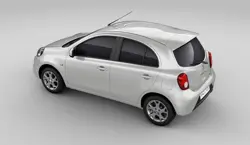
New Renault Pulse Rear 3Q
New Renault Pulse Dashboard

New Renault Pulse Interior
Latest Renault News
Recent updates from Renault
Search: "Renault"
Latest Automotive News
Stay updated with the latest happenings in the automotive world
Most Popular Cars
Based on Cars Popular on Autos