
TACC signs non-binding EV anode MoU for up to 30% of Phase 1 capacity
TACC’s non-binding MoU could lead to supply covering up to 30% of its planned 20,000-tonne annual anode capacity. A firm contract is still pending.
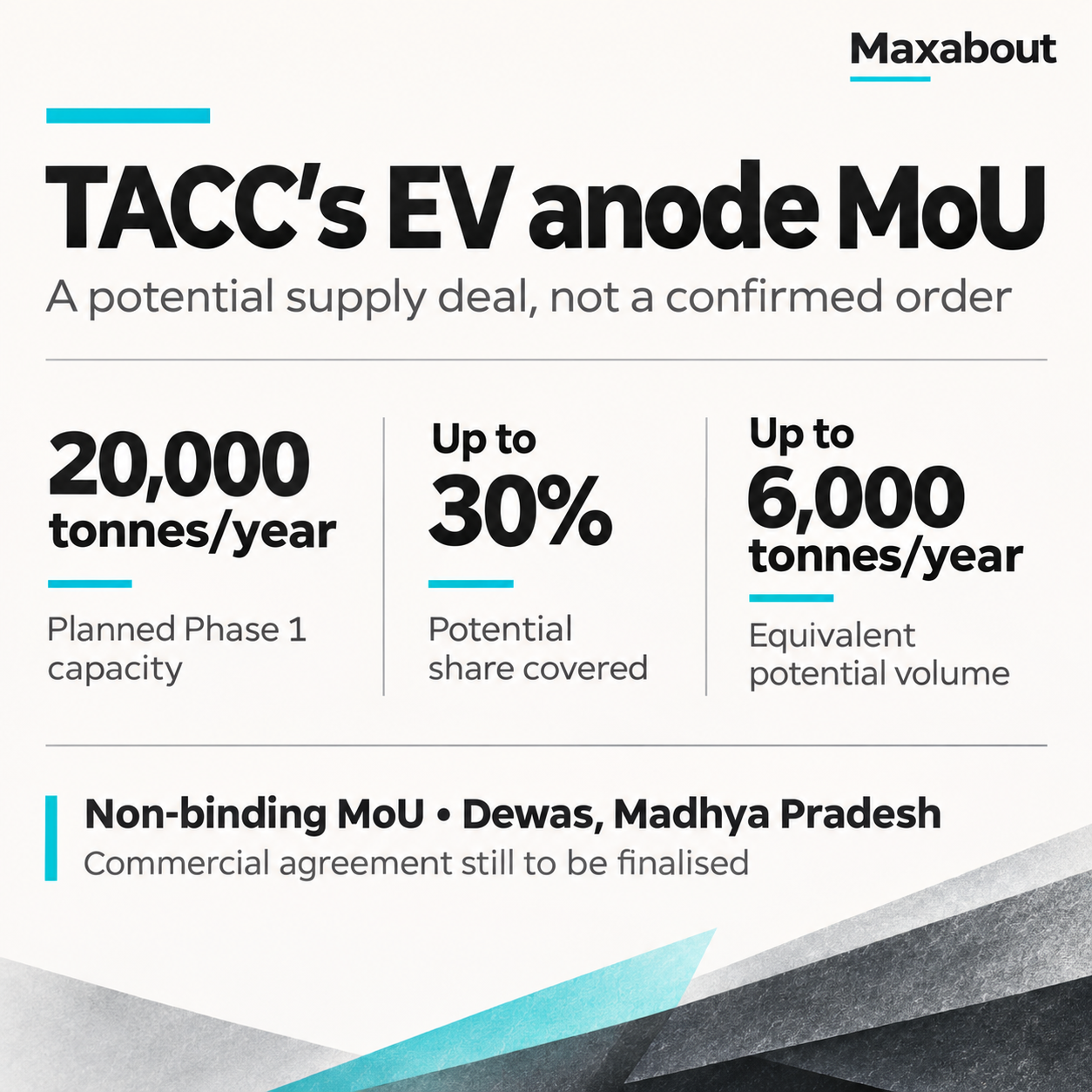
TACC has signed a non-binding memorandum of understanding with an unnamed global automotive manufacturer to explore supplying fast-charging anode materials for electric vehicles. A future commercial agreement could cover up to 30% of the planned annual capacity of its Phase 1 plant in Dewas, Madhya Pradesh. The announcement is a step towards a potential customer relationship, not a confirmed supply order.
What the TACC anode MoU covers
TACC, a subsidiary of HEG Advanced Materials, plans to produce 20,000 metric tonnes of anode active material a year in the first phase of the Dewas facility. The MoU creates a framework for development, evaluation and further commercial discussions with the automotive manufacturer.
- Agreement status: non-binding MoU, with a commercial supply agreement still to be finalised.
- Potential allocation: up to 30% of planned Phase 1 capacity.
- Equivalent annual volume: up to 6,000 metric tonnes, calculated as 30% of 20,000 tonnes.
- Customer: described as a global automotive manufacturer; its identity has not been disclosed.
Why 6,000 tonnes is a ceiling, not an order book
The phrase “up to 30%” matters. Applying that share to the planned 20,000-tonne annual capacity gives a maximum indicated volume of 6,000 tonnes a year. It does not establish a minimum purchase commitment, a delivery schedule or a guaranteed level of plant utilisation.
Likewise, the remaining capacity should not be described as unsold inventory. This is a planned production facility, and the announcement does not provide a complete account of its future customer allocations. TACC has separately outlined a further 44,000-tonne expansion plan; that figure is not the capacity base used for this MoU’s 30% calculation.
What it means for India’s EV supply chain
The development concerns materials used in batteries rather than a new EV model or a finished battery-pack supply contract. For industry watchers, the important question is whether the evaluation and commercial discussions progress into a firm agreement supported by operational manufacturing capacity.
For EV buyers, the announcement alone does not establish a faster charging time, lower vehicle price or a launch date. No vehicle application, battery specification or charging-performance figure has been announced as part of this arrangement. “Fast-charging anode materials” describes the intended technology application, not a verified charging result for a production car.
What needs to happen next?
A final commercial agreement, disclosed delivery terms and progress on the Dewas facility would clarify the practical scale of the relationship. Until then, the TACC anode material MoU is best understood as a potential route to commercial supply, with the distinction between planned capacity and contracted demand kept firmly in view.
Explore the story
Related news


Share your view and join the discussion.
Earn reward points for every comment and get a chance to win ₹1,000 in our weekly lucky draw. Sign in with Google in one tap.
Start the conversation
No one has commented on this article yet. Be the first to share your view.
Want to read more automotive news?
Stay updated with the latest car launches, reviews, and industry insights.
Browse All News