
India bans lithium-ion battery black mass exports under code 85491400
India has prohibited exports of covered lithium-ion battery black mass. Here is what the tariff code covers and how the move affects the domestic recycling chain.
India has prohibited exports of lithium-ion battery black mass covered by tariff code 85491400. The Directorate General of Foreign Trade changed the export policy from Free to Prohibited on 10 November 2026, with immediate effect and until further orders. The move aims to keep more feedstock available to Indian recyclers that can recover critical minerals from spent batteries and manufacturing scrap.
What does the export prohibition cover?
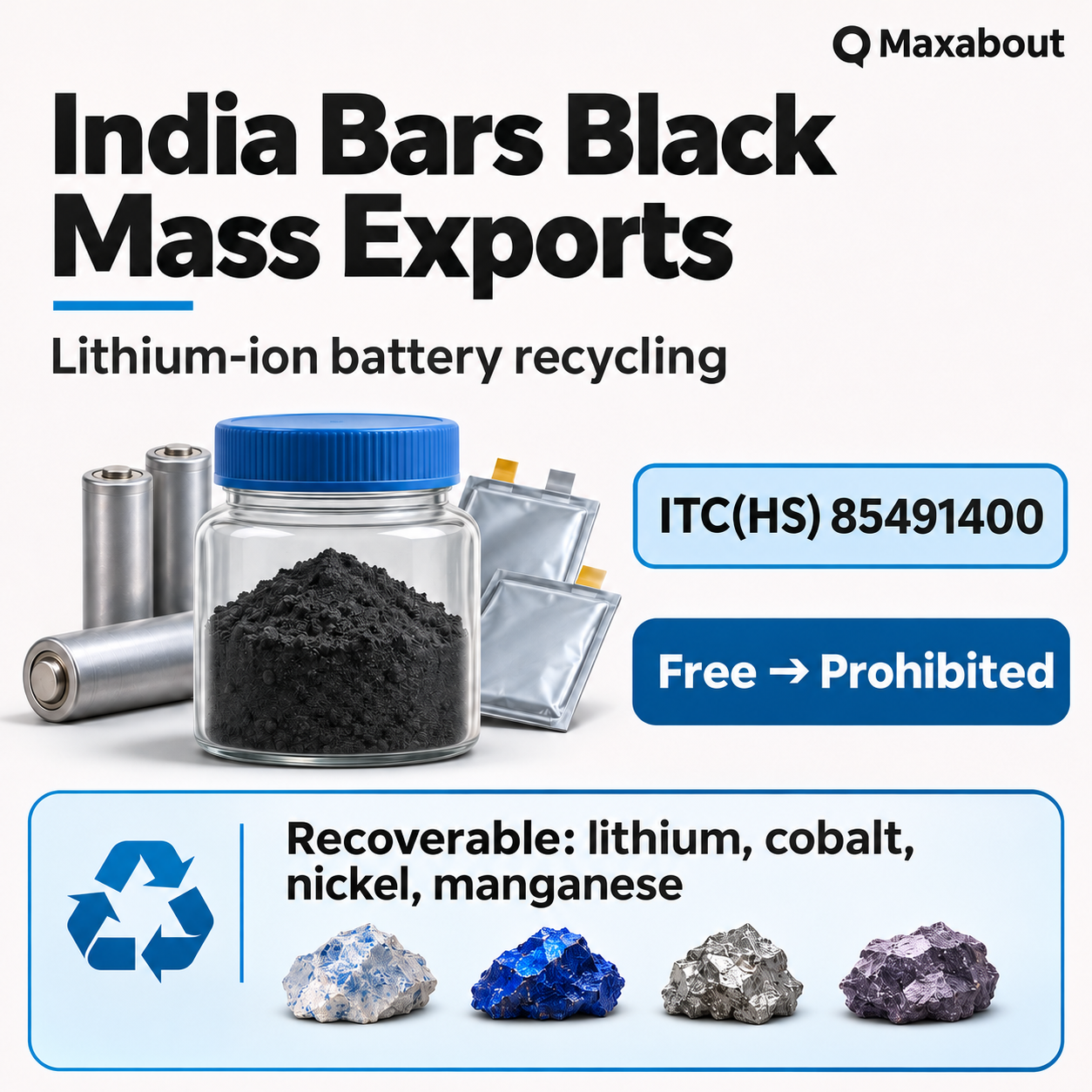
Notification 49/2026-27 identifies lithium-ion battery black mass under ITC(HS) 85491400. The underlying tariff heading covers unsorted waste and scrap from cells, batteries and accumulators, including spent units, that do not contain lead, cadmium or mercury. For exporters, the notification’s product description and tariff classification matter when deciding whether a shipment is covered.
| Detail | What the rule says |
|---|---|
| Product named in the notification | Lithium-ion battery black mass under ITC(HS) 85491400 |
| Export policy | Free to Prohibited |
| Effective period | Immediate effect from 10 November 2026 until further orders |
| Transitional arrangements | Paragraph 1.05 of the Foreign Trade Policy 2023 applies |
What is battery black mass?
Black mass is a dark powder produced when recyclers shred end-of-life lithium-ion batteries or battery manufacturing waste. Its contents vary with the battery chemistry. Refining can recover materials such as lithium, cobalt, nickel and manganese for further use. Shredding produces the feedstock, while refining turns it into usable mineral products.
Why the rule matters to India’s EV supply chain
The export restriction targets an early step in the recycling chain. More domestic feedstock can help Indian recyclers use existing processing capacity and support investment in refining. It complements the government’s ₹1,500 crore critical-mineral recycling incentive scheme, which supports recovery from secondary sources including battery waste and e-waste.
The effect on battery manufacturing depends on how much material recyclers collect, process and refine into grades manufacturers can use. The notification gives no timetable or estimate for changes in battery supply or retail EV prices.
FAQs
Can shipments already in progress qualify for transitional treatment?
The notification says the transitional arrangements in paragraph 1.05 of the Foreign Trade Policy 2023 apply. The treatment of a particular shipment depends on whether it meets those provisions.
How long will the black mass export prohibition last?
The notification applies until further orders and gives no expiry date.
The next measure of the policy’s impact will be how much additional black mass Indian plants process and how much usable material they recover for the domestic supply chain.
Explore the story
Related news
Share your view and join the discussion.
Earn reward points for every comment and get a chance to win ₹1,000 in our weekly lucky draw. Sign in with Google in one tap.
Start the conversation
No one has commented on this article yet. Be the first to share your view.
Want to read more automotive news?
Stay updated with the latest car launches, reviews, and industry insights.
Browse All News