
Suzuki e Vitara Gets 4-Star Japan NCAP Rating: What It Means for India
The Suzuki e Vitara has received a four-star overall rating in the 2026 Japan NCAP assessment, with an A rank for preventive safety and a B rank for collision safety. The result, announced on 20 October 2026, applies to the Japan-market electric SUV. For Indian buyers, the key distinction is that th...
The Suzuki e Vitara has received a four-star overall rating in the 2026 Japan NCAP assessment, with an A rank for preventive safety and a B rank for collision safety. The result, announced on 20 October 2026, applies to the Japan-market electric SUV. For Indian buyers, the key distinction is that this is a separate assessment from the e Vitara's five-star Bharat NCAP adult and child occupant ratings. The different results need to be read with their respective test protocols and vehicle specifications, rather than as a simple upgrade or downgrade.
What the Japan result tells you
Overall rating: Four stars in the 2026 Japan assessment.
Preventive safety: A rank for systems intended to help avoid accidents.
Collision safety: B rank for performance in the collision assessment.
Emergency reporting: Advanced Type II classification for the automatic accident-reporting system.
Four stars is only the starting point
The overall star rating is useful as a quick summary, but the individual categories answer different questions. Preventive safety concerns assistance intended to reduce the likelihood of a crash. Collision safety concerns the vehicle's performance when a collision occurs. Automatic emergency reporting addresses what happens after a serious impact by helping connect occupants with assistance.
The Maruti Suzuki e Vitara sold in India shares the model identity with the export vehicle, but that alone does not establish that every assistance feature, calibration or connected service is identical across markets. A Japan-market equipment statement should therefore not be applied automatically to an Indian variant.
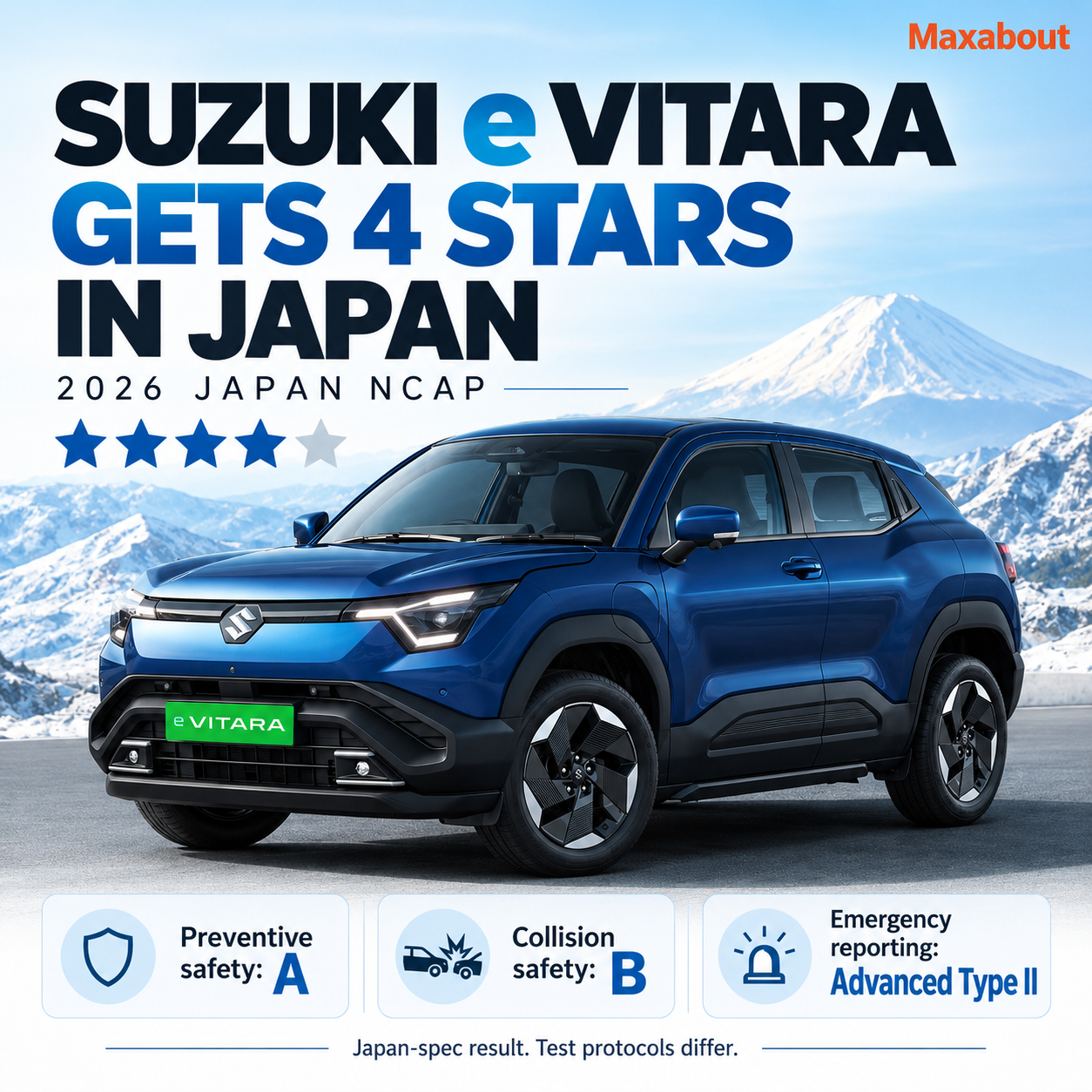
| Japan assessment category | 2026 result | What it helps readers assess |
|---|---|---|
| Overall safety | Four stars | The programme's combined assessment |
| Preventive safety | A rank | Accident-avoidance assistance |
| Collision safety | B rank | Protection assessed during collisions |
| Automatic emergency accident reporting | Advanced Type II | Post-impact emergency communication capability |
Why the 2026 test year matters
The Japanese programme introduced additional intersection emergency-braking scenarios for 2026, including motorcycle-related situations. It also changed the emergency-reporting evaluation to address rear-seat occupants and began providing child-occupant information from the new offset frontal test using dummies representing six- and ten-year-old children.
These changes are a reminder that an assessment year is part of the result. A star count without the programme, year and relevant specification leaves out important context. The headline result also does not justify inventing a percentage score or a precise number of points needed for five stars when those figures have not been established.
How does this relate to India's five-star result?
The Indian record, published in 2025 and listed as applicable from December 2025 onwards, identifies the tested vehicle as the e Vitara Alpha 61kWh. It records 31.49 out of 32 for adult occupant protection and 43 out of 49 for child occupant protection, with five stars in each category. Rating applicability should be checked against the variants listed in that assessment.
Those are occupant-protection results under India's assessment framework. Japan's overall assessment also addresses preventive safety and emergency reporting. The scores have different denominators, categories and evaluation rules, so they should not be converted into a common ranking. The Japan result does not replace the Indian result.
What Indian buyers should check
For shoppers comparing electric cars, the practical next step is to match the safety evidence to the exact car being considered:
Check the assessment's market, publication year, tested variant and applicability list.
Confirm the safety and driver-assistance equipment on the intended variant rather than assuming export equipment is standard locally.
Check whether emergency assistance depends on a connected-service subscription and local service availability.
Treat driver assistance as support for an attentive driver, rather than a guarantee that every collision will be prevented.
FAQs
Is the four-star Japan result a new Bharat NCAP rating?
No. It is the Japan-market vehicle's 2026 Japan NCAP result. India's assessment has its own published occupant-protection ratings and applicability.
Does the B rank mean every collision test received the same result?
No. B is the collision-safety category result. Individual tests assess different impact situations, so that category label should not be treated as a uniform score for every scenario.
Should buyers compare the two star ratings directly?
They should compare the test frameworks and applicable specifications first. Different programmes can assess different safety dimensions, making a star-only comparison incomplete.
The e Vitara Japan NCAP rating adds useful evidence about the export SUV's safety performance. For an Indian buying decision, read it alongside the applicable domestic assessment and the equipment of the chosen variant, keeping each result in its proper context.
Explore the story
Related news

Share your view and join the discussion.
Earn reward points for every comment and get a chance to win ₹1,000 in our weekly lucky draw. Sign in with Google in one tap.
Start the conversation
No one has commented on this article yet. Be the first to share your view.
Want to read more automotive news?
Stay updated with the latest car launches, reviews, and industry insights.
Browse All News