
Federal-Mogul India Approves ₹335.1 Crore Capacity Expansion at Three Sites
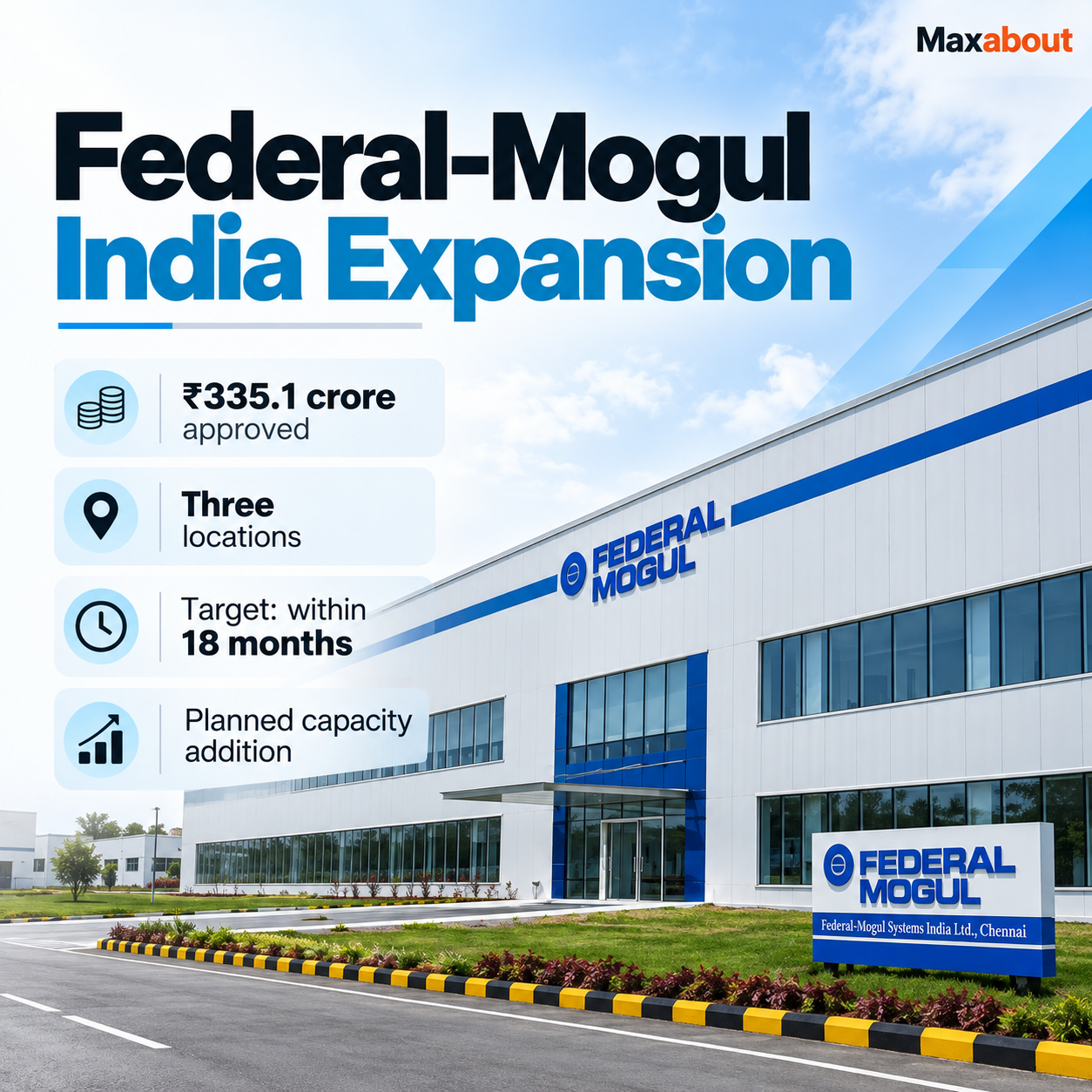
Federal-Mogul Goetze (India) has approved a reported ₹335.1 crore capacity-addition programme across three locations, with implementation targeted within 18 months. The board decision dated 9 October 2026 covers engine-component lines at Patiala, Bengaluru and Bhiwadi and is to be funded through int...
Federal-Mogul Goetze (India) has approved a reported ₹335.1 crore capacity-addition programme across three locations, with implementation targeted within 18 months. The board decision dated 9 October 2026 covers engine-component lines at Patiala, Bengaluru and Bhiwadi and is to be funded through internal accruals. Approval describes a plan; it does not mean the added capacity is commissioned or that the corresponding output has already been produced.
Which locations are covered?
The reported sites are Bahadurgarh, Patiala in Punjab; Yelahanka, Bengaluru in Karnataka; and Bhiwadi in Rajasthan. The checked announcement does not provide a product-by-product allocation to each site. It would therefore be misleading to assign a particular new line or share of the investment to one location without additional evidence.
The three-site description gives the geographic scope of the programme, rather than a new nationwide factory network. It also does not establish land acquisition, a new greenfield plant or a site-specific completion date.
The planned additions, with their units kept distinct
| Product category | Reported capacity addition |
|---|---|
| Cast-iron piston rings | 8.15 million units |
| PVD steel-ring sets | 5.04 million sets |
| Pistons | 3.96 million units |
| Engine valves | 3.24 million units; new line |
| Valve guides | 6 million units |
| Valve seats | 6 million units |
Ring sets and individual components are different units. Adding all six figures into a single “parts capacity” total would conceal that distinction and would not describe an equivalent number of finished engines or vehicles. The figures are best read category by category.
The engine-valve line is described as a new addition. That differs from expanding an existing line: no comparable current valve capacity was provided in the checked report, so a percentage growth claim for that category cannot be calculated responsibly.
Existing capacity and utilisation context
The report lists current annual capacity of 54 million cast-iron rings, 19.2 million PVD steel-ring sets and 21 million pistons. It also lists 124.92 million valve guides and 99.6 million valve seats, with existing capacity utilisation described as 100%.
Installed capacity is a measure of production capability, rather than automatically a sales figure. Utilisation describes how much of that capability is being used in the reported context. Neither tells readers which customer programmes will receive the additional components or what future revenue the programme will generate.
Product categories have different base sizes, so an equal numerical addition can have different significance in each line. A clear assessment retains the original units and avoids treating rings, sets, pistons, valves, guides and seats as interchangeable.
Funding and the 18-month target
Internal accruals are the reported funding route. The checked announcement does not establish a new equity issue, borrowing package or government subsidy for this programme. The ₹335.1 crore figure should be understood as approved investment, not as expenditure already completed.
The 18-month period is an implementation target. Actual commissioning is a later milestone, and the report does not break out separate schedules for procurement, installation, testing or customer approval. It would be premature to promise a precise date for each line from the headline period alone.
Why this matters to the automotive supply chain
The programme concerns components used within engine assemblies. Additional capacity can increase a supplier's manufacturing headroom once operational, but a board approval by itself does not identify guaranteed orders, a particular vehicle launch or an immediate change in replacement-part availability.
For industry observers, the useful follow-up evidence will be commissioning updates, actual utilisation of new lines and any specific customer or product disclosures. For end users, the announcement should not be translated into a claim that vehicles will become cheaper or maintenance intervals will change.
FAQs
How large is the approved programme?
The reported investment is ₹335.1 crore, funded through internal accruals.
Are the new lines already operational?
The report describes planned additions targeted within 18 months. Commissioning is not confirmed.
Can the component figures be added into one vehicle total?
No. They cover different products and include both individual units and ring sets.
Is a separate investment allocation available for each site?
The checked report identifies three locations but does not provide that allocation.
The Federal-Mogul India capacity expansion is a concrete board-approved manufacturing plan. Its investment, locations and product categories are reported; operational completion and the eventual business outcomes remain future checks.
Explore the story
Related news


Share your view and join the discussion.
Earn reward points for every comment and get a chance to win ₹1,000 in our weekly lucky draw. Sign in with Google in one tap.
Start the conversation
No one has commented on this article yet. Be the first to share your view.
Want to read more automotive news?
Stay updated with the latest car launches, reviews, and industry insights.
Browse All News