
J&K EV Policy 2026–32: Targets, Charging Plans and Buyer Checklist
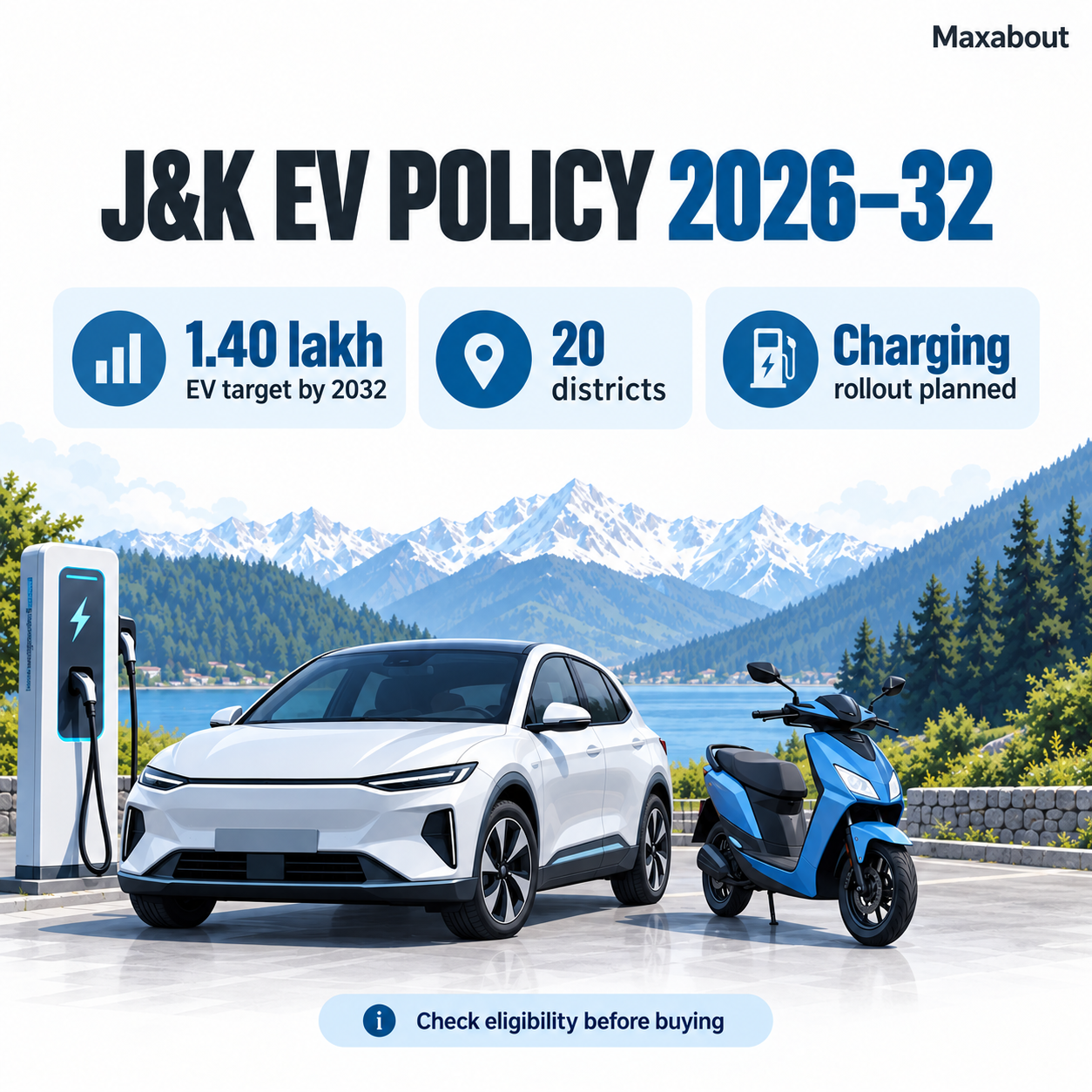
J&K EV Policy 2026–32 sets a reported target of 1.40 lakh electric vehicles by 2032 across all 20 districts. The notification combines vehicle adoption, charging infrastructure and financing measures. These are policy targets and reported support provisions; buyers still need the applicable impl...
J&K EV Policy 2026–32 sets a reported target of 1.40 lakh electric vehicles by 2032 across all 20 districts. The notification combines vehicle adoption, charging infrastructure and financing measures. These are policy targets and reported support provisions; buyers still need the applicable implementation rules and an eligibility check before treating any incentive as part of their purchase budget.
What the policy aims to deliver
Coverage: all 20 districts over the 2026–32 policy period.
Adoption: 1.40 lakh EVs by 2032, a target rather than a current registration count.
Charging: 900 planned public charging sites, including 140 fast-charging hubs.
Ownership support: reported interest support, early-adopter incentives and a scrappage provision, subject to implementation and eligibility.
The charging figures should not be added together. The 140 fast-charging hubs are included within the 900-site plan. The announcement does not establish that those locations are already operating, or give a verified site-by-site commissioning schedule.
Targets, infrastructure and buyer support explained
| Measure | Reported provision | What to verify |
|---|---|---|
| EV adoption | 1.40 lakh vehicles by 2032 | Progress against the target; it is not an individual buyer benefit. |
| Public charging | 900 sites including 140 fast hubs | Actual operating locations, connectors, uptime and charging prices. |
| Building readiness | EV readiness for 20% of parking under building bylaws | Applicable building rules and usable electrical capacity. |
| Financing | Reported 3–5% interest subvention for up to 36 months | Eligible borrower, lender, vehicle and calculation rules. |
| Scrappage | Reported annual ₹50 crore provision | Eligible vehicles, procedure and available budget. |
An interest subvention reduces an eligible financing cost under the scheme's rules. It should not automatically be read as a cash discount on the vehicle, a guaranteed reduction in every lender's quoted rate, or support lasting the full loan term. Similarly, ₹50 crore is a reported annual scrappage provision, not a payment to each applicant.
What is known about early-adopter incentives?
The reported policy describes support for the first 15,800 eligible early adopters. Examples given include ₹15 lakh for each of the first 300 electric buses, ₹1 lakh for each of the first 1,500 personal electric cars and ₹5,000 for each of the first 10,000 electric two-wheelers. These examples account for 11,800 vehicles; the remaining allocation cannot be reconstructed safely from that partial list.
Do not assume that a dealer can guarantee an incentive merely because a vehicle is electric. Registration location, vehicle class, applicant category, purchase timing, application procedure and available allocation can determine eligibility. Obtain the applicable rules and written confirmation of the application process before deducting a benefit from the amount you expect to pay.
Why winter use matters in Jammu and Kashmir
The policy report specifically mentions validation in snow and sub-zero conditions, together with managed grid integration. That context matters because charging access, electricity supply and route conditions shape everyday EV use. A planned public charger cannot substitute for a dependable charging arrangement at the places a buyer actually visits.
People comparing electric cars should assess their regular routes, parking and charging access alongside the vehicle itself. Before purchase, ask the manufacturer about cold-weather operating guidance, charging behaviour and warranty terms, and check the availability of local service support. The policy does not itself provide a tested winter range figure for any model.
A practical checklist before buying
Verify the scheme: obtain current notification and implementation instructions for the relevant vehicle class.
Separate costs: request a vehicle quotation, loan illustration and incentive explanation as distinct documents.
Check charging: confirm a working home, workplace or public option, including electricity connection and installation requirements.
Plan routes: check operational chargers on regular journeys rather than relying on a territory-wide target.
Retain evidence: keep registration, payment and application records required by the scheme.
FAQs
Does J&K already have 900 public charging sites?
The checked report describes a planned network. It does not verify that all 900 sites are operational.
Are the 140 fast hubs additional to the 900 sites?
No. They are reported as included within the 900-site plan.
Is the ₹1 lakh personal-car incentive guaranteed?
No individual entitlement can be established from the announcement alone. The reported early-adopter provision needs an eligibility and allocation check under the implementing rules.
What should buyers do now?
Compare the vehicle and charging arrangement on their own merits, then confirm support separately. The J&K EV Policy 2026–32 offers a direction for adoption; implementation details determine what a particular buyer can actually claim.
Explore the story
Related news
Share your view and join the discussion.
Earn reward points for every comment and get a chance to win ₹1,000 in our weekly lucky draw. Sign in with Google in one tap.
Start the conversation
No one has commented on this article yet. Be the first to share your view.
Want to read more automotive news?
Stay updated with the latest car launches, reviews, and industry insights.
Browse All News