
JSW Launches Ampstar Electric Bus and Truck Brand: Specs, Charging and India Plan
JSW Greentech has introduced Ampstar as its electric commercial-vehicle brand, opening with a 12-metre staff bus and a 55-tonne electric tractor-trailer. The launch targets a practical fleet problem: electric buses and trucks must deliver dependable uptime, predictable charging and enough usable ran...
JSW Greentech has introduced Ampstar as its electric commercial-vehicle brand, opening with a 12-metre staff bus and a 55-tonne electric tractor-trailer. The launch targets a practical fleet problem: electric buses and trucks must deliver dependable uptime, predictable charging and enough usable range to justify their higher upfront complexity. The first reported specifications are substantial, but operators should treat range and performance figures as launch claims until homologation, certified data, customer pricing and delivery schedules are available.
What you need to know
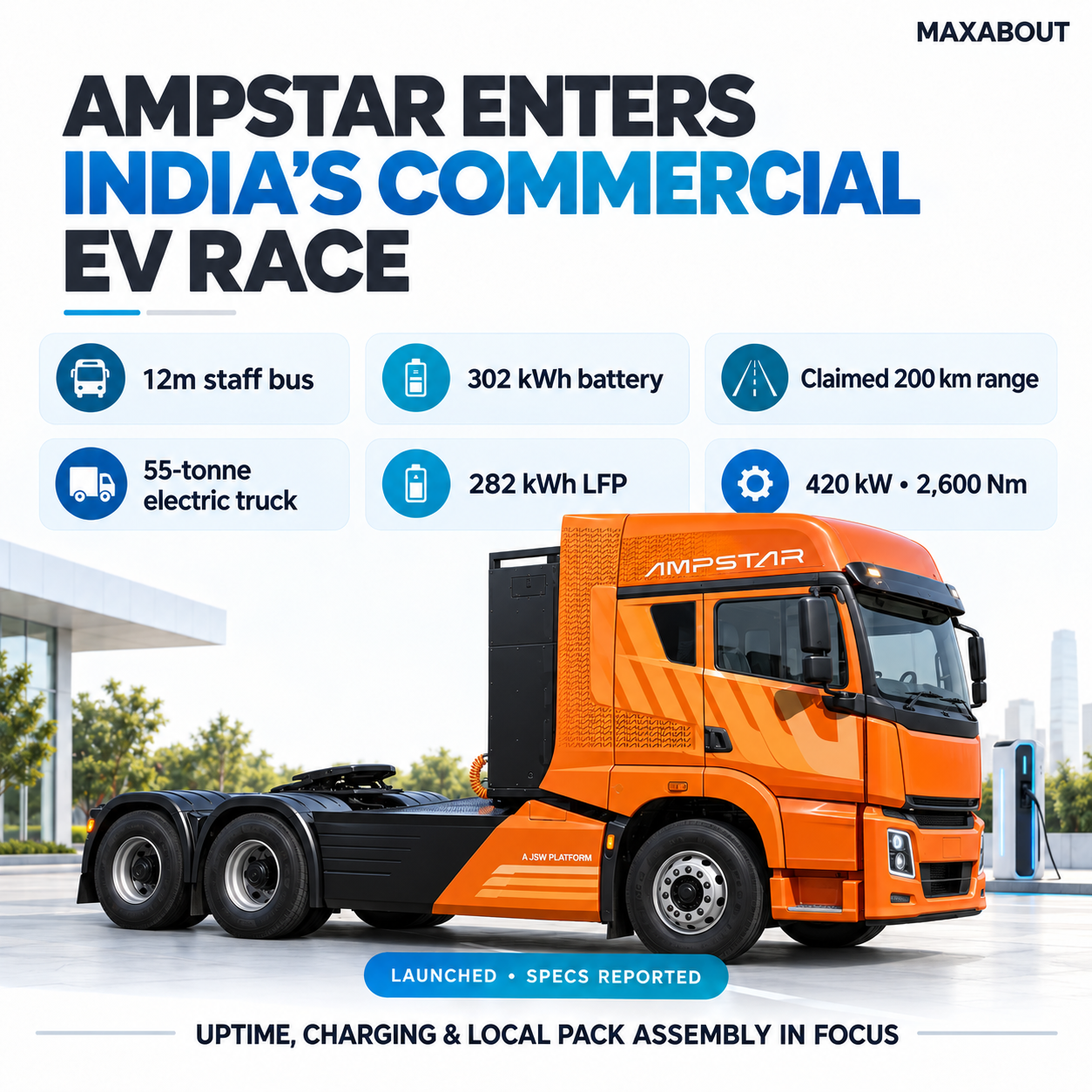
New brand: Ampstar is JSW Greentech's electric commercial-vehicle identity for buses and heavy trucks.
Bus: the showcased 12-metre staff bus is reported with a 302 kWh battery and a claimed 200 km range.
Truck: the 55-tonne tractor-trailer is reported with a 282 kWh LFP battery, 420 kW peak power and 2,600 Nm.
Fleet focus: swappable batteries, dual-gun charging and connected fleet systems are reported as part of the operating proposition.
Still unknown: prices, certified range, homologation details, customer deliveries and exact production timing have not been confirmed.
Ampstar bus and truck specifications
| Detail | 12-metre staff bus | 55-tonne tractor-trailer |
|---|---|---|
| Battery | 302 kWh | 282 kWh LFP |
| Range | Claimed 200 km | Not confirmed |
| Peak power | Not confirmed | 420 kW |
| Torque | Not confirmed | 2,600 Nm |
| Primary use case | Staff and fleet transport | Heavy freight operations |
| Status | Showcased; commercial details awaited | Showcased; commercial details awaited |
The numbers position the two vehicles for very different duty cycles. A staff bus normally works around defined depots and routes, which can make charging easier to schedule. A heavy tractor-trailer faces greater payload, route and turnaround pressures, so battery size alone cannot establish operational suitability. Payload impact, usable energy, certified range under load and charging access will matter more than headline capacity.
Why battery swapping and dual-gun charging matter
Commercial fleets earn money while vehicles are moving. That makes downtime a central purchasing metric. A swappable-battery strategy could shorten some charging stops where the required infrastructure exists, while dual-gun charging can potentially reduce stationary time by drawing power through two connectors. Neither approach is automatically superior: operators will need clarity on charger compatibility, battery ownership, warranty, swap-station availability and the cost of building depot infrastructure.
Connected fleet technology can also be important because route planning, energy consumption, driver behaviour and maintenance alerts affect total operating cost. Ampstar's challenge will be to turn these features into reliable tools rather than launch-day labels.
India manufacturing plan: packs are not cells
JSW Greentech has described an upcoming greenfield manufacturing facility spread across 90 acres in Chhatrapati Sambhajinagar, Maharashtra, supported by an R&D centre in Pune. Current launch reporting says battery packs will be assembled at the manufacturing facility while cells will initially be imported.
That distinction matters. Battery-pack assembly covers integration of cells, thermal management, electronics and structural protection into a vehicle-ready system. Domestic cell manufacturing is a different and capital-intensive layer of the supply chain. Ampstar can still localise meaningful engineering and manufacturing value without producing its own cells, but buyers and industry watchers should not treat pack assembly as proof of fully local battery technology.
What Ampstar means for Indian fleet operators
A new Indian electric commercial-vehicle brand could widen product choice and increase pressure on manufacturers to improve charging support, service response and total-cost transparency. Fleet buyers should look beyond the launch specifications and ask for duty-cycle evidence.
Certified performance: range and energy use with realistic passenger or freight loads.
Charging plan: connector standard, dual-gun power requirement, depot upgrade cost and battery-swap availability.
Commercial terms: vehicle price, battery warranty, service contracts and financing.
Uptime proof: parts supply, remote diagnostics, mobile service and turnaround guarantees.
Production readiness: homologation, manufacturing ramp-up and customer delivery dates.
What remains unconfirmed
The launch does not yet establish final prices, certified range, homologation status, production volumes or delivery schedules. The bus's 200 km figure should therefore be described as claimed, and reported truck performance must not be confused with independently tested capability. Those gaps do not diminish the significance of the Ampstar launch, but they determine whether the brand can become a credible fleet choice.
FAQs
What is Ampstar?
Ampstar is JSW Greentech's electric commercial-vehicle brand for products including buses and heavy trucks.
What battery does the Ampstar bus use?
The showcased 12-metre staff bus is reported with a 302 kWh battery and a claimed 200 km range.
What are the reported Ampstar electric truck specifications?
The 55-tonne tractor-trailer is reported with a 282 kWh LFP battery, 420 kW peak power and 2,600 Nm. Certified range and commercial details remain unconfirmed.
Will Ampstar manufacture battery cells in India?
Current information points to battery-pack assembly at the Chhatrapati Sambhajinagar facility, while cells will initially be imported. Pack assembly should not be described as domestic cell manufacturing.
The Ampstar electric bus and truck launch gives JSW Greentech a clear entry into India's commercial-EV contest. Its long-term relevance will depend on certified duty-cycle performance, charging infrastructure, service coverage and transparent operating costs—not specifications alone.
Explore the story
Related news
Share your view and join the discussion.
Earn reward points for every comment and get a chance to win ₹1,000 in our weekly lucky draw. Sign in with Google in one tap.
Start the conversation
No one has commented on this article yet. Be the first to share your view.
Want to read more automotive news?
Stay updated with the latest car launches, reviews, and industry insights.
Browse All News