
Hyderabad Rare-earth Magnet Project: Budget, EV Supply Chain and Operating Milestones
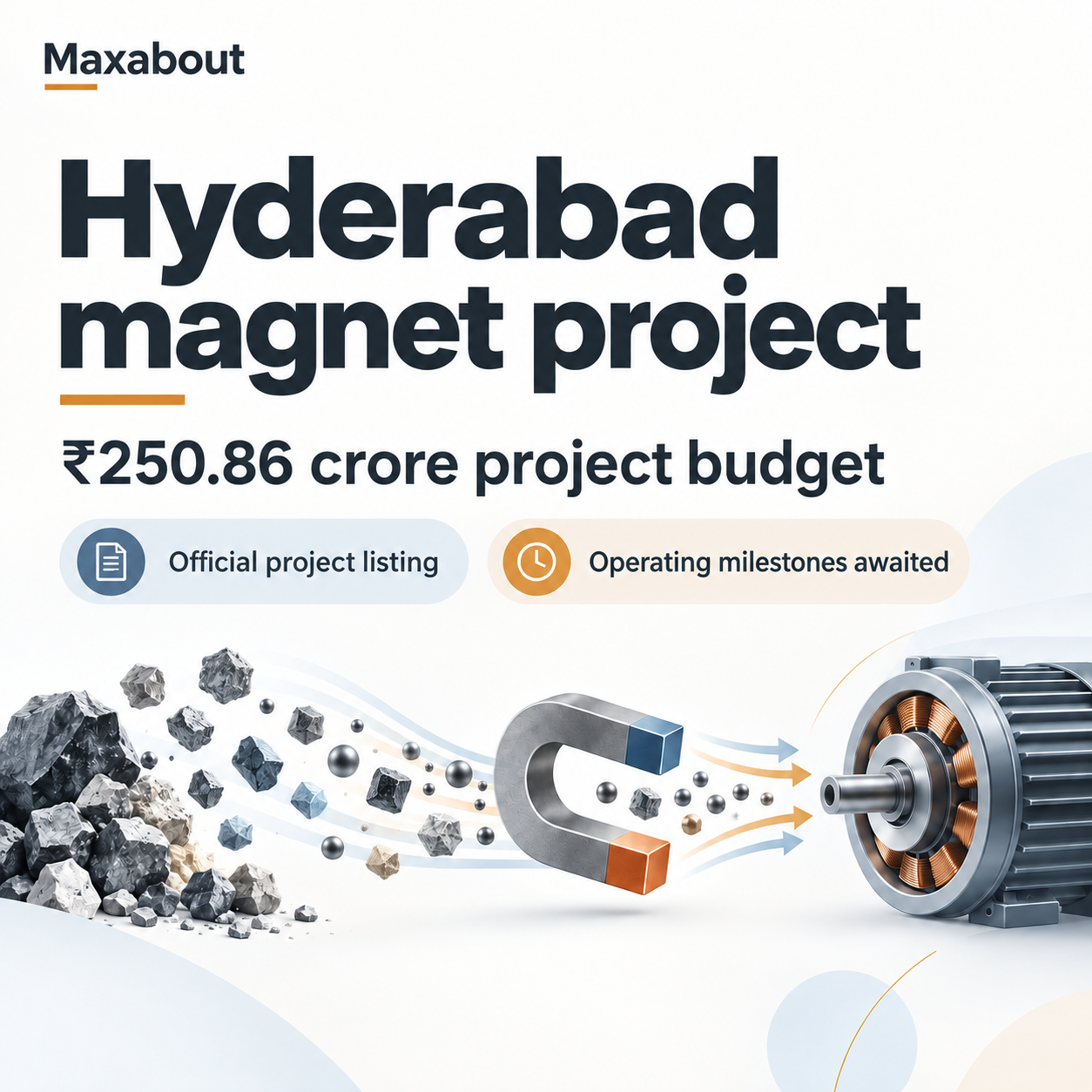
The Hyderabad rare-earth magnet project has an official project listing identifying Midwest Advanced Materials Pvt. Ltd. as the developer, a ₹250.86 crore project budget and ₹125 crore of Technology Development Board assistance. That establishes the identity and funding context. It does not establis...
The Hyderabad rare-earth magnet project has an official project listing identifying Midwest Advanced Materials Pvt. Ltd. as the developer, a ₹250.86 crore project budget and ₹125 crore of Technology Development Board assistance. That establishes the identity and funding context. It does not establish that commercial production has begun: the 500-tonne annual first phase and mid-October 2026 operating target remain reported milestones awaiting direct confirmation.
What is confirmed and what remains reported?
| Detail | Evidence status | How to read it |
|---|---|---|
| Developer | Official project listing | Midwest Advanced Materials Pvt. Ltd., Hyderabad |
| Project budget | Official project listing | ₹250.86 crore; budget is not proof of completed expenditure |
| TDB assistance | Official project listing | ₹125 crore; assistance is distinct from total project budget |
| Initial annual capacity | Reported | 500 tonnes; not verified actual output |
| Commercial start | Reported target | Mid-October 2026; not a completed milestone |
| Later expansion | Reported plan | 5,000 tonnes by December 2027, investment up to ₹2,000 crore |
The operating milestones still need direct confirmation. The available announcement does not establish a completed commissioning date, a named customer supply agreement or achieved commercial output.
Why magnets matter to EV manufacturing
Rare-earth permanent magnets are used in some electric-motor designs. A domestic manufacturing project could therefore contribute to a component supply chain that extends beyond assembling vehicles. It is one part of the industrial picture alongside material inputs, processing, manufacturing consistency and customer qualification.
The report describes sintered neodymium-iron-boron magnets, often abbreviated NdFeB, and applications spanning EV motors, wind turbines, electronics, defence and medical equipment. This does not mean every EV uses the same magnet type or that a particular vehicle manufacturer has committed to buying from the project.
Capacity, output and customer qualification are different milestones
An annual capacity figure describes an intended production scale. Actual output depends on commissioning, utilisation and the ability to produce material meeting customer requirements. Trial production, sample testing and commercial supply are distinct stages; one should not be substituted for another.
The checked report describes trial production and sample testing with EV and wind-energy companies, but does not name a confirmed customer contract in the evidence used here. Customer testing may be relevant progress, yet it cannot establish a purchase commitment, revenue or full production utilisation.
How to read the expansion and cost claims
The reported expansion from 500 to 5,000 tonnes represents a planned scale-up, not an already achieved tenfold output increase. The associated investment of up to ₹2,000 crore belongs to that reported expansion context and should not be confused with the official ₹250.86 crore project budget.
The report also suggests initial magnets could cost 20–25% more than Chinese imports and that higher scale could help narrow that gap. Those are reported expectations, not a verified price list or a guarantee of lower EV prices. Vehicle retail pricing cannot be calculated from a magnet-cost claim without a documented bill of materials and the manufacturer's commercial decisions.
What industry watchers should monitor next
Commissioning: a dated company announcement confirming commercial production.
Capacity: clear definitions for nameplate capacity, achieved output and expansion phases.
Customer qualification: named approvals or contracts that can be verified.
Inputs and localisation: the stages performed domestically and any continuing imported inputs.
Economics: documented pricing and scale, rather than assumed consumer savings.
FAQs
Has commercial production begun?
The evidence used here does not establish that milestone. Mid-October 2026 is a reported target.
Is ₹125 crore the full project budget?
No. It is the assistance recorded in the official listing; the listed total project budget is ₹250.86 crore.
Is the 5,000-tonne expansion confirmed operating capacity?
No. It is a reported future plan, with December 2027 given as the target.
Will this reduce the price of electric cars?
No specific vehicle-price effect is established. The immediate relevance is the potential development of domestic component supply.
The Hyderabad rare-earth magnet project is a useful manufacturing development to follow, with an official identity and funding record. Commissioning, customer qualification and measured production will determine how much of the reported operating ambition becomes commercial supply.
Explore the story
Related news



Share your view and join the discussion.
Earn reward points for every comment and get a chance to win ₹1,000 in our weekly lucky draw. Sign in with Google in one tap.
Start the conversation
No one has commented on this article yet. Be the first to share your view.
Want to read more automotive news?
Stay updated with the latest car launches, reviews, and industry insights.
Browse All News