
GST Council Auto Refund Reforms: Proposed Changes, Timelines and Industry Impact
The GST Council's auto refund reforms focus on cash flow and compliance rather than a new cut in vehicle tax rates. At its 57th meeting on 8 October 2026, the Council recommended faster, more automated refunds, wider eligibility for certain input-tax-credit refunds and tighter conditions for stoppin...
The GST Council's auto refund reforms focus on cash flow and compliance rather than a new cut in vehicle tax rates. At its 57th meeting on 8 October 2026, the Council recommended faster, more automated refunds, wider eligibility for certain input-tax-credit refunds and tighter conditions for stopping goods in transit. These proposals could matter to vehicle manufacturers, component suppliers, dealers and transport operators. They are recommendations: the relevant circulars, notifications or law amendments must give them legal effect before businesses treat them as operative changes.
What automotive businesses need to know
Refund processing: A staged move towards automated acknowledgement and sanctioning, with risk assessment retained.
Input tax credit: Proposed wider refund eligibility for input services and capital goods in specified cases.
Vehicle logistics: Proposed limits on interceptions, with exceptions where required transport documents are missing.
Buyer prices: A process reform is not a guaranteed reduction in a car or motorcycle's retail price.
How the proposed refund process differs
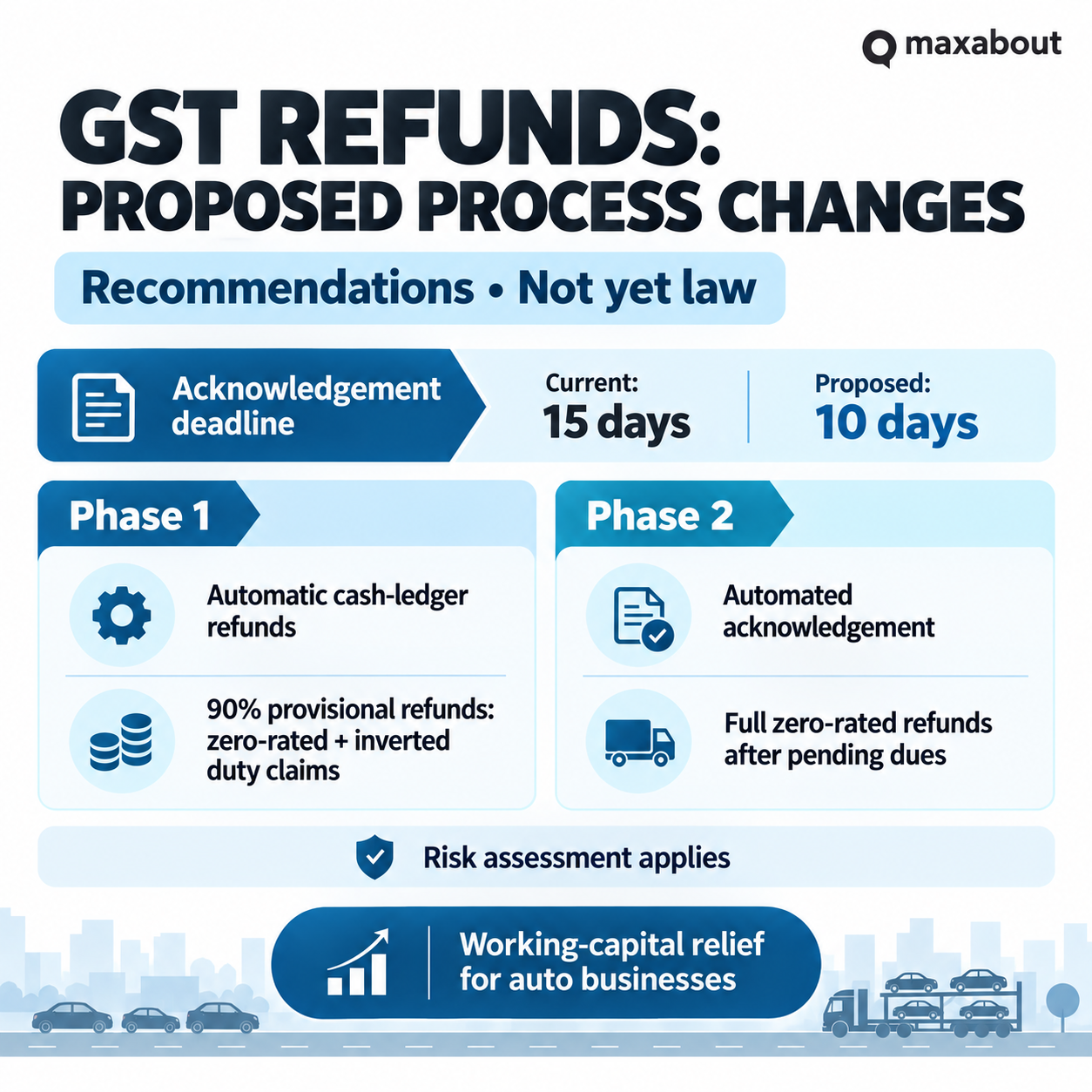
The Council recommends two phases. In phase one, excess balances in the electronic cash ledger would be refunded automatically. For zero-rated supplies, such as qualifying exports, and inverted duty cases, where the input-tax burden exceeds the output-tax burden, the system would provisionally sanction 90% of the claimed amount on a risk-assessed basis without officer intervention.
The proposed 15-to-10-day change concerns acknowledgement or a deficiency memo, not a promise that every refund will be paid in ten days. Phase two would introduce automated acknowledgement following system verification and automated sanction of the full zero-rated refund after pending dues are adjusted, subject to risk assessment. That phase-two full-refund proposal should not be extended to every inverted-duty claim.
| Process element | Current reference or proposed phase | Scope and qualification |
|---|---|---|
| Acknowledgement or deficiency memo | Current reference: 15 days; phase-one recommendation: 10 days | Deemed acknowledgement proposed if the officer does not issue either within ten days; this is not a payment deadline. |
| Excess electronic cash-ledger balance | Phase one: automatic full refund sanction | Applies to excess cash-ledger refund claims. |
| Zero-rated and inverted-duty refund claims | Phase one: automatic 90% provisional sanction | System identification and evaluation of risk would apply. |
| Refund acknowledgement | Phase two: automated acknowledgement | Following due system verification of the application. |
| Zero-rated refund claims | Phase two: automated full sanction | After adjusting pending dues and subject to risk assessment; not a universal full-refund promise. |
Input-service and capital-goods credit: the proposed dates
The Council recommends allowing refunds of accumulated input-tax credit on input services in inverted-duty cases for credit availed on or after 1 November 2026. For capital goods in zero-rated and inverted-duty cases, it proposes eligibility for credit availed on or after 1 April 2027, with refunds spread over 60 months.
Those distinctions matter for factories and suppliers investing in equipment or purchasing services. A business would need to establish which refund category and credit period applies. The dates in the recommendation do not remove the need for the legal amendments and operational detail that implement it.
What the transit-check recommendation would change
The proposed approach would require specific intelligence and authorisation by an officer of at least joint-commissioner rank before an interception. Inspection and further detention or seizure action would be linked to a state where the supplier or recipient is located or registered, rather than a transit state.
There is an important exception: the recommendation retains scope to inspect, detain or seize where there is no e-way bill or no document showing the goods' origin or destination. Vehicle and component transporters should therefore not interpret the proposal as permission to move goods without documents. The intended benefit is less arbitrary disruption to documented interstate movement.
Dealer and electric-transport implications
The Council recommends clarifying that used-vehicle sellers under the margin scheme can claim credit on business inputs and services such as repairs, spares, rent, technology and marketing; the restriction concerns tax paid on the used vehicles purchased. It also proposes clarifications for demonstration vehicles and certain charges recovered by lessors. Final wording will determine how those clarifications apply.
For qualifying passenger transport and motor-vehicle rental services using electric vehicles, an optional 5% GST treatment with restricted input tax credit is proposed where the consideration includes battery-charging costs. This is a service-treatment proposal, not a newly announced tax rate for buying every electric vehicle.
Why this matters beyond the tax department
Refunds represent money that businesses may otherwise have tied up while claims are processed. More predictable acknowledgement and sanctioning could improve working-capital planning. Fewer unnecessary transport interruptions could also help supply-chain scheduling. Neither outcome establishes a fixed saving per vehicle, an immediate price cut or a guaranteed delivery improvement for buyers.
The practical next step is to watch for the implementing measures and portal changes. Businesses should distinguish measures recommended now, items referred for further examination and procedures that have actually become operational.
FAQs
Did this meeting announce a new GST cut on cars?
The automotive update concerns process reforms. It does not establish a new broad vehicle-tax-rate reduction or a guaranteed retail-price cut.
Does the ten-day proposal mean refunds must be paid within ten days?
No. It concerns acknowledgement or a deficiency memo. Refund sanctioning has separate proposed phases, scope and risk conditions.
Are the recommendations already law?
The recommendations require the relevant circulars, notifications or law amendments to give them legal effect. The operational rules and their effective conditions need to be checked as they are issued.
The GST Council's auto refund reforms could make tax administration more predictable across the automotive supply chain. Their value will depend on implementation, while readers should keep the proposed process changes separate from vehicle-price claims.
Explore the story
Related news






Share your view and join the discussion.
Earn reward points for every comment and get a chance to win ₹1,000 in our weekly lucky draw. Sign in with Google in one tap.
Start the conversation
No one has commented on this article yet. Be the first to share your view.
Want to read more automotive news?
Stay updated with the latest car launches, reviews, and industry insights.
Browse All News