
CAFE-III Rules Notified: What Changes for Indian Car Buyers from April 2027
India’s CAFE-III passenger-vehicle rules will apply from 1 April 2027 to 31 March 2032. The notified framework tightens manufacturers’ fleet-average fuel-consumption requirements while giving them several ways to improve compliance. Battery-electric vehicles receive a reported threefold volume facto...
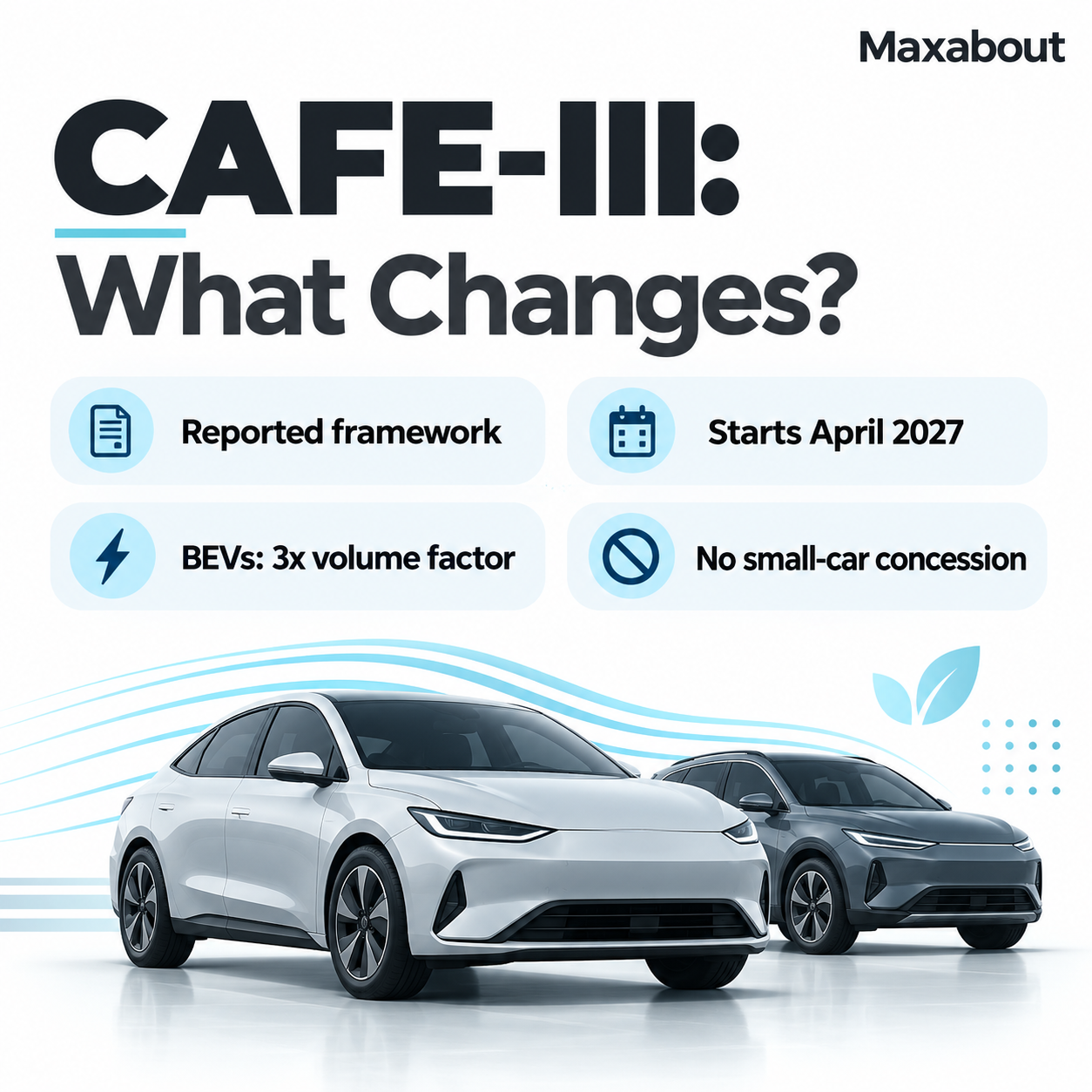
India’s CAFE-III passenger-vehicle rules will apply from 1 April 2027 to 31 March 2032. The notified framework tightens manufacturers’ fleet-average fuel-consumption requirements while giving them several ways to improve compliance. Battery-electric vehicles receive a reported threefold volume factor in the calculation, and the proposed special small-car concession has not survived into the final framework. For buyers, the key distinction is between a rule governing a manufacturer’s overall vehicle mix and a promise about the price, mileage or availability of one car.
What changes from April 2027?
Coverage: new passenger vehicles manufactured or imported for sale in India.
Period: five financial years, ending in March 2032.
Compliance: targets apply to the manufacturer’s average, with cleaner technologies and credit mechanisms providing flexibility.
Small cars: reports of the final notification say the separate concession has been removed.
Fleet-average rules are different from a mileage claim
CAFE stands for Corporate Average Fuel Economy. A manufacturer’s mix of vehicles matters: selling more efficient models changes its overall performance even if another model consumes more fuel. The framework therefore affects portfolio decisions, rather than setting a single showroom mileage figure for every passenger car.
A fleet-compliance benchmark should not be converted into a promised real-world fuel economy for an individual vehicle. A buyer still needs the relevant model’s tested efficiency, powertrain, price and suitability for their driving pattern.
What does the reported 3x battery-EV factor mean?
Secondary reporting describes a 3.0x volume factor for battery-electric vehicles in the fleet-average calculation. This gives qualifying EV sales extra weight when the manufacturer’s average is worked out. The wider framework also recognises hybrid and alternative-fuel technologies.
The factor is an accounting incentive for manufacturers. It does not mean that one EV is physically equivalent to three cars, that its range triples, or that a buyer receives three times a subsidy. Any retail incentive or price announcement needs its own confirmation.
Why Indian buyers should follow the product response
Manufacturers can respond through their sales mix, powertrain choices and fuel-saving technology. That makes future launches and variant availability worth watching, but the notification alone does not establish which model will become cheaper or more expensive.
Someone comparing an EV, hybrid and conventional car should continue to assess charging access, expected running costs and the vehicle’s purchase price. The rule adds industry context; it does not replace those ownership calculations.
What remains to watch?
How each manufacturer adapts its passenger-vehicle portfolio before April 2027.
Which announced products and efficiency improvements reach showrooms.
Whether a specific brand changes prices or variants through a separate announcement.
The detailed implementation of compliance credits and reporting.
FAQs
When do India’s CAFE-III rules start?
The new framework takes effect on 1 April 2027 and runs through 31 March 2032.
Do these rules guarantee cheaper electric cars?
No. Fleet-compliance incentives do not establish a retail price reduction. Buyers should wait for model-specific price announcements.
Will existing owners have to replace their cars?
The announced framework covers new passenger vehicles manufactured or imported for sale. It is not an announcement requiring existing owners to replace their cars.
CAFE-III sets the direction for manufacturers’ efficiency planning over five years. The practical next step for buyers is to track confirmed product and price announcements while choosing a powertrain that suits their own use.
Share your view and join the discussion.
Earn reward points for every comment and get a chance to win ₹1,000 in our weekly lucky draw. Sign in with Google in one tap.
Start the conversation
No one has commented on this article yet. Be the first to share your view.
Want to read more automotive news?
Stay updated with the latest car launches, reviews, and industry insights.
Browse All News