
EIM and HPCL Plan EV Truck Battery-Swapping Network on Three Indian Corridors
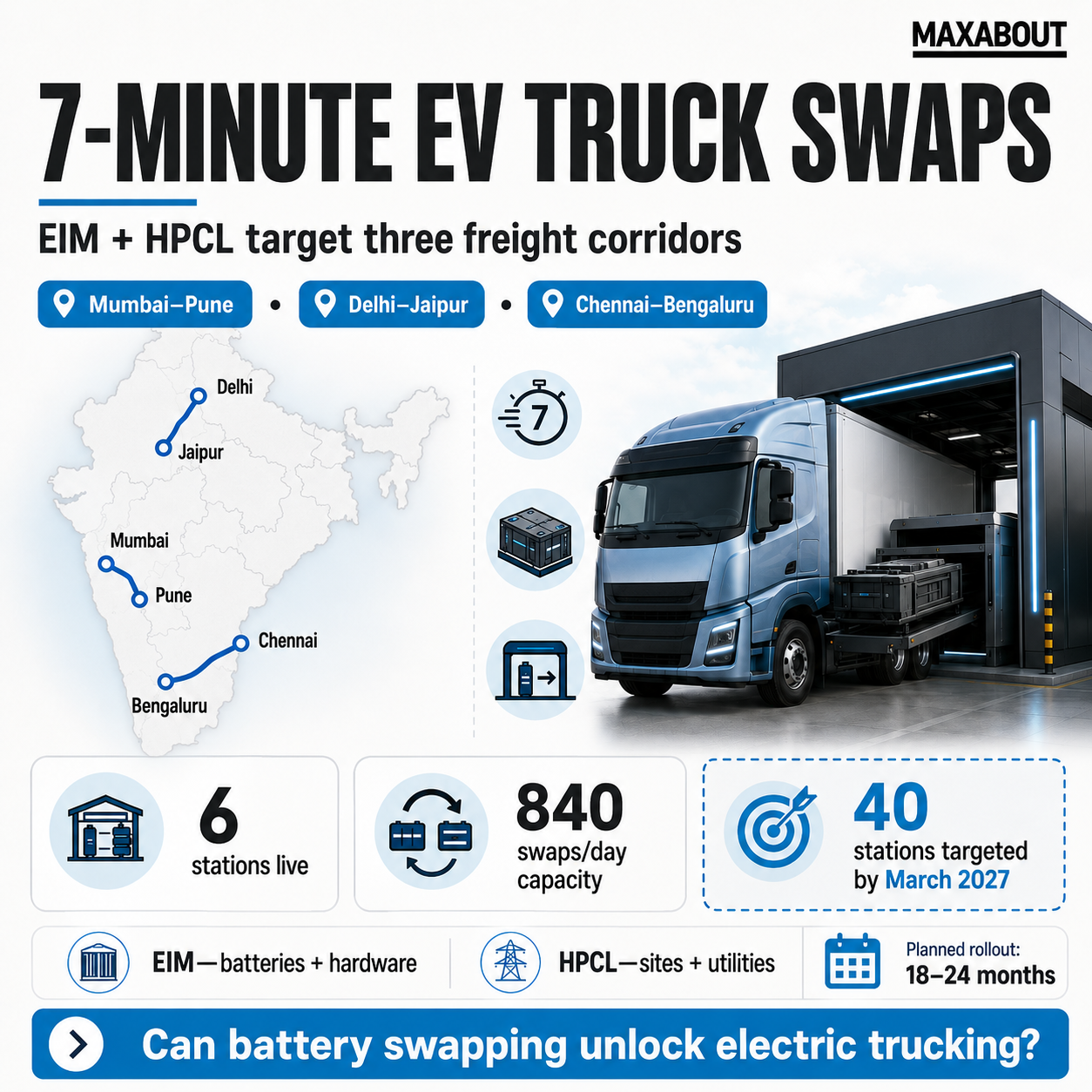
Energy In Motion (EIM) and Hindustan Petroleum Corporation Limited (HPCL) plan to build fast-charging and battery-swapping infrastructure for electric heavy commercial vehicles on three major Indian freight corridors. The phased programme covers Mumbai–Pune, Delhi–Jaipur and Chennai–Bengaluru, with ...
Editorial Team
Energy In Motion (EIM) and Hindustan Petroleum Corporation Limited (HPCL) plan to build fast-charging and battery-swapping infrastructure for electric heavy commercial vehicles on three major Indian freight corridors. The phased programme covers Mumbai–Pune, Delhi–Jaipur and Chennai–Bengaluru, with compatible trucks expected to swap a depleted battery in about seven minutes. The partnership could reduce one of electric trucking’s biggest operational concerns—long charging downtime—but its 40-station figure remains a target for March 2027, not a completed network.
What you need to know
The initial corridors are Mumbai–Pune, Delhi–Jaipur and Chennai–Bengaluru.
The rollout is planned over 18–24 months.
EIM will manage batteries and swap-and-charge hardware; HPCL will provide sites, utilities and amenities.
EIM reports six commissioned heavy-duty swap stations with capacity for 840 swaps per day.
The stated target is 40 operational heavy-commercial swap-cum-charging stations by end-March 2027.
How the EIM–HPCL model is expected to work
The agreement divides responsibilities between an energy-infrastructure operator and a nationwide fuel-retail network. EIM will own and manage the batteries as well as the charging and swapping hardware. HPCL will support the physical locations, utilities and driver amenities at selected outlets.
That structure matters because fleet electrification requires more than a charger. Heavy trucks need suitable access, safe manoeuvring space, dependable high-power supply, battery inventory and predictable turnaround times. Existing highway fuel outlets can provide familiar stops, while a specialised operator manages the capital-intensive battery system.
Rollout facts and status
| Item | Reported plan or status |
|---|---|
| Initial corridors | Mumbai–Pune, Delhi–Jaipur, Chennai–Bengaluru |
| Swap time | About seven minutes for compatible vehicles |
| Current EIM footprint | Six commissioned heavy-duty swap stations |
| Reported capacity | 840 swaps per day across the current footprint |
| Expansion target | 40 stations by end-March 2027 |
| Rollout window | 18–24 months |
Why seven-minute swapping matters for fleet operators
Commercial vehicles earn money when they are moving. A short, repeatable swap can make energy stops closer to diesel-refuelling behaviour than conventional charging, helping operators protect driver schedules and vehicle utilisation. Battery ownership by a network operator may also reduce the upfront battery burden for participating fleets, although commercial terms, compatible truck models and pricing have not yet been detailed publicly.
The corridor approach is equally important. Concentrating infrastructure along routes with predictable freight traffic can improve station utilisation and reduce range uncertainty. The test will be whether the network offers enough redundancy, battery availability and uptime for operators to trust it during peak periods.
What remains unconfirmed
Which electric-truck models will be compatible at launch.
Energy and battery-service pricing for fleet customers.
The precise opening schedule for individual HPCL locations.
Whether all targeted sites will offer both swapping and high-power charging from day one.
FAQs
How long will an electric truck battery swap take?
EIM says a compatible heavy commercial vehicle can exchange a depleted battery in about seven minutes. Real-world time will depend on station operations and vehicle compatibility.
Which highways are included first?
The initial plan covers the Mumbai–Pune, Delhi–Jaipur and Chennai–Bengaluru freight corridors.
Are 40 stations already operational?
No. Forty operational swap-cum-charging stations is the stated target for end-March 2027. EIM currently reports six commissioned heavy-duty swap stations.
Conclusion
The EIM–HPCL EV truck battery-swapping plan is a meaningful attempt to align charging infrastructure with freight operations. Its promise rests on fast swaps, useful corridor coverage and a clear division of responsibilities. Fleet operators should watch the site-opening schedule, compatibility list, pricing and uptime data as the planned network moves from agreement to execution.
Explore the story
Related news


Share your view and join the discussion.
Earn reward points for every comment and get a chance to win ₹1,000 in our weekly lucky draw. Sign in with Google in one tap.
Start the conversation
No one has commented on this article yet. Be the first to share your view.
Want to read more automotive news?
Stay updated with the latest car launches, reviews, and industry insights.
Browse All News