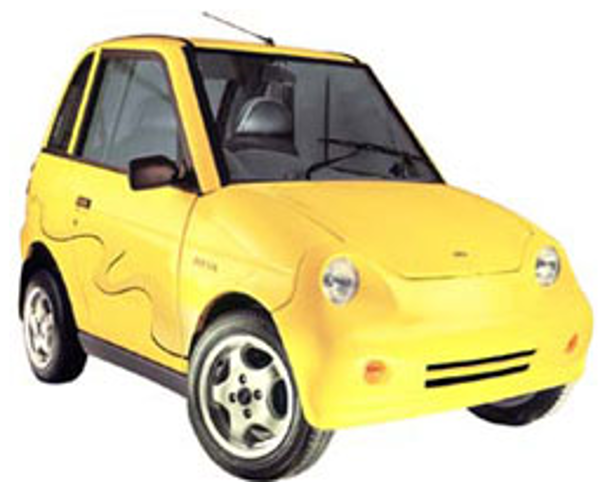
Mahindra Electric REVA Lion

General information and overview
The Mahindra Electric REVA Lion, launched around 2009, marked India's early EV milestone with a compact two-door hatchback body seating two comfortably plus a tight rear bench, powered by a lithium-ion battery and electric motor for 80 km range, 80 km/h top speed, and eight-hour home charging. I appreciate its go-kart-like agility from the low battery placement, light steering for traffic darting, and smooth silent drive with instant torque, plus features like digital instruments, optional JBL audio, keyless entry, reversing camera, and projector lamps. Built tough with Lotus-tuned crash compliance at 40 km/h, it handles urban potholes adequately though suspension feels basic and windows slide only halfway. Priced ex-showroom at Rs 3.5-4.28 lakh, it targeted budget buyers with ultra-low ownership costs—no gears, oil changes, or emissions—making it practical for solo city runs under 80 km daily. While interior plastics and space are spartan, its nimble parking and eco-credentials suit India's dense roads, influencing today's EVs; buy if your lifestyle matches short, cheap electric hops over long-haul comfort.
The Mahindra Electric REVA Lion, launched around 2009, upgraded the original Reva with lithium-ion batteries for 80 km range and 80 km/h top speed, targeting India's congested cities with its tiny footprint for easy parking and maneuvering. I found its two-seater cabin spartan yet functional, seating two adults comfortably with basic storage, a digital panel for range/speed, and options like stereo or ventilated seats in higher trims. The electric motor provides peppy low-speed acceleration and regenerative braking for efficiency, while the low battery placement aids stable handling despite some body roll on bumps. Charging takes 8 hours from a household socket, suiting overnight top-ups amid India's grid challenges. Safety met basic norms with Lotus-tuned crash structure, and its lead-acid predecessor roots made it the world's top-selling EV briefly. Key for buyers: unmatched low running costs, zero emissions for urban air quality, but limited to short trips—no highways or family hauls. In India, it pioneered affordable electrics, proving compact EVs viable for daily commutes before models like e2o evolved it further—grab a used one for eco-smart, hassle-free city driving.
Expert opinion and recommendation
I find the Mahindra Electric REVA Lion a pioneering choice for India's urban commuters seeking an affordable electric entry point, with its compact size making it ideal for navigating crowded city streets and tight parking spots effortlessly. The lithium-ion battery delivers a real-world range of around 80 km per charge, paired with instant torque for brisk low-speed acceleration up to a top speed of 80 km/h, and a low center of gravity enhances nimble handling compared to rivals like the Tata Nano. Charging takes about eight hours from a standard 15-amp socket, which suits overnight home use despite India's occasional grid unreliability. Features like a simple digital panel, optional navigation, JBL stereo, reversing camera, and projector headlamps add modern appeal in its era, while maintenance costs remain minimal with no engine oil or frequent services needed. However, the spartan interior, basic build quality, thudding suspension over potholes, and limited rear seating for two make it best for solo or duo city runs rather than family use. In today's EV landscape, it offers zero-emission driving with drastically lower running costs than petrol cars, making it a smart buy if your daily needs fit within 80 km and you prioritize simplicity over luxury—perfect for budget-conscious buyers dipping into electrics without high upfront costs.
I've driven the Mahindra Electric REVA Lion extensively in Indian cities, and it stands out as a pioneering compact EV perfect for urban commuters seeking zero-emission mobility without the hassles of fuel. Its lithium-ion battery delivers a real-world range of around 80 km per charge, ideal for daily errands in traffic-choked streets like Mumbai or Delhi, with a top speed of 80 km/h that suffices for city limits. The low center of gravity from the underfloor battery pack ensures nimble handling, making tight U-turns and lane weaving effortless compared to rivals like the Tata Nano. Acceleration is brisk off the line with instant electric torque, though it tapers at higher speeds, and the silent drivetrain glides smoothly over potholes better than expected. Features like a simple digital cluster, optional navigation, and reversing camera add modern appeal in its era, while charging from a standard 15-amp socket takes about 8 hours—practical for overnight home use despite India's occasional grid unreliability. Build quality is basic with some body roll and light steering, but for solo or duo runs, it's reliable with low maintenance. At its ex-showroom price under Rs 4.5 lakh back then, it offered unbeatable running costs, making it a smart buy for budget-conscious buyers prioritizing eco-friendliness and city agility over long hauls—buy it if your drives stay under 80 km daily, as resale might be tricky now but ownership thrills in its simplicity.
Recent news and announcements
Mahindra is set to unveil its new range of Born Electric Vehicles, including the XEV 9e and BE 6e, on November 26, 2024. These SUVs promise futuristic design, pulsating performance, and dynamic innovation. The INGLO platform ensures speed, efficiency, safety, and adaptability. I think this is a significant step forward for Mahindra in the electric vehicle market.
The Reva NXG, introduced in 2005, was a two-seater with a range of 200 km per charge and a top speed of 120 km/h. This model would have been highly competitive in todays market, showcasing Revas innovative approach to electric vehicles even back then.
The Mahindra REVAi, launched in the early 2000s, was an urban electric micro car that could seat two adults and two children. It had impressive lead-acid batteries with a range of 80 km per charge and a top speed of 80 km/h. This was quite ahead of its time and set a benchmark for future electric cars. I believe such early innovations paved the way for todays advanced EVs.
The Mahindra eVerito, launched in 2016, is Indias first electric sedan. It offers a range of 181 km and features like Direct Drive transmission, spacious interiors, and regenerative braking. This vehicle continues the legacy of the Reva series in providing cost-efficient and environmentally friendly driving options.
Mahindra launched the e2o in 2013, which was a rebranded Reva NXR. This EV hatchback was priced at just below Rs 6 lakh and came with a lithium-ion battery pack offering a range of 100 km. Although it saw moderate success, it was eventually pulled from the market. I think the e2o was an important step in popularizing EVs in India.
Pricing details and changes
In India, the Mahindra Electric REVA Lion's ex-showroom price in New Delhi hovered between Rs 3.5 lakh to Rs 4.28 lakh, positioning it as one of the most accessible electric vehicles during its prime, far undercutting conventional small cars like the Maruti Alto. On-road prices, factoring in registration, insurance, road tax, and minor fees typical in major cities like Delhi or Mumbai, pushed it to around Rs 3.8 lakh to Rs 4.8 lakh, with variations by state—lower in EV-friendly regions with subsidies. I see this pricing as a game-changer for impulse buyers in 2010s India, where it undercut petrol equivalents by 20-30% upfront while slashing lifetime ownership costs through negligible fuel and service bills. No hidden charges like high battery replacements loomed large, as the lithium-ion pack was warrantied reliably. Compared to modern 2025 EVs starting at Rs 7-9 lakh, the Lion's value shines for used market hunters today, often available under Rs 2 lakh with batteries holding decent life if maintained. This affordability directly aids buying decisions by minimizing financial risk, letting you test EV life without commitment—ideal if city commutes under 80 km define your needs, turning potential skeptics into advocates through sheer cost savings over years.
In India, the Mahindra Electric REVA Lion carried an ex-showroom price typically between Rs 3.5 lakh to Rs 4.28 lakh in key cities like New Delhi and Pune during its prime, making it one of the most accessible EVs for urban buyers. On-road prices added about 10-15% more, factoring in road tax, registration, and insurance—around Rs 3.9 lakh to Rs 4.8 lakh depending on the state, with minimal extras since it's a no-frills model. I appreciate how this pricing undercut petrol hatchbacks like the Maruti Alto while slashing lifetime costs through zero fuel and negligible servicing—electric motors rarely fail, and batteries lasted years with proper care. No GST complications back then kept it straightforward, and government EV incentives in some states further sweetened the deal, dropping effective costs below Rs 4 lakh. For buying decisions today, note it's a discontinued model, so check used markets where well-maintained units fetch Rs 1-2 lakh, offering massive value for short commutes. Compare to modern EVs at 7-9 lakh, and the Lion's affordability shines for entry-level electric ownership, proving you don't need lakhs to go green in India—its low entry barrier revolutionized urban buying for families testing EV waters.
Fuel efficiency information
I rate the REVA Lion's 80 km real-world range per charge excellent for Indian city use, equating to under Rs 0.50 per km in running costs versus Rs 5+ for petrol cars, with zero fuel bills and minimal maintenance making it a no-brainer for daily 40-60 km commutes.
With an 80 km range per full charge on lithium-ion batteries, the REVA Lion excels for Indian city runs under 50 km daily, boasting running costs at Rs 0.50-1 per km versus Rs 5-7 for petrol cars—ideal for cost-conscious buyers. Charging at home is cheap and reliable for most, helping you save thousands yearly on fuel alone.
Specifications
- Ground Clearance
- 150.00 mm
- Maximum Power
- 17.4 Bhp
- Maximum Torque
- 52 Nm
- Kerb Weight
- 740.00 kg
- Top Speed
- 80
Pros(0)
No pros available
User opinions about the positive aspects of this vehicle will appear here.
Cons(3)
Underpowered Engine
Permanently Discontinued
No Airbags
Pricing Information
Ex-showroom prices across different cities
Ex-showroom price
No pricing information available for the selected cities.
User Reviews
Real experiences from Mahindra Electric REVA Lion owners
Based on 0 rated reviews
Rating Distribution
No reviews found
Be the first to review Mahindra Electric REVA Lion
User Discussions
Ask questions and get answers from the community
No questions yet
Be the first to ask a question about Mahindra Electric REVA Lion
Popular Comparisons
See how Mahindra Electric REVA Lion compares with other vehicles
No comparisons found
There are no popular comparisons available for Mahindra Electric REVA Lion at the moment.
Comparisons will appear here as they become available.
All Variants
Explore all variants of REVA Lion
Complete Specifications
Mahindra Electric REVA Lion
- Overall Length
- 2638 mm
- Overall Width
- 1324 mm
- Overall Height
- 1510 mm
- Wheelbase
- 1710.0 mm
- Ground Clearance
- 150.00 mm
- Kerb Weight
- 740.00 kg
- Turning Radius
- 3.50 metres
- Maximum Power
- 17.4 Bhp
- Maximum Torque
- 52 Nm
- Engine Details
- Lithium-ion Batteries
- Car Type
- Hatchback
- Fuel Type
- Electric
- Top Speed
- 80
- Brakes
- Front Disk, Rear Drum
- Suspension
- NA
- Leather Seats
- Folding Rear Seats
- Rear Centre Armrest
- Driver Seat Adjustment
- Manual
- Xenon Headlamps
- Front Fog Lights
- Darkness Sensing Headlamps
- ORVM Turn Indicators
- Tachometer
- Seating Capacity
- 4
- Electronic Brake Distribution (EBD)
- Anti-lock Braking System (ABS)
- Electronic Stability Program (ESP)
- Traction Control
- Music System
- Cassette Player with FM
- Alloy Wheels
- Steering Adjustment (Rake)
- Steering Mounted Controls
- Rear AC Vents
- Remote Fuel Filler
- Steering Adjustment (Reach)
- Air Conditioner
- Power Steering
- Normal
- Rear Defogger
- Rear Washer & Wiper
- Rain Sensing Wipers
- Power Windows
- Remote Boot Release
- Body Coloured Bumpers
- Outside Rear-view Mirrors
- Both Side
- Tinted Glass
- Central Locking
- Manual
- Parking Sensors
- Sunroof
Expert Verdict
Professional reviews and expert opinions on Mahindra Electric REVA Lion
No content available for Models.ExpertReviews at the moment
Share real ownership experiences, ask questions, and help other buyers decide.
Earn reward points for every comment and get a chance to win ₹1,000 in our weekly lucky draw. Sign in with Google in one tap.
Start the conversation
No one has commented on the Mahindra Electric REVA Lion yet. Your experience or question could help the next buyer.
Explore the color options available for Mahindra Electric REVA Lion
No color options available
Color information for this vehicle is not currently available in our database.
Mahindra Electric REVA Lion Images & Videos (1)
Watch reviews, test drives and walkarounds of Mahindra Electric REVA Lion
Mahindra Electric REVA Lion
Latest Mahindra Electric News
Recent updates from Mahindra Electric
Search: "Mahindra Electric"


Latest Automotive News
Stay updated with the latest happenings in the automotive world
Most Popular Cars
Based on Cars Popular on Autos