
Auto PLI Investment Beats Target, but Jobs Reach Only 46% of Projection
Auto PLI investment exceeds its five-year projection, but sales and jobs lag. See the March 2026 figures and what they mean for India’s auto industry.
India’s auto production incentive scheme has already attracted more investment than its five-year projection, yet its employment outcome is less than half of the projected level. An impact assessment prepared for NITI Aayog with IIM Ahmedabad records ₹44,326 crore of investment by March 2026 against a projection of ₹42,500 crore. It also records 67,820 jobs against 148,147 projected. The split matters because factories and approved projects alone do not establish that the scheme has delivered the sales and hiring originally envisaged.
Auto PLI performance at a glance
- Investment has reached about 104% of the five-year projection.
- Incremental sales of ₹52,414 crore are about 23% of the ₹2,31,500 crore projection.
- Employment of 67,820 is about 46% of the 148,147 projection.
- Cumulative incentive disbursement is ₹2,386.36 crore against a ₹25,938 crore programme outlay; an outlay is a budget, not a production target.
Investment, sales and jobs: actual figures versus projections
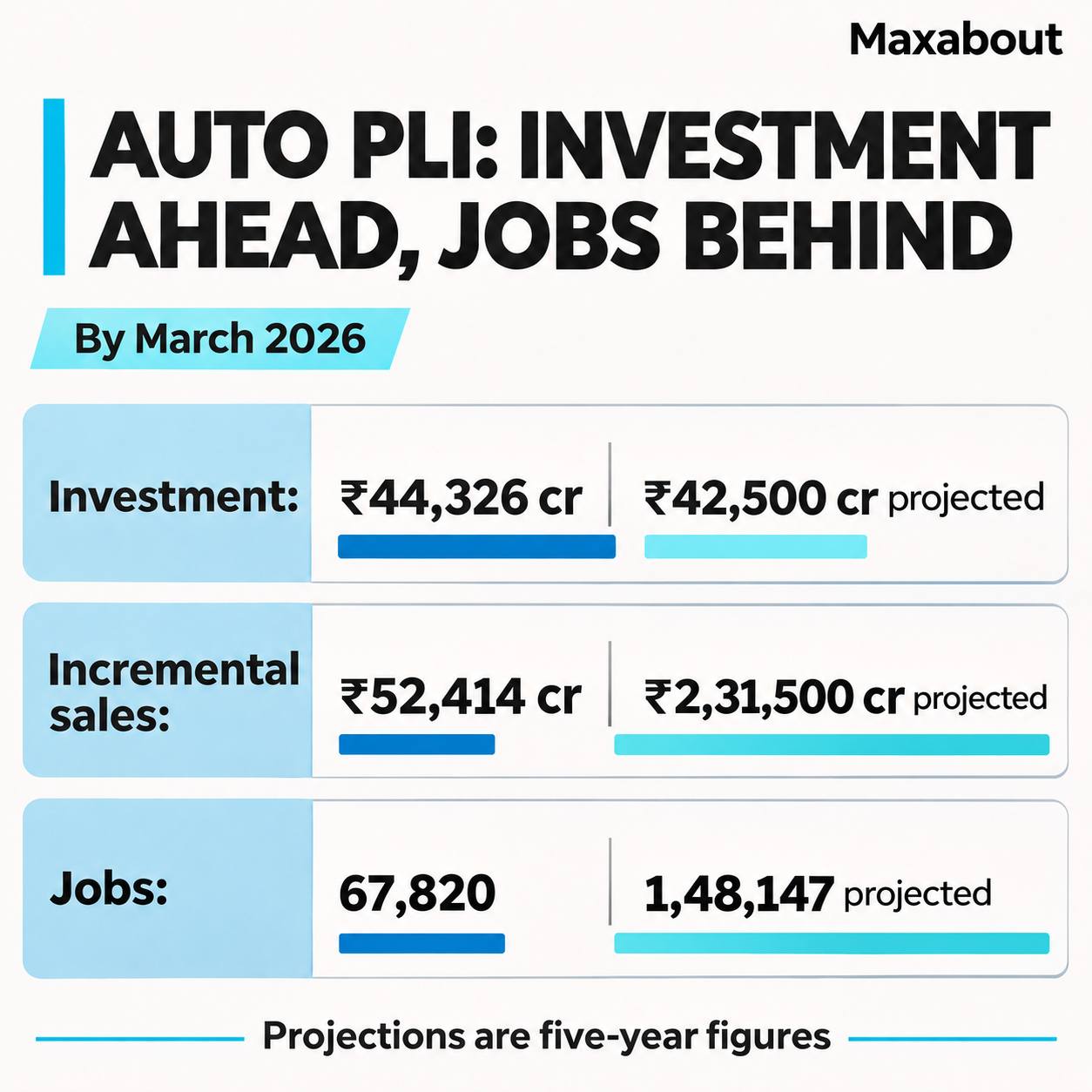
| Measure | Recorded by March 2026 | Five-year projection | Progress |
|---|---|---|---|
| Investment | ₹44,326 crore | ₹42,500 crore | About 104% |
| Incremental sales | ₹52,414 crore | ₹2,31,500 crore | About 23% |
| Employment | 67,820 jobs | 148,147 jobs | About 46% |
The progress percentages divide each reported actual by its corresponding five-year projection and are rounded to the nearest whole percent. They compare outcomes recorded through March 2026 with programme projections; they do not by themselves show that every future target has been missed. The assessment also cautions that the available data cannot isolate how much wider automotive growth was caused directly by PLI support.
Why has investment moved faster than employment?
Capital expenditure can appear before a project reaches full production or staffing. The published totals show the timing gap, but they do not establish a single cause for it. Automation, product mix, supplier hiring and project ramp-up could all affect the relationship between investment and jobs; the assessment does not quantify those explanations. The next useful test is whether the growing investment base produces more eligible sales and sustained employment in later reporting periods.
How much has been paid out?
Cumulative incentive disbursement stood at ₹2,386.36 crore. That is roughly 9% of the ₹25,938 crore scheme outlay, but the two figures represent different things: actual incentive payments versus the total approved budget. A low payout ratio is not itself a measure of factory utilisation, nor proof that approved investment will fail to translate into production.
Company-wise FY26 payouts reported from the assessment put Bajaj Auto first at ₹625.65 crore, followed by Tata Motors at ₹403.18 crore, Ola Electric Technologies at ₹366.78 crore, TVS Motor at ₹320.51 crore and Mahindra & Mahindra at ₹283.82 crore. These are company payments for that year, not a ranking of total scheme investment or employment.
What this means for India’s auto industry
The policy’s investment result is substantial: recorded commitments have moved beyond the original projection. For suppliers, workers and EV buyers, the more important follow-through is production that becomes saleable vehicles and components, jobs that persist, and models that reach customers. None of the aggregate figures proves that a particular vehicle will launch sooner or become cheaper.
Watch the next official update for incremental sales, employment and disbursement alongside investment. Reading all four measures together will give a more useful view of whether the auto PLI programme is converting capital spending into wider industrial output.
FAQs
Has the Auto PLI scheme met its investment target?
Recorded investment was ₹44,326 crore by March 2026, above the five-year projection of ₹42,500 crore. Sales and employment were still below their corresponding projections at that point.
How many jobs has the Auto PLI scheme generated?
The assessment records 67,820 jobs against 148,147 projected, or about 46% of the projection. That is an aggregate programme figure, not a count of every auto-sector job in India.
The Auto PLI impact assessment therefore gives a mixed verdict: investment is ahead, while incremental sales and jobs still have considerable ground to cover. Future reporting needs to show whether the investment lead turns into durable output and employment.
Explore the story
Related news



Share your view and join the discussion.
Earn reward points for every comment and get a chance to win ₹1,000 in our weekly lucky draw. Sign in with Google in one tap.
Start the conversation
No one has commented on this article yet. Be the first to share your view.
Want to read more automotive news?
Stay updated with the latest car launches, reviews, and industry insights.
Browse All News