
Why Royal Enfield Himalayan 750 Prototypes Were Seen at a UK Scrapyard
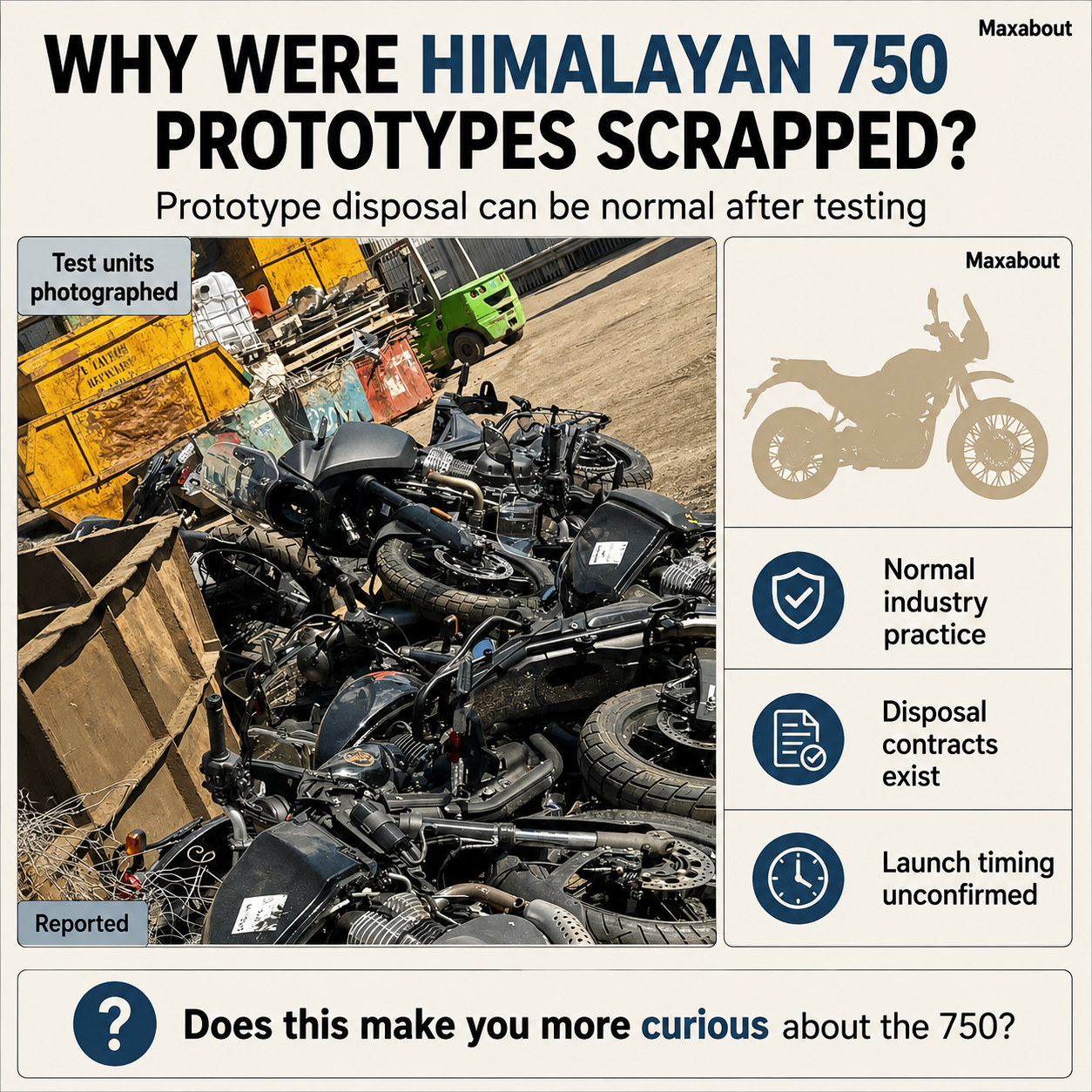
Photographs of reported Royal Enfield Himalayan 750 development motorcycles at a UK recycling facility have created an unusual—and easily misunderstood—moment in the model's development story. The images show multiple prototype motorcycles at the site, but they do not establish that Royal Enfield ha...
Editorial Team
Photographs of reported Royal Enfield Himalayan 750 development motorcycles at a UK recycling facility have created an unusual—and easily misunderstood—moment in the model's development story. The images show multiple prototype motorcycles at the site, but they do not establish that Royal Enfield has cancelled the programme or that a production launch is imminent.
The more grounded explanation is routine prototype disposal. Manufacturers regularly retire test vehicles after engineering, durability, validation or homologation work. Those machines may contain experimental components, may have experienced test stresses that are not visible, and are not necessarily built to production standards.
What the photographs appear to show
The motorcycles have been described as pre-production or test examples connected with the Himalayan 750 programme. The reported location is a UK recycling facility, and the bikes are said to have arrived from the Bruntingthorpe area, where Royal Enfield operates a technology centre.
This supports a narrow conclusion: physical development motorcycles reached the end of a test or evaluation phase and were sent for disposal. It does not, by itself, reveal their mileage, mechanical condition, exact specification or the state of the wider programme.
Why manufacturers destroy test motorcycles
Prototype parts: Development vehicles can use hand-built, experimental or non-certified components that are unsuitable for resale.
Unknown test history: A motorcycle may have completed durability cycles, calibration work or component testing that places stresses on it beyond ordinary road use.
Legal and homologation limits: Pre-production vehicles may not comply with every requirement needed for registration and retail sale.
Confidential engineering: Disposal helps prevent unreleased components, software or design details from entering the parts market.
Contractual control: Recycling agreements can require complete destruction rather than the removal and resale of components.
For those reasons, a prototype that looks nearly new can still be unsuitable for sale or reuse. Appearance alone is not a reliable guide to its engineering history.
What remains unconfirmed
One account linked to the report referred to eight van loads of Royal Enfield motorcycles. That figure has not been independently verified, and the available report does not establish that every motorcycle in the reported shipment was a Himalayan 750. We therefore cannot treat it as a confirmed Himalayan 750 quantity.
There is also no verified production specification, price or launch date in this evidence. The photographs should not be read as confirmation of a final engine tune, equipment list or market plan.
Does scrapping prototypes mean the Himalayan 750 is cancelled?
No such conclusion is supported by the photographs. Prototype disposal is compatible with a programme continuing normally: one group of machines can be retired after completing its work while newer development vehicles move on to another validation stage.
Cancellation would require stronger evidence, such as a company statement, a documented programme decision or consistent changes across testing and product planning. None of that is established here.
What the sighting tells enthusiasts
The sighting is still meaningful because it offers tangible evidence of a substantial development fleet and of Royal Enfield's testing activity in the UK. It also illustrates the less-visible end of vehicle development: test hardware does not automatically become a showroom motorcycle once engineers have finished with it.
For potential buyers, the useful signals will come later—continued testing, official teasers, certification filings, dealer communication and, ultimately, a launch announcement. Until then, reports around the Himalayan 750 should be separated into three buckets: what has been photographed, what has been credibly reported and what remains speculation.
Himalayan 750 prototype report: confirmed vs unconfirmed
| Claim | Status |
|---|---|
| Multiple reported Himalayan 750 development bikes were photographed at a UK recycling facility | Supported by the published images and report |
| Prototype destruction can occur after testing | Normal automotive-development practice |
| Every motorcycle in a reported larger shipment was a Himalayan 750 | Unconfirmed |
| The programme has been cancelled | Not supported |
| Final specifications, price or launch timing | Unconfirmed |
Frequently asked questions
Why would a manufacturer scrap a usable-looking prototype?
A prototype may contain experimental parts, have an intensive test history or lack road-registration approval. Disposal can be safer and legally simpler than resale.
Were all the reported motorcycles Himalayan 750 prototypes?
The available report shows multiple motorcycles described as Himalayan 750 development units, but it does not verify that every bike in the wider reported shipment was the same model.
Has Royal Enfield announced the Himalayan 750 launch date?
Not through the evidence covered here. Any launch timing should remain unconfirmed until Royal Enfield makes an official announcement.
Does this affect the existing Himalayan 450?
The photographs concern reported development motorcycles for a different programme. They do not indicate any immediate change to the Himalayan 450.
Explore the story
Related news




Share your view and join the discussion.
Earn reward points for every comment and get a chance to win ₹1,000 in our weekly lucky draw. Sign in with Google in one tap.
Start the conversation
No one has commented on this article yet. Be the first to share your view.
Want to read more automotive news?
Stay updated with the latest car launches, reviews, and industry insights.
Browse All News