
Suzuki’s Reported Six-day India Supplier Schedule: Maintenance and Production Context
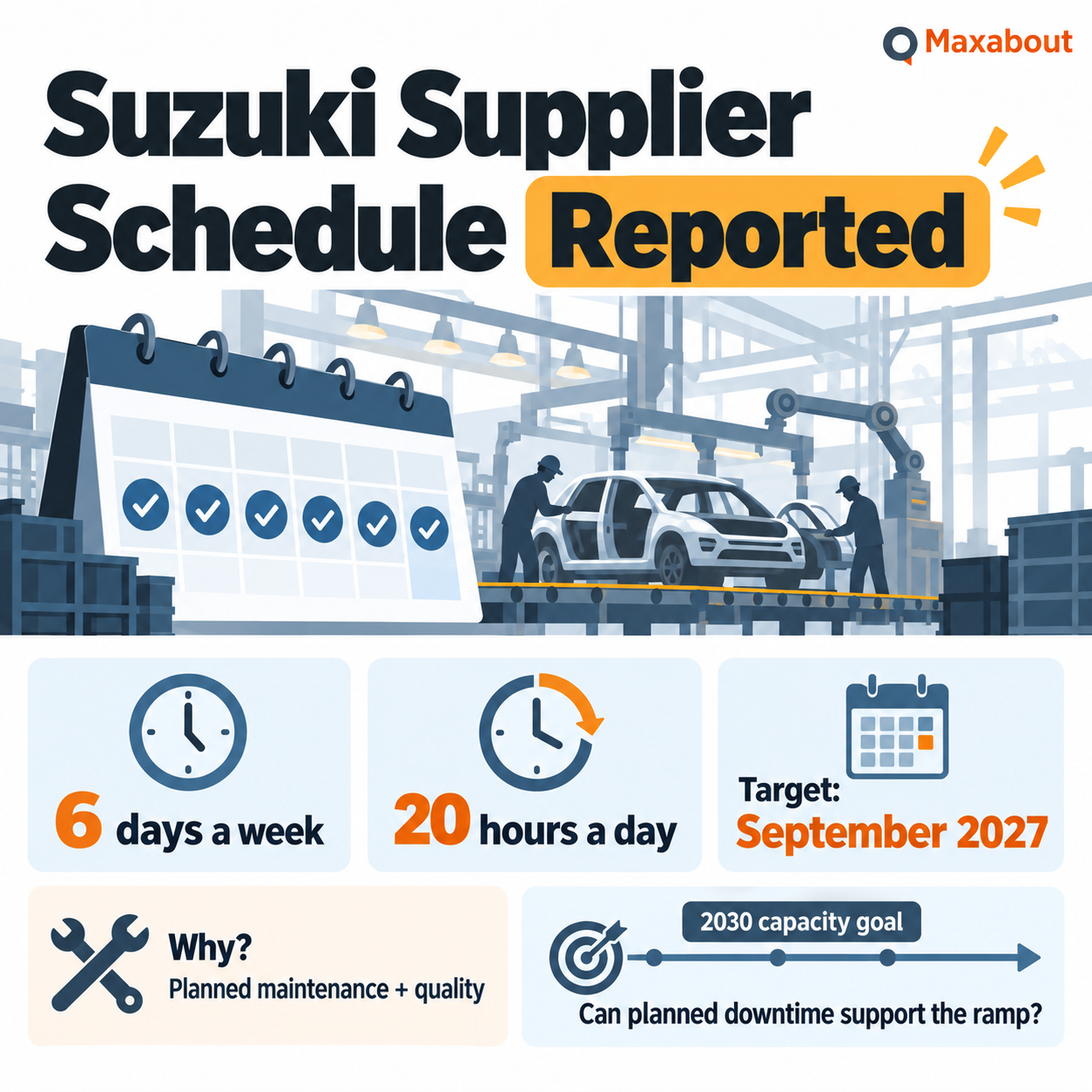
Suzuki's reported six-day India supplier schedule would reserve a weekly day for machine maintenance while supporting a production ramp. The report describes a target of 20 hours a day, six days a week by September 2027, leaving four hours of nightly downtime and one full day each week. The request ...
Suzuki's reported six-day India supplier schedule would reserve a weekly day for machine maintenance while supporting a production ramp. The report describes a target of 20 hours a day, six days a week by September 2027, leaving four hours of nightly downtime and one full day each week. The request is attributed to people familiar with the matter; it has not been established as a publicly confirmed company directive.
What is the reported request?
Suppliers in India are reportedly being asked to plan production capacity around a six-day week rather than running the relevant production lines all seven days. The report says the request was discussed with suppliers in August, and declarations were sought by year-end for lines producing Maruti Suzuki components.
The stated operating target is September 2027. A future target should not be read as proof that every supplier has already changed its schedule. The available evidence does not establish the individual implementation status of any named supplier.
| Reported measure | Timing or scale | Meaning |
|---|---|---|
| Production-day schedule | Six days per week | One weekly day reserved for maintenance |
| Daily machine operation | 20 hours | Four hours of nightly downtime |
| Supplier declarations | Reportedly by year-end 2026 | Confirmation about production-line operation |
| Operating-model target | September 2027 | Reported transition goal |
| Maruti output context | About 2.4 million to 4 million annually by 2030 | Reported expansion context, not achieved output |
Why reserve time for maintenance during a ramp?
The reported rationale is to reduce unplanned stoppages and protect component quality as output and exports increase. Planned downtime provides an opportunity to inspect and maintain equipment. Whether that approach succeeds depends on the actual maintenance work, production planning and supplier implementation; the announcement alone cannot prove an improvement.
A schedule covering machine operation is also different from an individual employee's working hours. The 20-hour figure should not be represented as a required personal shift or as a conclusion about labour conditions. The checked report does not supply those employment details.
How it fits the production expansion
The report places the request alongside Maruti Suzuki's ambition to increase annual production to 4 million cars by 2030 from about 2.4 million. Capacity and output need clear definitions: an annual ambition is not a count of vehicles already produced, and supplier readiness cannot be inferred solely from a factory expansion goal.
Component supply is part of delivering a larger production programme. A supplier plan has to account for equipment availability, maintenance, staffing and usable production capacity. The six-day proposal is therefore meaningful industrial context, but it does not itself establish a specific model launch or delivery date.
What the report does not show
No vehicle recall: the maintenance request is not evidence of a recall or a known defect in cars already sold.
No individual supplier finding: no named company's maintenance compliance is established here.
No delivery guarantee: the operating target does not determine a dealer's allocation for a particular customer.
No public directive text: the exact company document and supplier declarations were not available in the reported evidence.
Maruti Suzuki did not provide a comment for the checked report. That response neither confirms the directive nor disproves the reported request. Follow-up company or named supplier confirmation would strengthen the operating details.
What buyers and industry readers should watch next
Industry watchers should look for direct confirmation of the schedule, the scope of supplier lines, implementation timing and measured outcomes. Buyers should continue using their dealer's written allocation and delivery information rather than interpreting a supply-chain report as a promise that waiting periods will change.
FAQs
Is the six-day supplier schedule officially confirmed?
The checked report relies on attributed sources. A public company directive was not available.
Does 20 hours a day mean a 20-hour employee shift?
No such conclusion is supported. The reported figure describes production-machine operation, not an individual work schedule.
Does this indicate a defect or recall?
No. The reported rationale concerns maintenance planning and quality protection during an output ramp.
When is the target operating model expected?
September 2027 is the reported target; individual implementation has not been verified.
The reported Suzuki supplier schedule is useful for understanding the preparation behind a larger production programme. Its practical significance rests on confirmed implementation and outcomes, rather than assuming that a reported request is already an operating policy across the network.
Explore the story
Related news





Share your view and join the discussion.
Earn reward points for every comment and get a chance to win ₹1,000 in our weekly lucky draw. Sign in with Google in one tap.
Start the conversation
No one has commented on this article yet. Be the first to share your view.
Want to read more automotive news?
Stay updated with the latest car launches, reviews, and industry insights.
Browse All News