
Pirelli–BKT India tyre deal: what the 8 lakh by 2030 plan covers
Pirelli and Balkrishna Industries (BKT) have signed an agreement under which BKT is to produce up to 8 lakh Pirelli-branded car tyres in India by 2030. The arrangement begins with an off-take phase using Pirelli technology and quality standards. A separate 50:50 joint venture and dedicated high-valu...
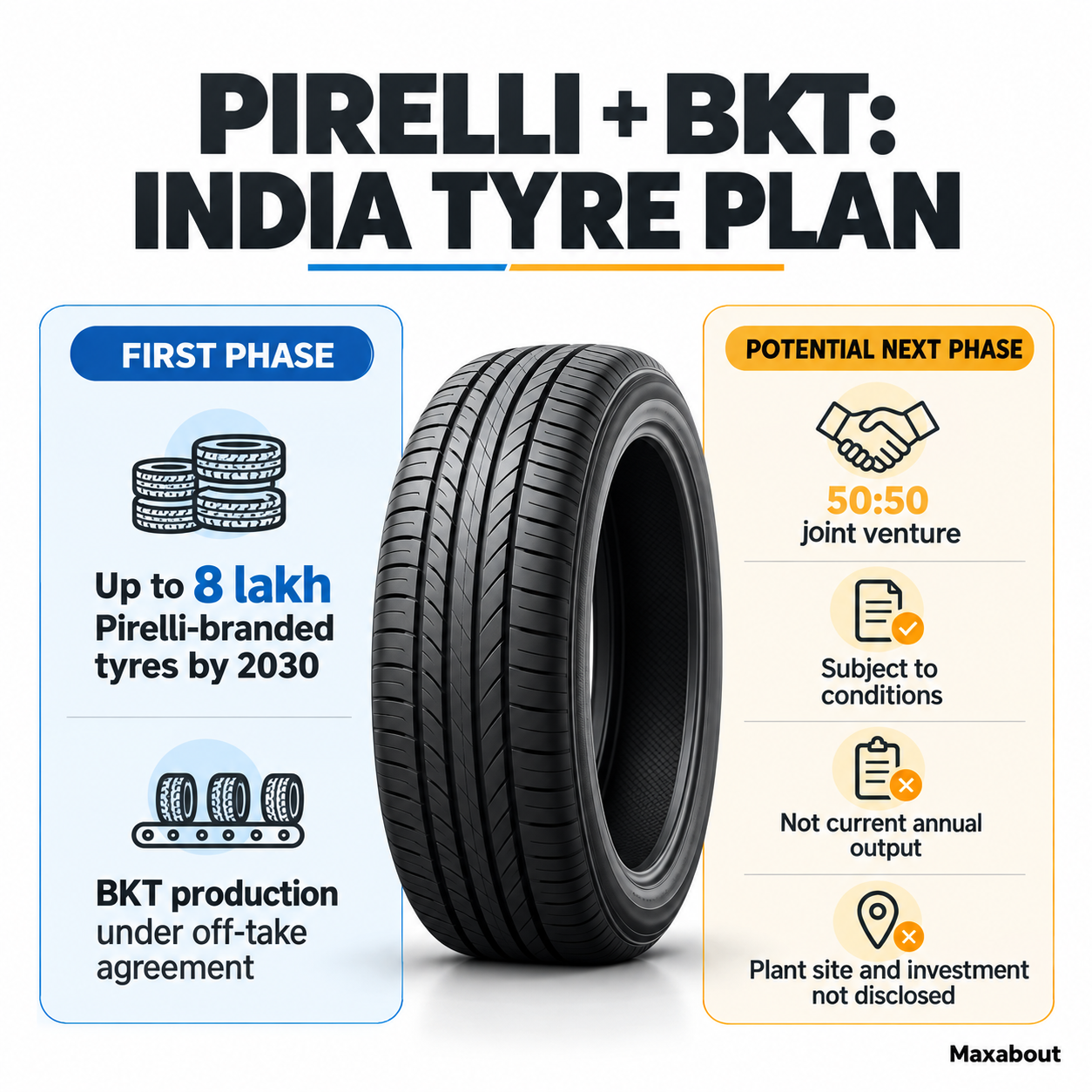
Pirelli and Balkrishna Industries (BKT) have signed an agreement under which BKT is to produce up to 8 lakh Pirelli-branded car tyres in India by 2030. The arrangement begins with an off-take phase using Pirelli technology and quality standards. A separate 50:50 joint venture and dedicated high-value tyre plant are envisaged for a later phase, but remain subject to conditions. The announcement should not be read as proof that the proposed JV plant is already built or that 8 lakh tyres represents current annual output.
The agreement in three points
First phase: BKT production of Pirelli-branded tyres through an off-take agreement.
Volume wording: up to 8,00,000 tyres by 2030, rather than a disclosed current annual production figure.
Potential next phase: a 50:50 JV and dedicated high-value car-tyre plant, subject to conditions.
What the first phase covers
The first arrangement would use one of BKT's newly constructed plants, with production following Pirelli's specified technological and quality standards. The tyres in this phase would carry the Pirelli brand.
The release does not identify the plant's location, the year-by-year ramp or a detailed product list. It therefore does not support a site map, a present-day production estimate or a claim that a particular tyre size will be locally available on a specific date.
The phrase “up to” also matters. It places a ceiling on the announced figure; it should not be rewritten as a guaranteed fixed output. The release's by-2030 wording should be retained without adding an annual-capacity interpretation that has not been established.
How the potential JV differs
The second phase envisages a 50:50 joint venture and a production plant dedicated to high-value car tyres. Unlike the first-phase brand description, the proposed JV would serve products under both the Pirelli and BKT brands, for India and international markets.
This phase is explicitly conditional. An agreement that envisages a JV is different from confirmation that every condition has been met, the investment has been committed or the dedicated plant is operational. Those later milestones need their own confirmation.
First phase versus potential second phase
| Detail | First phase | Potential second phase |
|---|---|---|
| Arrangement | Off-take agreement | Envisaged 50:50 joint venture, subject to conditions |
| Production description | BKT manufacturing using Pirelli technology and quality standards | Dedicated high-value car-tyre plant envisaged |
| Brand scope | Pirelli-branded tyres | Pirelli and BKT brands |
| Announced volume | Up to 8,00,000 tyres by 2030 | No separate capacity figure disclosed in the announcement |
| Site and investment | Specific location, ramp and investment not disclosed | Final site, investment and detailed conditions not disclosed |
Why the India-production angle matters
Pirelli describes its existing India presence as commercial. The agreement gives the company a route towards locally produced supply through BKT's industrial base, while BKT says the partnership supports its expansion in passenger-car tyres.
That makes the announcement relevant to premium-tyre localisation and the supplier industry. It does not, by itself, establish future retail prices, a particular vehicle manufacturer's fitment contract or the performance of an individual tyre.
The release also presents growth expectations for the Indian car and premium-tyre markets. Those are company estimates and should not be treated as independent guarantees that every part of the production plan will be achieved.
What buyers and industry watchers should look for next
The next useful disclosures are the first-phase site, the product and size range, production timing and distribution details. For the later phase, watch for confirmation that the JV conditions have been met, followed by a defined plant and investment programme.
A locally made tyre announcement is not a reason to assume a future price reduction or postpone a purchase around an undisclosed product date. For a specific purchase, the relevant information remains the exact available product, specification and quotation.
FAQs
Does the 8 lakh figure describe current annual output?
No. The announcement says up to 8,00,000 Pirelli-branded tyres by 2030. A current annual output figure and detailed ramp have not been established here.
Is the 50:50 JV plant already confirmed as operational?
No. The later JV and dedicated plant are envisaged subject to conditions; they are separate from the first off-take phase.
The Pirelli–BKT India tyre agreement is a significant production step, but its two phases need to stay distinct. The first-phase brand, volume wording and 2030 horizon are defined; the later JV and several implementation details remain conditional or undisclosed.
Explore the story
Related news


Share your view and join the discussion.
Earn reward points for every comment and get a chance to win ₹1,000 in our weekly lucky draw. Sign in with Google in one tap.
Start the conversation
No one has commented on this article yet. Be the first to share your view.
Want to read more automotive news?
Stay updated with the latest car launches, reviews, and industry insights.
Browse All News