
India's proposed AEBS mandate: what the 2028, 2030 and 2032 dates mean
India has proposed making Advanced Emergency Braking Systems (AEBS) mandatory for new M1 passenger-car models manufactured from 1 October 2030, followed by all M1 models manufactured from 1 October 2032. The proposal also includes an earlier, conditional technical-standard requirement from 2028. The...
India has proposed making Advanced Emergency Braking Systems (AEBS) mandatory for new M1 passenger-car models manufactured from 1 October 2030, followed by all M1 models manufactured from 1 October 2032. The proposal also includes an earlier, conditional technical-standard requirement from 2028. These are draft rules, rather than a final notification or an instruction to retrofit every car already on the road.
What car buyers need to know
2030: AEBS fitment is proposed for new M1 models manufactured from 1 October.
2032: The proposed fitment requirement extends to all M1 models manufactured from 1 October.
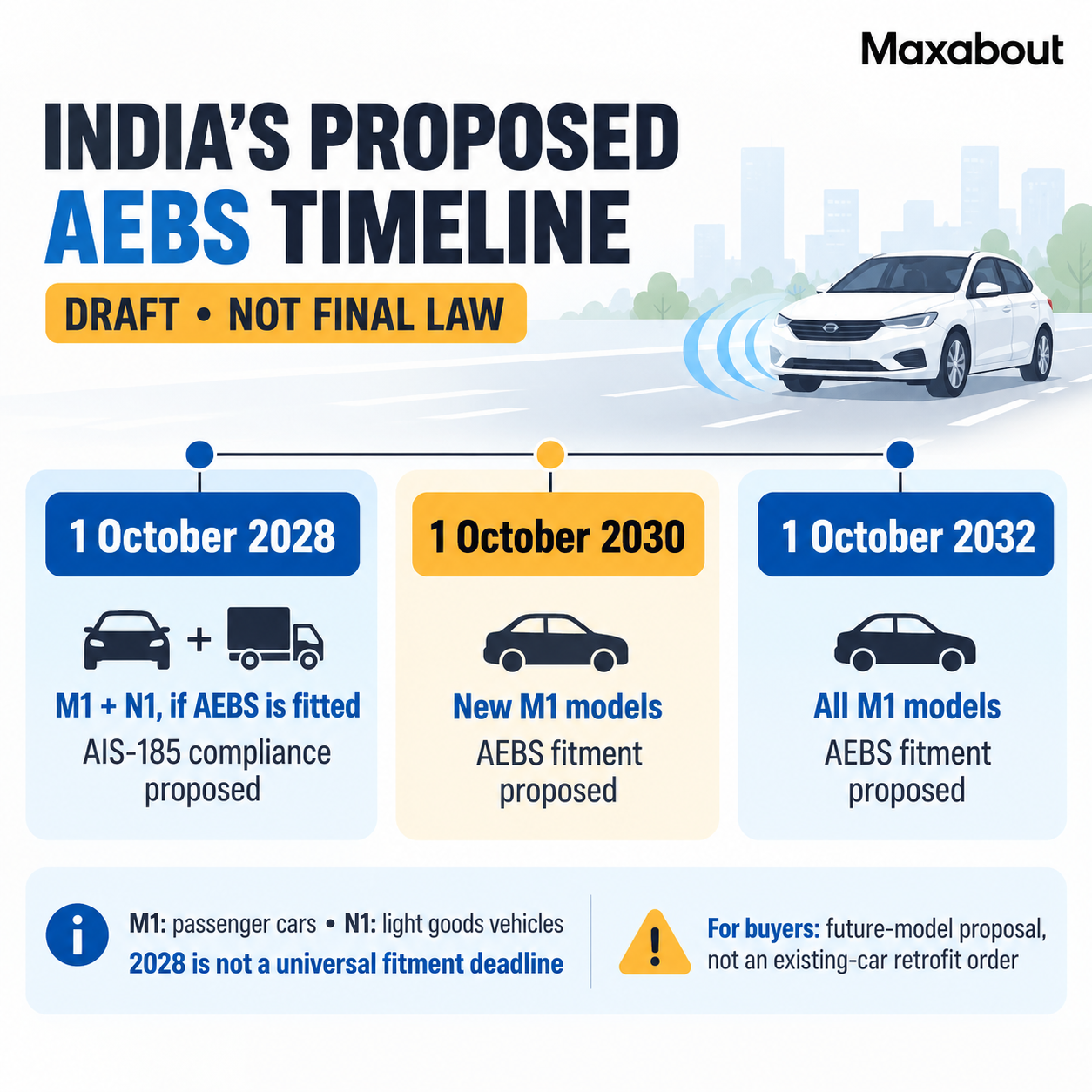
2028 is different: M1 and N1 vehicles manufactured from 1 October would need to meet AIS-185 if they are fitted with AEBS.
Status: The text remains a proposal. It does not establish a universal retrofit deadline for existing cars.
Why the 2028 date is easy to misunderstand
The draft contains two separate ideas: a technical standard for an installed system, and a requirement to install that system. Treating them as the same obligation would bring the passenger-car deadline forward by two years and incorrectly extend the proposed fitment timetable to light goods vehicles.
Under the first provision, M1 and N1 vehicles manufactured on or after 1 October 2028, if provided with AEBS, would have to conform to AIS-185, as amended from time to time. The words “if provided” matter: this clause sets the proposed conformity requirement where the equipment is fitted. It does not, by itself, require every vehicle in those two categories to have AEBS from 2028.
The next provision specifically addresses M1. It proposes AEBS fitment for new models from 2030 and all models from 2032. The same fitment deadlines should therefore not be presented as a blanket N1 requirement.
The proposed AEBS timetable at a glance
| Proposed date | Vehicle scope | What the draft would require | Important distinction |
|---|---|---|---|
| 1 October 2028 | M1 and N1 vehicles manufactured on or after this date, if fitted with AEBS | The installed AEBS would conform to AIS-185, as amended | A conditional equipment-standard provision, not universal mandatory fitment |
| 1 October 2030 | New M1 models manufactured on or after this date | AEBS fitment conforming to AIS-185 | The first proposed mandatory M1 fitment stage |
| 1 October 2032 | All M1 models manufactured on or after this date | AEBS fitment conforming to AIS-185 | The later manufacturing-stage requirement, including continuing models |
Every date in this table belongs to the draft proposal. M1 refers here to passenger cars; N1 refers to light goods vehicles. The table does not describe a final legal obligation or an existing-vehicle retrofit programme.
What AEBS is intended to do
AEBS is intended to apply braking automatically when a driver does not respond to an emergency, helping avoid a collision or reduce its impact. That purpose is different from guaranteeing that every collision will be prevented.
The proposal names a technical conformity standard, but the dates alone do not establish the performance of a particular car. They also do not identify the sensor layout, detection capability or operating limits of any model. Buyers should assess the actual equipment and documentation supplied for the exact variant they are considering rather than treating a future regulatory deadline as a feature specification.
What this means for a car purchase now
The practical question for today's buyer is whether the exact car and variant already offers the braking assistance they want. The draft does not make every current model AEBS-equipped, and it provides no basis for assuming that an existing car will receive the feature later through a software update.
Before choosing a variant, ask the dealer to confirm its installed driver-assistance equipment and consult the manufacturer's description of how it operates. Keep three questions separate: whether the feature is fitted, what it is designed to do, and which conditions or limitations apply. A future compliance timetable cannot answer those questions for a specific vehicle sold today.
For manufacturers, the phased dates distinguish the introduction of new M1 models from continued manufacture of the wider model range. That is the central rollout difference. The draft does not quantify the resulting vehicle-price change, and no reliable price impact can be inferred from these dates alone.
What still needs to happen
The draft provides for objections and suggestions within thirty days from the date copies of the Gazette notification are made available to the public. That wording should not be converted into a precise consultation closing date merely by counting from the notification date.
The final text and any subsequent changes need to be checked before these dates are treated as settled requirements. Until then, the accurate description is a proposed AEBS timetable with distinct vehicle-category and manufacturing-date provisions.
FAQs
Is AEBS already mandatory for every new car in India under this proposal?
No. The text proposes future M1 fitment dates in 2030 and 2032 and remains at draft stage.
Does the 2028 provision require every light goods vehicle to have AEBS?
No. The cited M1/N1 clause applies if AEBS is fitted and would require that installed system to meet AIS-185. The separate 2030 and 2032 fitment provision names M1.
Will owners have to retrofit cars they already use?
The proposed provisions discussed here concern vehicles manufactured from the stated dates. They do not set out a universal retrofit instruction for cars already in use.
The key to India's proposed AEBS mandate is the difference between equipment conformity in 2028 and M1 fitment in 2030 and 2032. For buyers, the immediate priority remains checking the exact vehicle's equipment while the final rules take shape.
Explore the story
Related news
Share your view and join the discussion.
Earn reward points for every comment and get a chance to win ₹1,000 in our weekly lucky draw. Sign in with Google in one tap.
Start the conversation
No one has commented on this article yet. Be the first to share your view.
Want to read more automotive news?
Stay updated with the latest car launches, reviews, and industry insights.
Browse All News