
Hyundai Venue Remote Immobiliser via OTA: Eligibility and Limits Explained
Hyundai has added a remote immobiliser to compatible Venue HX10 and Venue N Line N10 variants through a connected over-the-air update. The Bluelink feature is designed to stop a parked vehicle from starting again after the owner activates it; it does not shut down or stop a car that is already movin...
Editorial Team
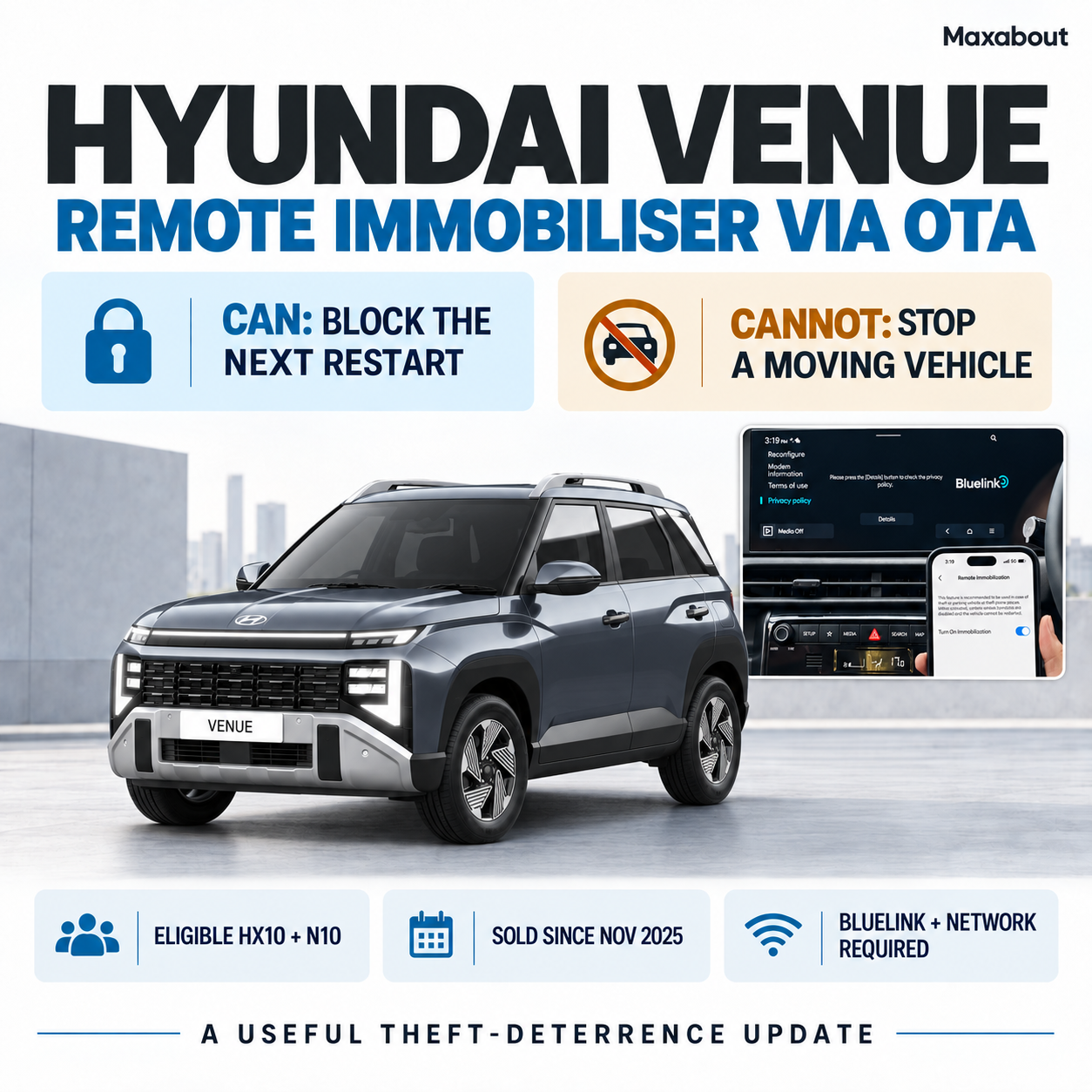
Hyundai has added a remote immobiliser to compatible Venue HX10 and Venue N Line N10 variants through a connected over-the-air update. The Bluelink feature is designed to stop a parked vehicle from starting again after the owner activates it; it does not shut down or stop a car that is already moving. Compatible vehicles sold since November 2025 are included in the reported rollout, while the feature becomes standard on supported variants from September 2026.
What the Venue remote immobiliser does
The new control adds a software-based theft-deterrence layer to the Venue's connected-car package. If an owner believes the car has been stolen, the command can be activated through Bluelink while the vehicle is parked. Once the engine has been switched off, the system can prevent the next start. That distinction is central to understanding the feature safely.
| Capability | What owners should know |
|---|---|
| Block the next restart | Yes, after activation and once the parked vehicle has been switched off. |
| Stop a moving vehicle | No. The feature is not designed to shut down a car in motion. |
| Work without connectivity | No guarantee. Bluelink communication depends on network access and vehicle power. |
| Replace police reporting or tracking | No. It is an additional deterrence and response tool, not a complete recovery service. |
Which Hyundai Venue models are eligible?
The rollout is reported for compatible Hyundai Venue HX10 and Venue N Line N10 variants equipped for Bluelink and connected over-the-air updates. Eligible vehicles sold since November 2025 can receive the feature without a workshop visit. From September 2026, Hyundai says it will be standard on compatible HX10 and N10 variants.
Compatibility still matters. A model name or registration date alone does not prove that a specific car has the required connected hardware, software configuration or active service. Owners should check their Bluelink app, vehicle notifications or an authorised Hyundai service channel before assuming the command is available.
How the OTA security update works
The feature is delivered through C-OTA, Hyundai's connected over-the-air update route. That allows supported software to reach eligible cars remotely rather than requiring every owner to book a workshop appointment. After installation, the immobiliser command is available through the vehicle's connected ecosystem, subject to activation and service conditions.
Confirm that the vehicle and Bluelink account are eligible and active.
Install any pending connected-car or vehicle software update shown for the car.
If theft is suspected, contact the police and use available location or security tools as advised.
Activate remote immobilisation only through the genuine connected service.
The command is intended to prevent a subsequent start after the vehicle is parked and switched off.
Owners should not interpret this sequence as a guarantee of recovery. The command must reach the vehicle, the vehicle needs power, and the relevant wiring and connected hardware must remain functional.
Network, power and tampering limitations
Connected security features are only as effective as their communication path. Live location and remote commands can be affected by poor mobile coverage, interrupted vehicle power or tampered wiring. A thief who disables the communication system may reduce the usefulness of app-based controls. Underground parking, remote areas and network outages can also delay communication.
For that reason, the Venue remote immobiliser should sit alongside physical precautions such as secure parking, steering locks where appropriate, key security and prompt reporting. It strengthens the response toolkit but does not make theft impossible.
Why the feature matters for owners
Software-defined features increasingly shape the ownership experience after a car leaves the showroom. In this case, an OTA update brings a meaningful security function to already-sold compatible vehicles rather than limiting it to a new model-year purchase. That can improve the value of connected hardware and demonstrates how manufacturers can add safety or convenience functions during the vehicle's life.
The careful design choice not to stop a moving vehicle is equally important. Remotely disabling propulsion in traffic could create a serious safety risk. Blocking the next restart aims to make the car harder to move again once it is stationary without introducing that hazard.
What Hyundai plans next
Hyundai has indicated that remote immobilisation will expand in phases to selected existing Bluelink-equipped models. A complete model-by-model list was not available in the inspected material, so owners of other Hyundai cars should wait for a direct eligibility notice rather than assuming their vehicle will receive the update.
Frequently asked questions
Can the Hyundai Venue remote immobiliser stop a stolen car while it is moving?
No. It is designed to block the next restart after the vehicle has stopped and been switched off.
Does an eligible Venue need a workshop visit?
The feature is being delivered through a connected OTA update for compatible vehicles, so a workshop visit should not normally be required for the software delivery. Vehicle-specific issues may still need dealer support.
Will every Venue sold since November 2025 receive it?
Only compatible HX10 and N10 variants with the required Bluelink and OTA capability are covered by the reported rollout. Owners should verify their individual vehicle.
Does the immobiliser work if the vehicle has no network signal?
Remote commands depend on communication. Weak coverage, power loss or tampering can prevent or delay operation.
The Hyundai Venue remote immobiliser is a useful OTA security addition because it can prevent a parked, switched-off vehicle from being restarted. Its value is clearest when owners understand the limits: it cannot stop a moving car, it relies on connectivity and power, and it complements rather than replaces conventional theft reporting and security precautions.
Explore the story
Related news




Share your view and join the discussion.
Earn reward points for every comment and get a chance to win ₹1,000 in our weekly lucky draw. Sign in with Google in one tap.
Start the conversation
No one has commented on this article yet. Be the first to share your view.
Want to read more automotive news?
Stay updated with the latest car launches, reviews, and industry insights.
Browse All News