
Bajaj EV Sales Cross 3 Lakh in 2026—Can Chetak Close the Gap to TVS?
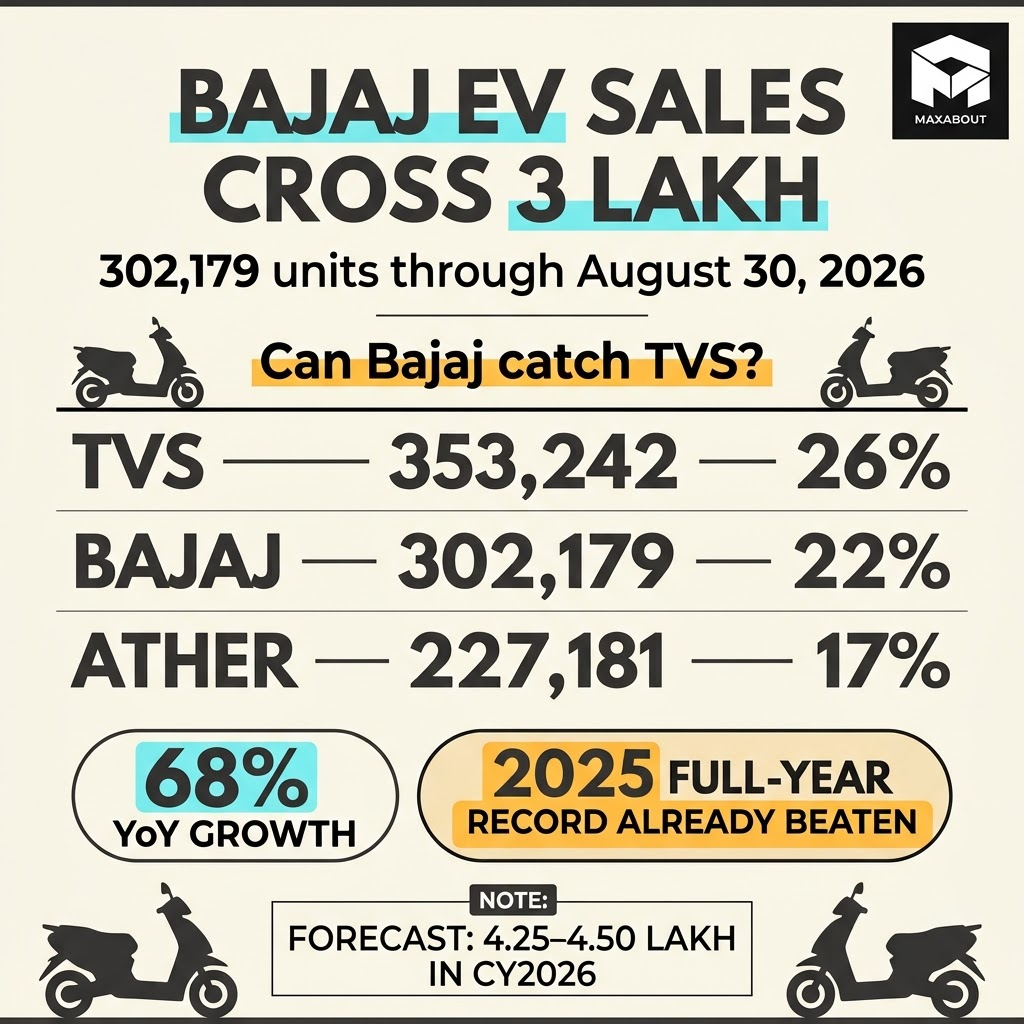
Bajaj Auto has crossed 300,000 electric two-wheeler retail sales in 2026, reaching 302,179 Chetak electric scooters and Yulu e-bikes through August 30. The VAHAN-based tally represents 68% year-on-year growth and puts Bajaj at roughly 22% of India's electric two-wheeler market. More importantly, the...
Editorial Team
Bajaj Auto has crossed 300,000 electric two-wheeler retail sales in 2026, reaching 302,179 Chetak electric scooters and Yulu e-bikes through August 30. The VAHAN-based tally represents 68% year-on-year growth and puts Bajaj at roughly 22% of India's electric two-wheeler market. More importantly, the company has already exceeded its entire 2025 volume before the festive season, turning the remaining four months into a test of whether it can close the gap to TVS while keeping Ather behind.
What you need to know
2026 sales through August 30: 302,179 electric two-wheelers.
Year-on-year growth: 68%, versus 180,209 units in the comparable 2025 period.
Estimated market share: about 22% of 1,346,571 electric two-wheelers sold nationally.
Competitive position: behind TVS at 353,242 units and ahead of Ather at 227,181 units.
Forecast status: 425,000–450,000 Bajaj units for CY2026 is a source projection, not a confirmed company target.
Bajaj's 2026 EV sales milestone in context
The milestone is notable because it is both a scale record and an acceleration signal. Bajaj sold 279,685 electric two-wheelers in all of 2025. By August 30, 2026, it had already moved 22,494 more units than that full-year total. March was the first month in which Bajaj crossed 40,000 retail units, and the company repeated that performance in June and July.
The mix includes the Chetak electric-scooter family and Yulu electric bikes. That matters when comparing manufacturers because the reported total is a company-level electric two-wheeler figure, not a single-model number. Buyers should therefore read the milestone as evidence of Bajaj's broader EV retail reach rather than as a direct sales count for one Chetak variant.
TVS, Bajaj and Ather: the market-share race
| Manufacturer | 2026 retail units through August 30 | Approximate share |
|---|---|---|
| TVS | 353,242 | 26% |
| Bajaj | 302,179 | 22% |
| Ather | 227,181 | 17% |
TVS held a lead of 51,063 units over Bajaj at the reporting cut-off. That is meaningful, but the festive season can still shift monthly momentum. Ather is further behind on volume, yet its new mass-market Konarc range could add pressure at lower price points. The result is a three-way contest shaped by production capacity, dealer availability, pricing and the number of variants each brand can deliver without long waiting periods.
Why the 68% growth matters
A large percentage gain is most useful when it comes with a substantial base. Bajaj's rise from 180,209 units to 302,179 units adds nearly 122,000 retail registrations year on year. That suggests stronger consumer acceptance, wider product availability or both. It also gives Bajaj more installed vehicles that can support service-network learning, parts demand and word-of-mouth visibility.
For buyers, sales volume is not a guarantee of product quality, battery durability or service satisfaction. It is, however, one practical indicator of how widely a platform is being adopted. A growing vehicle population can make service reach, technician experience and resale-market awareness more important competitive factors over time.
Can Bajaj reach 4.25–4.50 lakh units in 2026?
The published analysis projects Bajaj could finish CY2026 between 425,000 and 450,000 units. That range assumes another 125,000–150,000 sales in the final four months, supported by the festive season. It should be treated as an expected range, not an official confirmed forecast.
To reach the lower end, Bajaj would need to average a little over 30,000 units per month from September through December. The upper end requires roughly 37,000 units per month. Both are below the 42,455 monthly average reported for June–August, so the projection is mathematically plausible if production, retail demand and dealer stock remain healthy. Competitive discounts or stronger launches from TVS and Ather could still change the outcome.
What this means for Indian electric-scooter buyers
More competition at mainstream prices: TVS, Bajaj and Ather all have incentives to defend share with sharper variants, finance offers and feature upgrades.
Availability matters as much as specifications: a well-priced scooter is less attractive when dealer stock or delivery timelines are uncertain.
Compare ownership support: buyers should check battery warranty, service access, software support, charging convenience and real-world range—not only headline IDC figures.
Watch variant-level pricing: market-share totals do not show which trims deliver the best value in a particular city.
FAQs
How many electric two-wheelers did Bajaj sell in 2026?
Bajaj Auto recorded 302,179 electric two-wheeler retail sales from January through August 30, 2026, according to the reported VAHAN-based analysis.
What was Bajaj's electric two-wheeler market share?
The reported share was about 22% of India's 1.346 million-unit electric two-wheeler market for the period, behind TVS at 26% and ahead of Ather at 17%.
Did Bajaj already beat its 2025 EV sales record?
Yes. The 2026 year-to-date total of 302,179 units exceeded Bajaj's full-year 2025 record of 279,685 units.
Will Bajaj sell 450,000 electric two-wheelers in 2026?
That is not confirmed. The source analysis projects a range of 425,000–450,000 units, depending on festive-season demand and monthly retail performance.
Bajaj electric scooter sales in 2026 show that the Chetak-led portfolio has become a major force in India's EV market. The next question is whether Bajaj can sustain its recent monthly pace and narrow TVS's lead while Ather expands its lower-priced offering.
Explore the story
Related news

Share your view and join the discussion.
Earn reward points for every comment and get a chance to win ₹1,000 in our weekly lucky draw. Sign in with Google in one tap.
Start the conversation
No one has commented on this article yet. Be the first to share your view.
Want to read more automotive news?
Stay updated with the latest car launches, reviews, and industry insights.
Browse All News