
ARAI Opens ₹55 Crore Battery Lab and EV Powertrain Test Facility
ARAI's new battery and EV powertrain facilities explained, with the proposed crash-test project kept separate from inaugurated infrastructure.
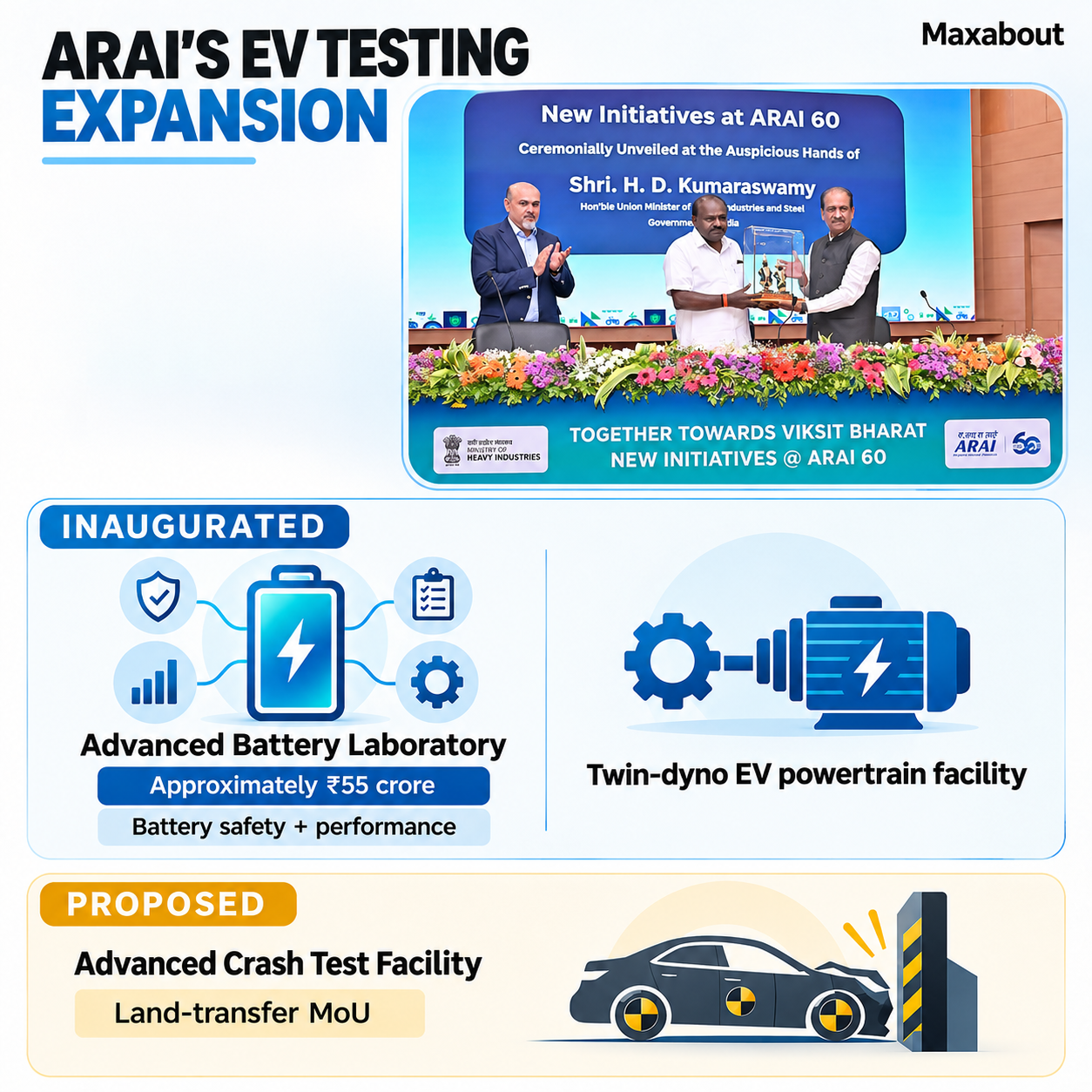
ARAI has inaugurated an approximately ₹55 crore Advanced Battery Laboratory and a twin-dynamometer EV powertrain facility, expanding India's infrastructure for electric-mobility testing. A separate land-transfer MoU concerns a proposed advanced crash-test facility. These are different stages of development: the battery and powertrain facilities have been inaugurated, while the crash-testing project remains proposed.
What has been inaugurated?
The Automotive Research Association of India marked the additions during its Diamond Jubilee programme. The battery laboratory supports battery validation, safety and performance assessment, certification and export-compliance work. It was developed with support from the Ministry of Heavy Industries and ARAI.
The second addition focuses on e-axles and EV powertrains. In an electric vehicle, the battery stores energy, while the drive system turns that energy into motion. Testing one does not replace testing the other.
| Facility or project | Focus | Status |
|---|---|---|
| Advanced Battery Laboratory | Battery testing and validation; approximately ₹55 crore investment. | Inaugurated. |
| Two-dynamometer e-axle and EV powertrain facility | Electric-drive development and validation. | Inaugurated. |
| Advanced Crash Test Facility | Proposed expansion of crash-testing capability. | Land-transfer MoU with Skoda Auto Volkswagen India; not an operational-facility announcement. |
Why this matters to India's EV industry
Developers need to establish how components behave before a vehicle reaches customers. More domestic validation infrastructure gives manufacturers another part of the development chain to work with inside India. The practical benefit depends on the tests a programme needs, available capacity and the applicable standards.
The announcement does not quantify a reduction in development cost, waiting time or overseas testing for the newly inaugurated facilities. Those outcomes should be assessed with operating data rather than assumed from the investment figure.
What it means for car buyers
A new test facility is an industry capability, not a safety rating for a particular car. Buyers should continue to examine the published results, warranty and specifications of the model they are considering. A manufacturer's access to testing infrastructure does not show that every vehicle has passed every possible assessment.
Likewise, the proposed crash-test project should not be read as evidence that a new crash-rating requirement or consumer deadline has begun. This announcement concerns infrastructure development.
FAQs
Does the ₹55 crore amount cover all three facilities?
The stated approximate investment relates to the Advanced Battery Laboratory. It should not be treated as the combined cost of the powertrain facility and proposed crash-test project.
Is the new crash-test facility already operational?
The announcement describes an MoU towards land transfer for a proposed facility. It does not announce that project's completion.
ARAI's EV testing expansion adds battery and electric-drive validation infrastructure while setting out a separate crash-testing development. The distinction helps readers understand what has opened and what still lies ahead.
Explore the story
Related news


Share your view and join the discussion.
Earn reward points for every comment and get a chance to win ₹1,000 in our weekly lucky draw. Sign in with Google in one tap.
Start the conversation
No one has commented on this article yet. Be the first to share your view.
Want to read more automotive news?
Stay updated with the latest car launches, reviews, and industry insights.
Browse All News