
Yamaha MBSI & Sikhar Fleet Build Vehicle Leasing Network
Something is quietly shifting in how India thinks about vehicle ownership. For decades, buying outright — whether a scooter, a sedan, or a truck — was the default. But that calculus is changing. Leasing models, once associated almost exclusively with corporate car fleets, are now creeping into two-w...
Editorial Team
Something is quietly shifting in how India thinks about vehicle ownership. For decades, buying outright — whether a scooter, a sedan, or a truck — was the default. But that calculus is changing. Leasing models, once associated almost exclusively with corporate car fleets, are now creeping into two-wheeler territory. And a recent tie-up between Yamaha Motor Business Solutions India (MBSI) and Sikhar Fleet might just be one of the clearest signals yet that this shift is picking up real momentum.
MBSI is Yamaha's dedicated business solutions arm in India — essentially the division focused on fleet sales, B2B mobility, and structured vehicle financing solutions beyond the typical showroom transaction. Sikhar Fleet, meanwhile, operates in the vehicle leasing and fleet management space, working with businesses that need organised, scalable mobility without the burden of full ownership.
Together, they are building what looks like a structured leasing network specifically designed for the Indian market. And the timing is hard to ignore. The gig economy is booming. Last-mile delivery demand is surging across metros and smaller cities alike. Logistics companies are under constant pressure to scale their fleets quickly without locking up capital. Could this partnership actually reshape how businesses — and eventually individual buyers — access two-wheelers in India? That is genuinely worth thinking about.
Understanding the MBSI-Sikhar Fleet Partnership: What Exactly Is Being Built Here?
So let us actually break this down, because the phrase "structured vehicle leasing network" gets thrown around loosely and deserves a clearer explanation.
This is not a rental arrangement where a business borrows two-wheelers for a few days. And it is not hire-purchase either, where a company gradually buys vehicles through installments and eventually owns them outright. What Yamaha MBSI and Sikhar Fleet appear to be building is something more deliberate — a long-term leasing framework where businesses access two-wheelers for defined periods, with maintenance, servicing, and vehicle replacement cycles all baked into the agreement from day one.
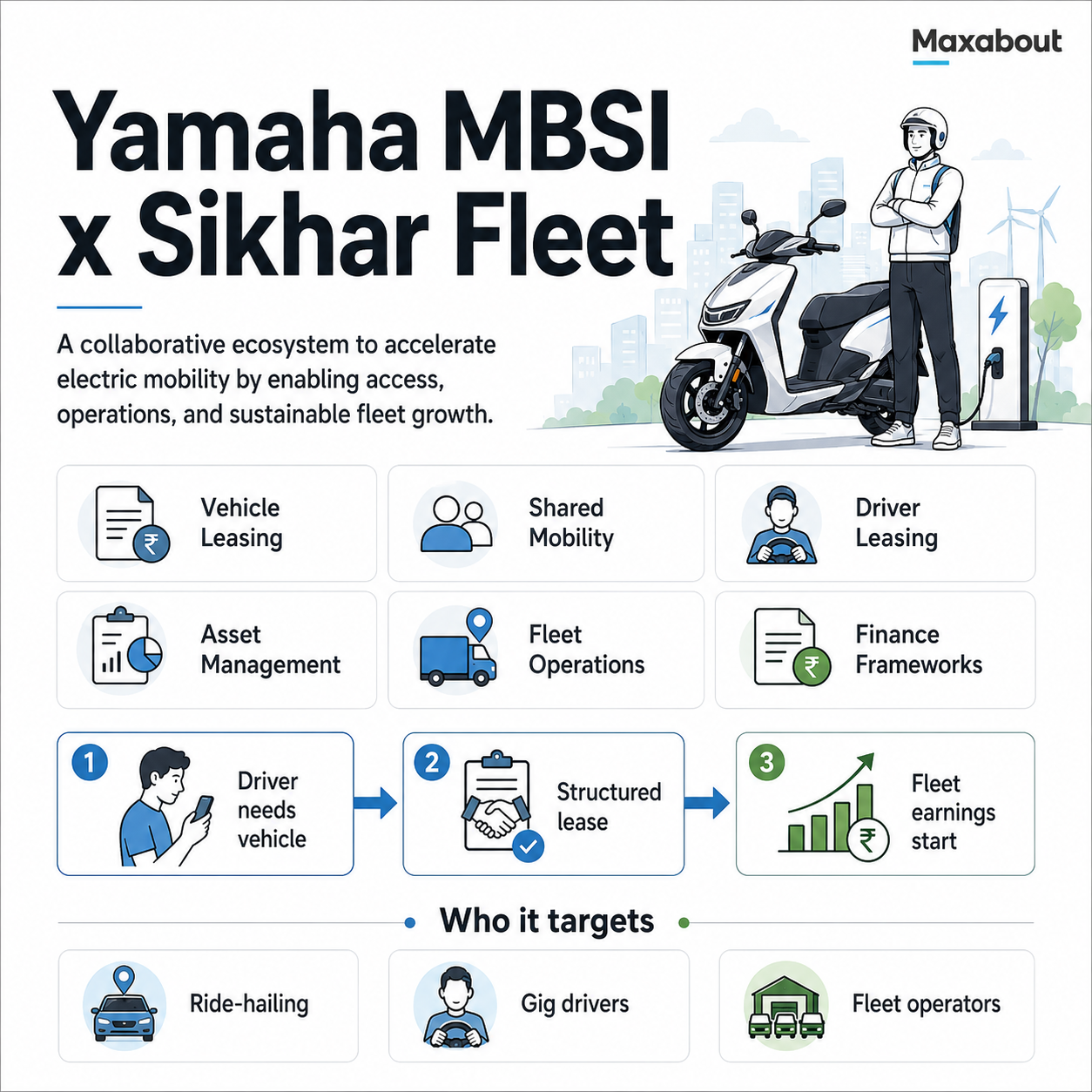 In practical terms, think of it this way. A logistics company signs on, receives a defined fleet of Yamaha two-wheelers, operates them across their delivery network, and does not worry about workshop visits, spare parts sourcing, or what happens when a vehicle crosses a certain mileage threshold. That is handled within the leasing structure itself. The business pays a predictable periodic cost and focuses on its core operations.
Yamaha MBSI brings considerable weight to this arrangement — brand credibility, an established two-wheeler portfolio suited for commercial use, and deep technical knowledge of their own vehicles. Sikhar Fleet, from what industry reports suggest, contributes the operational backbone: fleet management experience, existing relationships with commercial clients, and the ground-level infrastructure to actually run such a network at scale.
Together, that combination addresses a genuine gap in the Indian market.
Why India's Fleet and Leasing Market Is Ready for This Kind of Disruption
That gap, it turns out, is enormous. India's fleet sector has grown at a pace few industries can match over the last five years. E-commerce, quick commerce, food delivery — these are not niche segments anymore. Zomato and Swiggy alone operate through hundreds of thousands of two-wheelers daily. Add large FMCG distributors, pharmaceutical logistics companies, and corporate last-mile solutions, and you are looking at a fleet ecosystem that runs into millions of vehicles nationwide.
Managing those vehicles, though, is a genuine operational headache. Most fleet operators today rely on unorganized leasing arrangements — informal agreements, inconsistent maintenance schedules, no structured contracts, and very little accountability when something breaks down on a busy Mumbai expressway or a congested Bengaluru delivery route. The system works, barely, until it doesn't.
That unreliability has real business consequences. Delivery windows get missed. Maintenance costs spiral unpredictably. There is no credible partner who can offer standardized pricing, guaranteed servicing, and actual fleet-level data visibility.
Industry trends also point toward another pressure building quietly — fleet electrification. Companies have public commitments around emission reduction, but transitioning a commercial fleet to EVs without a structured leasing and maintenance partner is logistically complicated. A credible, OEM-backed leasing network could genuinely accelerate that transition.
What This Means for Businesses Using Yamaha Vehicles in Their Fleets
For businesses actually operating Yamaha two-wheelers on the ground, this tie-up could change some genuinely frustrating realities. The most immediate one is capital. Buying even twenty bikes outright is a significant upfront hit — and for a delivery startup in Pune still finding its operational footing, that money is often better deployed elsewhere. A structured leasing arrangement flips that equation into predictable monthly outflows, which makes budgeting far more manageable.
Bundled maintenance is the other piece that quietly matters more than people acknowledge. Downtime is expensive. When a delivery bike is off the road, that is lost capacity, not just a repair bill. If Sikhar Fleet can offer guaranteed service timelines through Yamaha's existing network, smaller operators stand to benefit the most — they rarely have dedicated fleet managers tracking vehicle health proactively.
That said, the concerns are real too. Lock-in periods could be a problem for businesses whose scale shifts quickly. A logistics company in Ahmedabad expanding or contracting its delivery radius within twelve months needs flexibility that rigid lease terms may not accommodate easily. Whether exit clauses or fleet-size adjustments are actually built into the contracts will determine how genuinely useful this is for dynamic businesses.
There is also the question of accessibility. Structured fleet leasing programs historically tend to favor larger operators with documented financials and credit histories. Whether a ten-bike operation or an early-stage startup can actually qualify — or whether this network is practically built for enterprises running hundreds of vehicles — is something worth watching closely as details emerge.
The Role of Structured Leasing in India's Shift Toward Organized Mobility
India has always been an ownership-first market. The idea of paying monthly for something you never actually own cuts against a deeply ingrained instinct — buy it, keep it, pass it on. But that mindset is slowly cracking, and vehicle leasing is one of the clearer signs of that shift.
In the US and much of Europe, operating leases for commercial vehicles are almost standard practice. In India, they remain a relatively niche arrangement, mostly limited to large corporates with dedicated fleet managers. The gap exists for real reasons — fragmented financing infrastructure, low awareness of total cost of ownership, and historically lower vehicle prices that made outright purchase feel straightforward.
Those conditions are changing. Vehicle prices have climbed considerably over the last few years, and for businesses managing working capital carefully, locking large sums into depreciating assets makes less financial sense than it once did. The calculation is shifting.
What makes OEM-backed leasing particularly interesting is lifecycle management. When Yamaha itself is involved — not just a third-party financier — servicing schedules, parts availability, and resale planning tend to be better coordinated. For cities like Delhi, Bengaluru, Mumbai, and Chennai, where Yamaha already has dense service networks, this could meaningfully improve vehicle uptime and reduce operational friction for fleet operators.
Potential Challenges and Honest Concerns
That said, it would be premature to treat this as a solved problem. There are real complexities here that deserve honest discussion.
India's regulatory landscape is genuinely fragmented. Vehicle leasing rules, road tax structures, and permit requirements vary significantly from state to state. What works smoothly in Karnataka may run into bureaucratic friction in Uttar Pradesh or West Bengal. Building a uniform, scalable leasing framework across this patchwork is harder than it sounds on paper.
Then there's the question of geographic reach. Sikhar Fleet's operational depth in Tier-2 and Tier-3 markets remains unclear. Cities like Gorakhpur, Kottayam, or Bhavnagar have genuine last-mile delivery demand — but if the leasing network doesn't extend there meaningfully, the partnership's impact stays concentrated in larger metros.
Remote service coverage is another concern worth raising. When a leased vehicle breaks down in a smaller town, who handles it? Yamaha's service network is solid in urban centers, but response times and parts availability in peripheral areas are a different story entirely.
Finally, the financial model carries inherent risk. Leasing depends on consistent vehicle utilization. India's gig economy, however, is anything but predictable — platform policy shifts, seasonal demand swings, and driver attrition can all disrupt that equation quickly. These aren't reasons to dismiss the partnership, but they're questions worth watching closely.
Could This Eventually Benefit Individual Buyers and Consumers?
Right now, this partnership is firmly a commercial play. Fleet operators, logistics companies, last-mile delivery businesses — that's the audience Yamaha's MBSI and Sikhar Fleet are speaking to. Individual buyers aren't part of this conversation yet. But that word "yet" is worth sitting with for a moment.
Infrastructure like this rarely stays purely B2B forever. Once the leasing framework matures — the pricing models, the maintenance protocols, the documentation processes — adapting it for individual consumers becomes a much shorter leap. Some four-wheeler brands have already experimented with subscription models in India, with mixed but genuinely interesting results. Two-wheelers could follow a similar path.
Think about a working professional in Bengaluru or Hyderabad. Parking is a real headache. Ownership means EMIs, insurance renewals, depreciation anxiety. A monthly lease on a Yamaha R15 or MT-15, with servicing bundled in, starts sounding surprisingly practical. Younger urban professionals increasingly prefer access over ownership — that shift in mindset is well documented.
Is Yamaha there yet? Honestly, no. But this tie-up could be the foundation that makes it possible eventually. Worth watching closely.
Final Thoughts: A Smart Move That Deserves Watching Closely
India's vehicle leasing space has long been fragmented — held together by informal arrangements, inconsistent service standards, and operators who treat fleet management as an afterthought. That's the baseline this tie-up is working against. And honestly, even moving the needle slightly from that baseline would be meaningful progress.
What makes the Yamaha MBSI and Sikhar Fleet partnership worth tracking isn't drama or disruption. It's the quiet, structural logic behind it. An OEM-backed leasing network brings accountability that informal operators simply cannot match — standardized maintenance, genuine parts, and a brand reputation that has real skin in the game.
That said, the questions that matter most remain unanswered for now. How aggressively will this network expand beyond metro cities? Will pricing be genuinely competitive for mid-sized logistics operators? Execution, as always, will tell the real story.
If you work in fleet management, logistics, or simply follow how Indian automotive usage models are evolving, this is a development worth monitoring over the next few years. The ownership-to-access transition in Indian mobility is still early. The foundations being laid today will shape how that transition actually unfolds.
No comments yet
Be the first to share your thoughts!
Want to read more automotive news?
Stay updated with the latest car launches, reviews, and industry insights.
Browse All News