
Uno Minda to Manufacture 4W EDUs and Hybrid Systems at New ₹550 Cr Maharashtra Plant
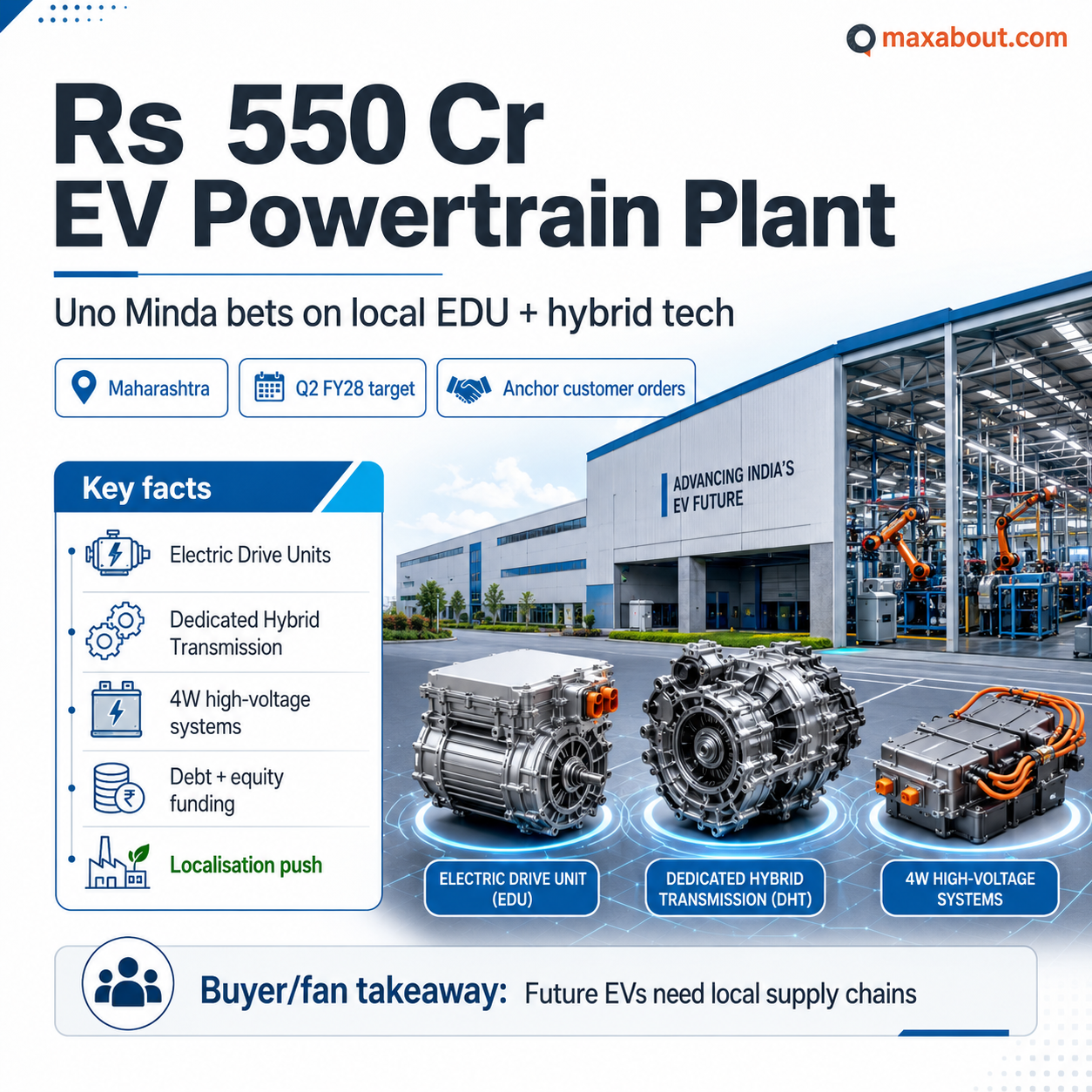
Uno Minda's board has officially approved a ₹550 crore investment to build a brand-new manufacturing plant in Maharashtra, specifically focused on powertrain systems for four-wheeler electric vehicles. That's a significant number, and honestly, it's the kind of announcement that deserves more attent...
Editorial Team
Uno Minda's board has officially approved a ₹550 crore investment to build a brand-new manufacturing plant in Maharashtra, specifically focused on powertrain systems for four-wheeler electric vehicles. That's a significant number, and honestly, it's the kind of announcement that deserves more attention than it's getting.
Here's why this matters. India's EV space is growing fast — there's genuine excitement around electric cars right now. But scratch beneath the surface, and a lot of that momentum still depends on imported components, particularly when it comes to powertrain technology. Motors, inverters, transmission units — the core systems that actually make an electric car move — largely come from outside India. That dependency has quietly been a weak link in the whole "Make in India EV" story.
When we talk about a powertrain system, think of it simply as everything responsible for generating power and delivering it to the wheels. In an electric car, that's essentially the heart of the vehicle. Getting that manufactured domestically, at scale, changes the equation around cost, supply chain reliability, and long-term serviceability.
Uno Minda isn't a newcomer here — they're an established auto components supplier with real industry credibility. So this isn't just ambition on paper. This plant could genuinely influence what the next generation of affordable, reliable electric cars looks like for Indian buyers.
What Exactly Is an EV Powertrain and Why Should You Care
Think of an EV powertrain as everything that takes electricity from the battery and converts it into actual movement. It sounds simple, but there's a lot happening under that hood — or under the floor, more accurately.
The core players are the electric motor, the inverter, and supporting power electronics. The motor does the obvious job — spinning the wheels. The inverter is arguably just as important. It converts the battery's direct current into alternating current that the motor can actually use, and how efficiently it does that job directly determines your real-world range.
 This matters enormously on Indian roads. Crawling through Bengaluru's evening traffic is a completely different electrical load than cruising at 110 kmph on the Mumbai-Pune Expressway. A well-engineered powertrain manages both scenarios efficiently. A poorly designed one bleeds energy and leaves you watching the range drop faster than expected.
Potholed stretches in cities like Nagpur or Lucknow add another layer — vibrations and thermal stress that cheaper components simply handle worse over time. Component quality directly affects long-term reliability, which translates to real ownership costs. Fewer failures, lower repair bills, better resale confidence. For anyone seriously evaluating an EV purchase, the powertrain quality isn't just a spec-sheet detail — it's genuinely the difference between a satisfying ownership experience and an expensive regret.
Uno Minda's Position in India's Auto Components Landscape
When a company like Uno Minda makes a move this significant, it helps to understand exactly who they are and why this matters. This isn't some startup chasing EV money — Uno Minda is one of India's most established Tier-1 auto component suppliers, with decades of manufacturing experience and relationships baked deep into the country's automotive supply chain.
The company's existing portfolio is genuinely broad. Lighting systems, switches, sensors, acoustics, alloy wheels, and safety components — they supply across categories that touch nearly every vehicle segment. Their client list reads like a who's who of Indian automotive manufacturing, covering major passenger vehicle and two-wheeler OEMs operating across the country. That kind of embedded relationship with manufacturers doesn't happen overnight.
So when their existing OEM partners began accelerating electrification plans, Uno Minda faced a straightforward strategic question: evolve or risk becoming less relevant. Expanding into EV powertrain systems is a calculated response, not a reactive scramble. Industry reports indicate the company has maintained a strong expansion trajectory in recent years, with consistent revenue growth reflecting broader demand for localized component manufacturing.
That credibility matters here. Executing a ₹550 crore plant successfully requires engineering depth, supply chain muscle, and OEM trust — all things Uno Minda has already demonstrated across its existing operations.
Why Maharashtra and Why Now: The Strategic Timing of This Plant
Location decisions in manufacturing rarely happen by accident. Maharashtra makes obvious sense here — and not just because it's a large state. Pune and Nashik together form one of India's most established automotive corridors, with decades of supplier ecosystems, tooling expertise, and OEM relationships already embedded in the region. Setting up a powertrain facility close to that infrastructure isn't just convenient — it's genuinely efficient.
The state government's EV-friendly policy framework adds another layer. Maharashtra has actively positioned itself as a preferred destination for electric mobility investments, offering incentives that meaningfully improve the financial case for large capital commitments like this one.
Then there's the national picture. India's PLI scheme for automotive components was specifically designed to encourage exactly this kind of domestic supply chain investment — reducing import dependency for critical EV components while building local manufacturing depth. Uno Minda's plant fits neatly into that policy logic.
The timing also aligns with something real in the market. Multiple new passenger EVs from established players are expected within the next two to three years. A domestic powertrain supplier coming online around that window could find itself well-positioned to serve rising OEM demand.
That said, plant commissioning takes time. The benefits here won't be immediate — production ramp-ups, quality validation, and OEM approvals all add lead time. This is a medium-term play, not a short-term win.
How This Could Impact EV Pricing and Availability in India
This is the part that actually matters to anyone considering an electric car purchase. Right now, a significant portion of EV powertrain components — motors, power electronics, battery management systems — are either imported directly or assembled using heavily imported parts. That import dependency quietly adds cost at every step, and it also introduces uncertainty into delivery timelines that buyers rarely see coming.
If Uno Minda scales this Maharashtra facility successfully and OEMs begin sourcing locally, the cost structure of electric vehicles could improve over time. Domestic procurement typically reduces logistics costs, import duties, and currency fluctuation risks. In theory, some of those savings could flow downstream to the customer. But I want to be honest here — that's not guaranteed. Whether manufacturers actually pass on savings or absorb them as margin is entirely their decision, and history suggests it often goes the latter way.
There's also something beyond pricing worth considering. The COVID years exposed just how fragile global supply chains really are. Plants shut down, shipments stalled, and vehicle launches were delayed for reasons completely outside anyone's local control. A domestic source of critical powertrain components has genuine strategic value — not just for cost, but for supply chain resilience that keeps production lines moving regardless of what's happening globally.
For Indian buyers, that resilience could translate into shorter waiting periods and more predictable availability — which, frankly, has been a real frustration in the EV segment so far.
Challenges Uno Minda Will Face Scaling EV Powertrain Production
That said, let's be honest about what lies ahead. Strategic intent and actual execution are very different things, and EV powertrain manufacturing is genuinely complex territory.
The competition alone is formidable. Established global suppliers — companies with years of dedicated EV powertrain development behind them — already hold meaningful technology advantages. Closing that gap requires more than capital. It requires deep engineering capability, validated processes, and time. Uno Minda has a solid track record in conventional auto components, but powertrain systems demand a different level of precision engineering that isn't simply transferred from existing operations.
Then there's the workforce question. Building a skilled team that understands motor controllers, power electronics, and thermal management systems isn't straightforward in India's current talent landscape. This takes deliberate investment in training and, frankly, patience.
The volume reality also deserves mention. Indian four-wheeler EV numbers, while growing steadily, remain modest compared to markets where global suppliers have refined their manufacturing at real scale. Lower volumes make it harder to justify certain fixed costs and achieve the efficiency that drives quality consistency.
And ₹550 crore, while a serious commitment, is a moderate investment for a full-scale powertrain facility. Execution quality will matter enormously — how the money is deployed, which technology partnerships are secured, and how rigorously OEM quality benchmarks are met from day one.
What This Means for the Broader Indian EV Supply Chain Ecosystem
Uno Minda isn't moving in isolation here. Across the sector, component suppliers — from battery management system makers to thermal management specialists — are quietly expanding domestic capacity. The overall direction is unmistakable: Indian EVs are gradually being built with more Indian content. That shift matters more than any single investment announcement.
A stronger local supply chain creates compounding benefits. For OEMs, it means better supply security, faster iteration cycles, and easier collaboration on India-specific adaptations — whether that's tuning powertrains for stop-and-go urban traffic or managing heat dissipation in extreme summer conditions. Reduced dependence on imports also means less foreign exchange exposure, which becomes significant when the rupee weakens.
For consumers, the long-term promise is gradual cost reduction. Domestic manufacturing at scale lowers logistics costs and import duties in the component chain — savings that can eventually flow into vehicle pricing, even if that takes time.
China's EV dominance wasn't built on vehicle brands alone. It was built on an extraordinarily deep supplier ecosystem developed over years of deliberate policy and investment. India won't replicate that scale, but a proportionate version of that logic applies here. Progress is real, even if the road remains long.
Final Thoughts: A Promising Step, But the Real Test Is Execution
So where does this leave us? Honestly, somewhere between cautious optimism and patient skepticism — which is probably the right place to be.
Uno Minda's ₹550 crore commitment is meaningful, not symbolic. This isn't a press release dressed up as strategy. A dedicated Maharashtra facility for four-wheeler EV powertrain systems signals genuine conviction that domestic EV demand will sustain serious manufacturing volumes. That matters.
But announcements and operational plants are very different things. Execution — timelines, OEM partnerships, consistent quality at scale — is where these stories succeed or fall apart. India has seen ambitious manufacturing plans lose momentum before.
What I'd watch closely: which OEMs sign supply agreements with Uno Minda, when the plant actually commissions, and whether a second investment round follows within two to three years. Those signals will tell you far more than today's headlines.
If you're planning an EV purchase in the next few years, this story genuinely affects you — not immediately, but in terms of long-term pricing, service reliability, and component availability. A stronger supplier base eventually means better-value vehicles. That's worth tracking.
No comments yet
Be the first to share your thoughts!
Want to read more automotive news?
Stay updated with the latest car launches, reviews, and industry insights.
Browse All News