
Ultraviolette & Bolt.Earth Hit 130 Type-6 DC Fast Chargers
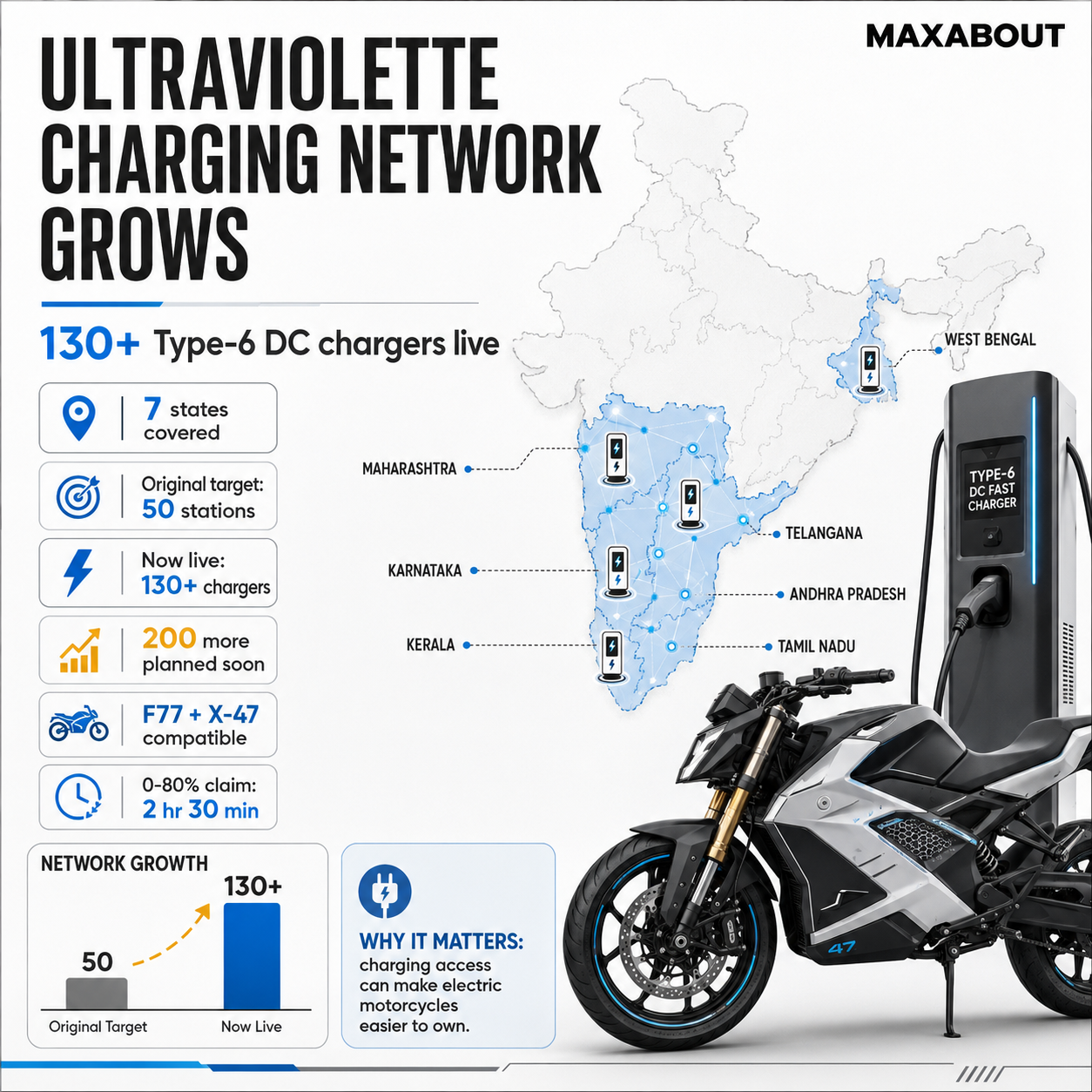
One thirty. That number might not sound dramatic at first, but in the context of India's EV charging landscape, crossing 130 Type-6 DC fast chargers is actually a meaningful step forward. Ultraviolette and Bolt.Earth have quietly hit this milestone together, and I think it deserves more attention th...
Editorial Team
One thirty. That number might not sound dramatic at first, but in the context of India's EV charging landscape, crossing 130 Type-6 DC fast chargers is actually a meaningful step forward. Ultraviolette and Bolt.Earth have quietly hit this milestone together, and I think it deserves more attention than it's getting.
For anyone who has seriously considered buying a premium electric two-wheeler in India, the conversation almost always circles back to the same concern — where do I charge it when I'm away from home? That anxiety is real. It has stopped more than a few potential buyers from making the switch, regardless of how impressive the bike itself looks on paper.
This partnership makes sense when you think about it. Ultraviolette builds high-performance electric motorcycles aimed at riders who actually push their machines. Bolt.Earth brings a growing fast-charging network to the table. Together, they are trying to solve the infrastructure problem that has held back serious EV adoption in this segment.
Is 130 chargers enough? Honestly, no. Not yet. India is a vast country, and coverage across tier-2 cities, highways connecting Chennai to Bengaluru, or routes through central India remains thin. But the direction is right, and momentum in charging infrastructure tends to build on itself once it starts moving.
What Exactly Is a Type-6 DC Fast Charger and Why Does It Matter
If you have spent any time reading about EV charging in India, you have probably seen terms like CCS2 and CHAdeMO thrown around. Those standards are built for four-wheelers. Type-6 is different — it is the DC fast charging standard designed specifically for electric two-wheelers in India. Think of it as the right plug for the right vehicle.
In plain terms, a DC fast charger skips the onboard converter in your vehicle and pushes direct current straight into the battery. That is what makes it significantly faster than the AC charger you plug in at home overnight.
On a standard home AC charger, getting an Ultraviolette F77 from nearly empty to full can take anywhere from four to five hours. On a Type-6 DC fast charger, that same job is done in roughly 60 to 75 minutes. For a quick top-up — say 20 to 80 percent — you are looking at under 45 minutes in practical conditions.
Now connect that to real life. Imagine you are riding out of Pune toward Satara and your battery drops unexpectedly. Or you are commuting across Bengaluru during peak hours and realize you cannot make it back home. A fast charger nearby changes everything. It turns a stressful situation into a short break rather than a full afternoon problem.
That practical difference — between waiting five hours and waiting one — is exactly why Type-6 infrastructure expansion actually matters to everyday riders.
Where Are These Chargers Located Across India
Right now, if you look at the geographic spread of these 130-plus chargers, the honest answer is that coverage remains largely urban-centric. According to official announcements from both Ultraviolette and Bolt.Earth, the strongest concentration sits across Bengaluru, Hyderabad, Mumbai, Pune, Delhi, and Chennai. That is not surprising — these cities have the highest density of electric two-wheeler owners, so it makes commercial sense to start there.
For intercity riders, there is some encouraging progress. The Bengaluru to Mysuru corridor has seen improved coverage, which is genuinely useful given how popular that stretch is for weekend rides. Similarly, the Mumbai-Pune Expressway route now has more accessible fast-charging options than it did even a year ago, based on recent industry reports.
That said, Tier-2 cities and rural highway corridors are still thin on coverage. If you are planning a longer run — say, Hyderabad toward Vijayawada or Delhi toward Jaipur — you will want to plan carefully rather than assume a charger will appear when needed.
For daily urban commuters, though, this network already offers real peace of mind. The gaps that remain are real, but the direction of expansion looks promising.
What This Means for Current and Prospective Ultraviolette F77 Owners
The F77 is a genuinely exciting machine on paper. Claimed range figures look strong, and the performance numbers are hard to argue with. But if you spend time reading real owner feedback and long-term reviews, a consistent concern surfaces — real-world range in dense city traffic falls noticeably short of those claimed figures. Stop-and-go conditions in Bengaluru or Pune, frequent braking, and sustained low speeds all take a toll. Some riders report figures that feel considerably more modest than what Ultraviolette advertises.
That gap between claimed and real-world range is exactly where fast charging infrastructure starts to matter. Knowing there is a Type-6 DC charger within reasonable distance changes how confidently you ride. Instead of mentally rationing every kilometre, you can simply top up quickly and continue.
Ultraviolette does offer a charging locator through their app, which lets you identify nearby Bolt.Earth stations before heading out. From what users have reported, the experience is reasonably straightforward. Not perfect, but functional enough for daily planning.
For prospective buyers who have been hesitating specifically over charging access — 130 fast chargers across major cities is a meaningful shift. It does not eliminate every concern, but it makes the ownership proposition considerably more practical than it was before.
Bolt.Earth's Role in Building India's Two-Wheeler Charging Network
Bolt.Earth is not a company that arrived specifically for Ultraviolette. They have been quietly building one of India's larger EV charging networks across workplaces, residential apartments, and public spaces for a few years now. Their broader strategy has always been about dense, accessible charging points rather than high-profile highway corridors — which makes them a genuinely interesting partner for urban two-wheeler infrastructure.
The honest reality is that four-wheeler DC fast charging has received disproportionate attention in India. Tata, MG, and Ather's own grid get discussed constantly. Two-wheeler fast charging — particularly Type-6 — has remained relatively underserved. Most public chargers you encounter are slow AC units, fine overnight but useless when you need a quick top-up mid-day.
On the business model side, based on official announcements, Bolt.Earth operates primarily on a pay-per-use basis at public locations. Ultraviolette owners access the network through the F77's companion app, with session costs billed per unit consumed. There is no indication of a blanket free-charging benefit — which is arguably more sustainable long-term than loss-leader free charging models.
For workplaces and apartment installations, Bolt.Earth typically works on a B2B arrangement with property managers setting access terms. That means charging costs can vary depending on where you plug in.
The Bigger Picture: Is India's EV Charging Infrastructure Finally Getting Serious?
Step back from the specifics of this partnership and ask a more fundamental question: where does India actually stand on EV charging infrastructure? The honest answer is — better than two years ago, but still far behind where it needs to be.
The government's FAME II scheme allocated significant funds toward public charging stations, yet real-world deployment has been patchy. Urban centers like Bengaluru, Pune, and Delhi have seen reasonable progress. Smaller cities and highways? Still largely underserved. That gap is exactly where private players like Bolt.Earth have found their opening.
130 fast chargers sounds impressive as a headline, but across a country of India's scale, it remains modest. To put it in perspective, petrol stations number in the hundreds of thousands. The infrastructure deficit is enormous. Acknowledging that honestly matters, because overpromising is precisely what erodes buyer confidence.
There is also a cultural dimension to range anxiety that often gets overlooked. For Indian buyers, the fear is not purely technical — it is deeply psychological. Decades of fuel station familiarity have conditioned people to expect convenience on demand. Charging infrastructure has to work harder to overcome that ingrained expectation.
The two-wheeler EV ecosystem is also developing differently from the four-wheeler side. Cars have seen broader charging investment, partly driven by higher transaction values and corporate fleet adoption. Two-wheelers are only now catching serious attention from infrastructure providers.
Milestones like this 130-charger network matter not because they solve everything, but because they signal direction. Confidence is built incrementally.
Challenges That Still Need to Be Solved Before EV Two-Wheelers Go Mainstream
Acknowledging progress honestly also means acknowledging what is still broken. And quite a few things are.
Charger uptime is a persistent problem. Anyone who has used Indian public charging infrastructure regularly will tell you that finding a charger listed on an app and finding one that actually works are two different experiences. Maintenance response times are slow, vandalism happens, and software glitches can lock out a perfectly functional unit. Until uptime reliability crosses a credible threshold, range anxiety does not disappear — it just shifts into charger anxiety.
Then there is the standardization gap. These Type-6 fast chargers are built around Ultraviolette's ecosystem. If you ride a different electric two-wheeler brand, this network simply does not serve you. The Indian EV two-wheeler market has multiple players, and the absence of a universal fast-charging standard means infrastructure investment stays fragmented. That is a real structural problem buyers should think about before committing.
The cost equation also deserves scrutiny. Fast charging is noticeably more expensive per unit than home charging overnight. For daily commuters, the economics of home charging make obvious sense. But for someone without a dedicated parking spot or a stable power connection — which describes a large portion of urban renters — that home charging advantage simply does not exist.
Rural and semi-urban India remains almost entirely underserved. The 130-charger milestone is concentrated around accessible urban corridors. A buyer in a smaller town still has very limited support infrastructure around them.
Finally, trained EV service technicians are genuinely scarce. Traditional mechanics are not equipped to handle battery management systems or motor diagnostics. That gap creates real anxiety around long-term ownership costs and breakdown situations.
Final Thoughts: Is This Milestone Enough to Change Your Mind?
Honestly? It moves the needle. But not enough to make the decision easy.
The Ultraviolette and Bolt.Earth partnership crossing 130 Type-6 DC fast chargers is a genuinely meaningful step forward. A year ago, this kind of dedicated fast-charging coverage for electric two-wheelers barely existed. Progress is real and it deserves acknowledgment.
But if you are sitting on the fence about buying an F77 or any premium electric two-wheeler, infrastructure is only one piece of the puzzle. The pricing remains steep, after-sales service is still a question mark in many cities, and resale value for electric two-wheelers is largely uncharted territory in India. Those concerns do not disappear because of 130 chargers.
From what I have seen and read, daily urban commuters in well-covered cities like Bengaluru or Pune are the ones who genuinely benefit right now. For everyone else, patience still makes sense.
That said, if this expansion pace holds over the next two to three years, the picture changes considerably. Wider coverage, more trained technicians, and maturing resale markets could together make the premium electric two-wheeler a genuinely compelling everyday choice — not just an aspirational one.
We are not there yet. But the direction is right.
Explore the story
Related news
Share your view and join the discussion.
Earn reward points for every comment and get a chance to win ₹1,000 in our weekly lucky draw. Sign in with Google in one tap.
Start the conversation
No one has commented on this article yet. Be the first to share your view.
Want to read more automotive news?
Stay updated with the latest car launches, reviews, and industry insights.
Browse All News