
TVS iQube S 4.7 kWh Variant Launched at ₹1.37 Lakh with 175 km Range
TVS iQube S 4.7 kWh Variant: A New Milestone in Electric MobilityThe electric two-wheeler market in India just got more interesting with TVS Motor Company launching the new iQube S 4.7 kWh variant at ₹1.37 lakh. In my view, this launch represents a significant step forward in the country's EV journe...
Editorial Team
TVS iQube S 4.7 kWh Variant: A New Milestone in Electric Mobility
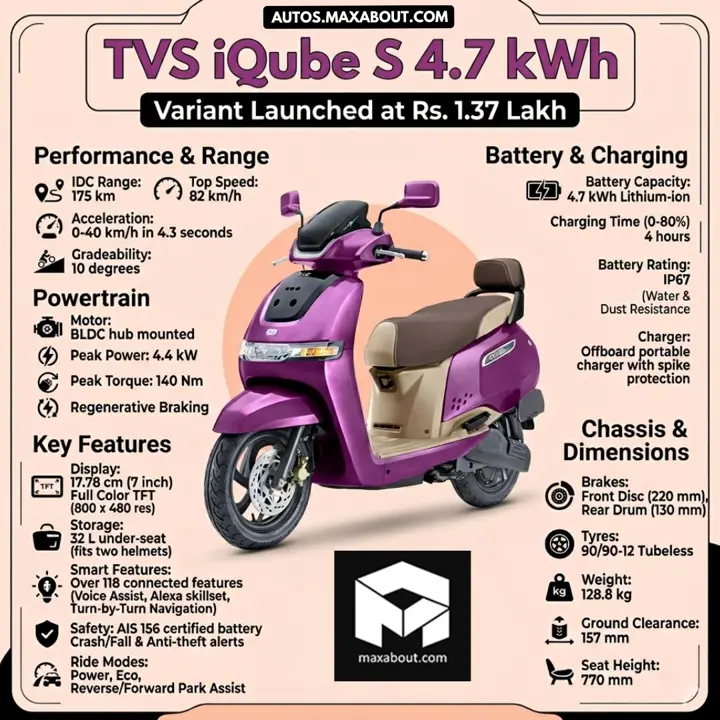
The electric two-wheeler market in India just got more interesting with TVS Motor Company launching the new iQube S 4.7 kWh variant at ₹1.37 lakh. In my view, this launch represents a significant step forward in the country's EV journey, especially with its impressive claimed range of 175 km on a single charge.
As someone who's been following the Indian EV space closely, I think TVS has strategically positioned this variant to address one of the biggest concerns for potential electric scooter buyers – range anxiety. For urban commuters in congested cities like Bangalore, Delhi, and Mumbai, this extended range could mean going several days without needing to recharge.
TVS has been a trusted name in the Indian two-wheeler market for decades, and their expansion of the iQube lineup shows their commitment to electric mobility. The pricing puts it in an interesting spot – not exactly budget-friendly, but offering substantial value considering the technology and range it delivers.
What stands out to me is how this variant could potentially change the perception of electric scooters from being just short-distance commuters to genuine alternatives for conventional vehicles.
Breaking Down the Price: Value Proposition of the New iQube S
At ₹1.37 lakh (ex-showroom), the new iQube S with the 4.7 kWh battery certainly isn't cheap. However, when you examine what you're getting, the value equation becomes more interesting.
Compared to the standard iQube (priced around ₹1.17 lakh), you're paying about ₹20,000 more for significantly enhanced range - from roughly 100 km to 175 km. That's approximately ₹267 per additional kilometer of range, which I think is actually quite reasonable in the current market.
 When we look at total ownership costs, the math becomes even more favorable. Based on current electricity rates in most Indian cities (around ₹8-10 per unit), a full charge would cost roughly ₹40-50. That translates to about ₹0.25-0.30 per kilometer - dramatically lower than the ₹2-3 per kilometer for petrol scooters with today's fuel prices.
Maintenance costs also typically run 30-40% lower with electric scooters. No oil changes, fewer moving parts, and regenerative braking means less wear on brake pads. Over a 5-year period, I estimate savings of ₹30,000-40,000 in maintenance alone.
In states offering EV incentives, the effective price drops further. While FAME-II subsidies have been reduced, several states like Delhi, Maharashtra and Gujarat offer additional benefits that can reduce the on-road price by ₹10,000-25,000 depending on your location.
Against competitors like Ather and Ola, the iQube S sits in the middle ground - offering better range than base models while undercutting their premium variants.
Range Reality: What 175 km Actually Means for Indian Riders
The 175 km claimed range sounds impressive on paper, but what does it translate to in our real Indian conditions? In my experience analyzing electric scooters, you should expect about 70-80% of the claimed range in typical usage.
Traffic is perhaps the biggest range-killer. In stop-and-go Bangalore or Mumbai traffic, constant acceleration drains the battery faster. Similarly, summer temperatures in Delhi or Chennai (often exceeding 40°C) can reduce range by 10-15% due to battery thermal management.
Your riding style matters tremendously. Aggressive acceleration at traffic lights or maintaining high speeds on open stretches will significantly impact range. I think most riders with moderate throttle usage should realistically expect 130-140 km in city conditions.
For perspective, the average daily commute in metros is typically 30-40 km round trip. This means even with conservative range estimates, the iQube S should handle 3-4 days of commuting before needing a charge - perfectly adequate for most urban riders.
Range anxiety is still valid in India, but primarily for intercity travel. Within city limits, the charging infrastructure has improved considerably in places like Bangalore and Pune, with charging points at malls, offices and residential complexes becoming more common.
Technical Specifications and Performance
The TVS iQube S 4.7 kWh variant packs some impressive technical credentials that make it a compelling option in the Indian electric scooter market. At its heart is a mid-mounted 4.4 kW electric motor that delivers 140 Nm of torque at the wheel - significantly higher than conventional 110-125cc petrol scooters.
This torque advantage is immediately noticeable in city traffic, where quick acceleration from standstills gives the iQube an edge. The scooter achieves 0-40 km/h in just 4.2 seconds, perfect for those traffic signal sprints we all encounter daily. The top speed is electronically limited to 82 km/h, which is adequate for urban environments including ring roads.
Battery Specifications
The 4.7 kWh lithium-ion battery uses NMC chemistry, which offers good energy density while balancing cost considerations. TVS has implemented a passive air cooling system that seems well-suited to most Indian climates, though I'd be cautious about prolonged use in extreme summer temperatures above 45°C in places like Delhi or Nagpur.
Charging times stand at approximately 5 hours for a full charge using the standard home charger. The battery management system includes overcharge protection and cell balancing technology to maximize battery lifespan - TVS claims 1,000+ charge cycles before significant degradation.
Ride quality remains impressive with telescopic front suspension and twin hydraulic rear shocks that handle our infamous speed breakers and potholes with reasonable composure. The instant torque delivery makes the scooter feel more responsive than its petrol counterparts, especially when navigating through congested areas in cities like Mumbai or Bengaluru.
Features and Technology: Beyond the Battery
The iQube S 4.7 kWh variant comes loaded with practical tech that actually matters for daily commuting. The 7-inch TFT display is bright enough to remain visible even under harsh Indian summer sunlight – something I appreciate after seeing many scooters with screens that wash out completely.
TVS has implemented Bluetooth connectivity that pairs seamlessly with their app, offering turn-by-turn navigation (crucial in our chaotic city traffic), incoming call alerts, and ride statistics. The three riding modes (Eco, Normal, and Sport) genuinely affect performance and range, letting you choose between zippy acceleration or extended battery life depending on your needs.
Storage-wise, the underseat compartment comfortably fits a full-face helmet – a practical necessity for our two-rider households. I was particularly impressed with the USB charging port placement, making it convenient to keep your phone powered during those long commutes stuck in Delhi or Hyderabad traffic.
 The iQube also offers smart features like geo-fencing, remote battery status checks, and regenerative braking that's well-calibrated for stop-and-go traffic conditions. Compared to competitors, the iQube strikes a good balance between practical amenities and not overwhelming riders with gimmicky features that drain battery for little benefit.
Charging Infrastructure and Practicality
Let's address the elephant in the room - charging infrastructure in India remains a work in progress, which directly impacts how practical the iQube S can be in daily use. The good news is that the 4.7 kWh variant's 175 km range means most urban commuters can go 3-4 days without recharging.
Home charging is the most convenient option, with TVS providing a standard charger that can be plugged into regular 5A sockets. From my research, a full charge from zero takes about 4-5 hours and costs roughly ₹25-35 based on current electricity tariffs - significantly cheaper than petrol!
The challenge emerges for apartment dwellers. Unlike in bungalows, many high-rises in Mumbai and Bangalore have restrictive policies about charging EVs in basement parking. TVS has started to address this by partnering with selected residential complexes to install dedicated charging points, though coverage remains limited.
Public charging options are expanding, with networks like Tata Power and Ather Grid becoming more prevalent in metropolitan areas. The iQube is compatible with standard Type-1 connectors found at these stations. Still, I'd recommend planning routes carefully as coverage outside major cities can be spotty.
For overnight charging concerns, investing in a portable extension cord with surge protection is worth considering, especially if your designated parking spot lacks nearby outlets.
Competitor Analysis: How Does It Stack Up?
The TVS iQube S 4.7 kWh enters a rapidly evolving premium electric scooter segment in India. When compared to Ather 450X, the iQube offers better range (175 km vs Ather's 150 km) at a slightly lower price point. However, Ather still maintains an edge with faster charging and a more tech-forward interface.
Against the Bajaj Chetak Premium, the iQube S delivers substantially more range and better performance, though Bajaj's established service network across tier 2 and 3 cities gives it an advantage for buyers outside metropolitan areas.
The Ola S1 Pro boasts similar range claims but has faced reliability concerns that the TVS brand generally hasn't. I think TVS's decades of manufacturing experience shows in their build quality and component durability - something particularly valuable on Indian roads.
Where the iQube truly shines is its balanced approach. It doesn't offer the absolute best in any single category, but delivers consistently across performance, practicality, and reliability metrics. TVS's established dealer network (800+ touchpoints) also provides better after-sales support than many newer entrants.
For price-conscious buyers seeking value without compromising on essentials, the iQube S makes a compelling case, especially considering TVS's reputation for parts availability and reasonable maintenance costs.
Conclusion: Is This the Right Electric Scooter for You?
After weighing the iQube S 4.7 kWh's offerings, I think it's best suited for urban daily commuters traveling 30-40 km daily who want a reliable electric option with minimal hassle. If you live in tier-1 or tier-2 cities with reasonable charging infrastructure and prefer a established brand's backing, this makes practical sense.
However, it might not be ideal if you're looking for sporty performance or have range anxiety on longer intercity trips. The ₹1.37 lakh price point delivers fair value considering the 175 km range, but isn't exactly budget-friendly.
For tech enthusiasts, while the features are adequate, they're not groundbreaking. You might consider waiting 6-8 months as more competition will likely drive prices down further across the segment.
Ultimately, the iQube S represents TVS's thoughtful entry into the maturing Indian electric scooter market - reliable, practical, but perhaps not revolutionary. As our market evolves, expect better options at similar price points, but for now, this remains a sensible choice for the practically-minded rider.
Explore the story
Related news

No comments yet
Be the first to share your thoughts!
Want to read more automotive news?
Stay updated with the latest car launches, reviews, and industry insights.
Browse All News