
Toyota Starlet Zero-Star Safety Rating Explained
Toyota Starlet's Zero-Star Safety Rating: What Indian Buyers Need to KnowSafety used to be an afterthought for most car buyers in India. Not anymore. Over the past few years, crash test results have started influencing purchase decisions in ways that even manufacturers did not anticipate. And the re...
Editorial Team
Toyota Starlet's Zero-Star Safety Rating: What Indian Buyers Need to Know
Safety used to be an afterthought for most car buyers in India. Not anymore. Over the past few years, crash test results have started influencing purchase decisions in ways that even manufacturers did not anticipate. And the recent zero-star safety rating awarded to the Toyota Starlet is exactly the kind of result that demands attention — not panic, but serious consideration.
The Starlet, a budget-oriented hatchback sold in select markets, was assessed by Global NCAP, one of the most recognised independent vehicle safety testing organisations globally. A zero-star result is about as stark as it gets. It does not simply mean the car performed poorly — it means the vehicle offered minimal meaningful protection to occupants during a frontal crash scenario.
In plain terms: if a serious collision occurs, the car's structure may not adequately shield the people inside it.
Why does this matter to Indian buyers specifically? Because budget hatchbacks remain among the highest-selling segments here, and safety is increasingly part of that conversation. Buyers today are asking the right questions before signing on the dotted line — and this result gives everyone reason to pause and think carefully.
Understanding the Crash Test: What Exactly Happened
The Toyota Starlet was evaluated under the Global New Car Assessment Programme (Global NCAP) — one of the more credible independent crash testing bodies that regularly tests cars sold in emerging markets, including Africa and South Asia.
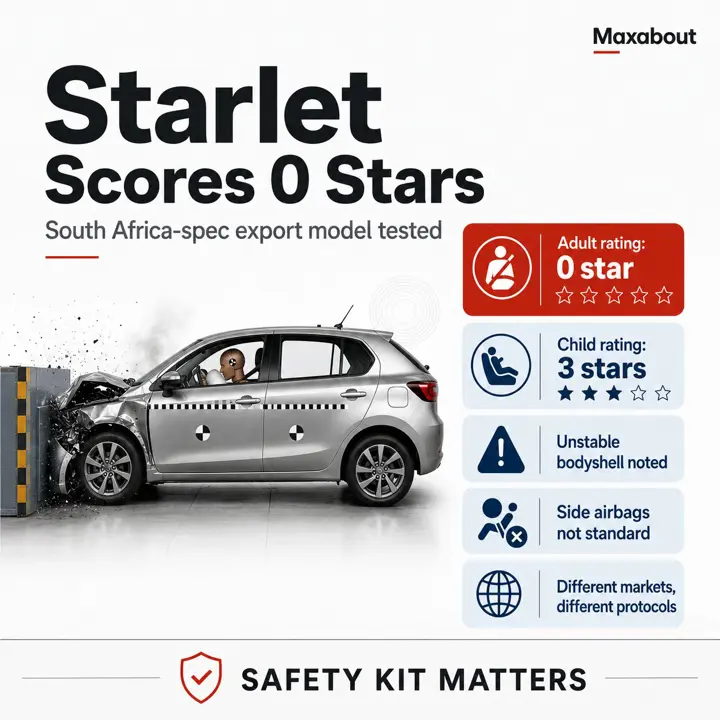 The results were not close. This was not a borderline one-star or two-star outcome. The Starlet scored zero stars for adult occupant protection and zero stars for child occupant protection. Across the board, the numbers were deeply concerning.
So what actually went wrong during testing? A few things stand out clearly:
Body shell integrity was rated as unstable — meaning the passenger cabin itself showed signs of significant deformation during the frontal offset impact
No airbags were present in the tested variant, leaving occupants with zero passive restraint beyond seatbelts
Safety assist features — things like electronic stability control — were absent entirely
Child protection scores were similarly poor, with test dummies showing inadequate protection levels
In simple terms, a zero-star result means the car structurally fails to protect you in a serious impact. It is not just about missing features — the shell itself is the problem.
Is the Toyota Starlet Sold in India? Understanding the Market Context
To be straightforward about this — the Toyota Starlet is not sold in India. It is not available at any Toyota dealership here, and there are no official announcements suggesting it is headed to the Indian market anytime soon. The Starlet is primarily sold in certain African markets, including Uganda, Kenya, and Tanzania, along with some other emerging economies where ultra-budget personal mobility is the priority.
So why should Indian readers care? A few reasons, actually.
First, this result reveals something important about how global automakers think about budget segments. When cost pressure is extreme, safety engineering sometimes takes the hit. India is itself a cost-sensitive market, and understanding that dynamic matters — especially as more affordable cars enter the segment here.
Second, grey imports are a reality. Buyers in border regions or neighboring countries sometimes source vehicles through informal channels, and awareness of results like this is genuinely useful.
Third — and this is the bigger picture — India's own Bharat NCAP framework is still finding its footing. Watching international results, even for vehicles sold elsewhere, helps calibrate expectations and keeps pressure on manufacturers to not engineer safety differently based on geography.
From what industry observers have noted, the Starlet result is a reminder that a trusted badge does not automatically guarantee structural protection.
The Bigger Problem: Budget Cars and the Safety Compromise
The Starlet result is disappointing, but it is not surprising. Not really. Because if you look at the broader pattern of safety testing across affordable vehicles, a troubling picture emerges — one that goes well beyond any single model or brand.
Several cars in the ₹5 lakh to ₹10 lakh segment have historically performed poorly in independent crash assessments. Some have scored zero stars. Others have managed one or two, which sounds better until you realise what that actually means for occupant survival in a serious collision.
The argument from manufacturers is almost always the same: buyers at this price point prioritise running costs and reliability over safety ratings. And honestly, there is some economic truth to that. For a family stretching their budget just to afford personal mobility, an airbag or a reinforced cabin structure may feel like a luxury concern.
But here is where that reasoning starts to fall apart. Renault and Dacia have produced budget-positioned vehicles that achieved credible safety scores. Tata, closer to home, demonstrated with the Punch and Nexon that affordable does not have to mean structurally compromised. The engineering solutions exist. The decision to apply them — or not — is largely commercial.
That is the uncomfortable truth. Weak safety in budget cars is rarely an engineering impossibility. It is often a cost calculation. And when that calculation repeatedly disadvantages buyers who have the least resources to absorb the consequences of a serious accident, the ethical weight of that choice becomes very hard to ignore.
What This Means for Toyota's Brand Reputation in India
Toyota has spent decades building something genuinely valuable in the Indian market — trust. The Fortuner is aspirational. The Innova Crysta is practically a household name. The Urban Cruiser Hyryder has brought hybrid technology to a more accessible price point. When Indians think Toyota, they broadly think reliable, well-built, worth the premium. That reputation did not come cheap or fast.
So a zero-star result on a Toyota-badged vehicle — even one not sold here — creates a quiet but real problem. Brand perception rarely respects geographical boundaries, especially in an era where safety ratings circulate instantly online. Indian consumers researching Toyota models will encounter this result. And not everyone will pause to read the fine print about which market the Starlet was tested for.
There is another layer worth considering. Toyota in India operates partly through its partnership with Maruti Suzuki, selling rebadged versions of Maruti platforms — the Glanza, the Urban Cruiser. These cars carry Toyota branding but are fundamentally Maruti products. From what industry observers have noted, buyers often purchase these specifically because of the Toyota badge, expecting a certain quality assurance that comes with it.
That expectation creates a fragile situation. When any Toyota-badged product globally underperforms on safety, it raises uncomfortable questions about how much that badge actually guarantees. Indian buyers may not always distinguish between a budget Starlet built for an African market and a Fortuner engineered for global standards. The badge reads the same.
How Indian Buyers Should Evaluate Car Safety Before Purchasing
So if the badge alone cannot be trusted blindly, what should you actually look for? This is where most buyers need a genuine reality check.
Start with crash test ratings — specifically Global NCAP and Bharat NCAP results. India now has its own crash testing program, which means manufacturers can no longer hide behind region-specific excuses. If a car has been tested, that data is publicly available through official announcements and industry reports. A zero-star or one-star result is not a minor footnote. It is a structural verdict.
At minimum, any car you consider should offer:
At least four airbags — front and side curtain coverage
ABS with EBD as standard fitment, not an optional upgrade
Electronic Stability Control, especially for highway driving
ISOFIX child seat anchors if you have young children
A rigid body structure that does not crumple disproportionately on impact
Here is what concerns me honestly — many buyers will spend hours debating sunroof size or touchscreen resolution, then accept a car with two airbags and no ESC without a second thought. That trade-off feels harmless until you are navigating a rain-soaked expressway outside Pune at night, with trucks overtaking unpredictably.
Indian roads are genuinely demanding. High-speed national highways, chaotic city intersections, and constant two-wheeler interactions create a uniquely complex risk environment. Passive safety features matter more here, not less. When an accident happens — and statistically, India's road fatality numbers are sobering — a structurally sound cabin is the last line of defense. No sunroof compensates for that.
The Road Ahead: Can Budget Cars Be Safe and Affordable?
The short answer is yes — and we already have proof. The Tata Punch earned a five-star Global NCAP rating at a price point that competes directly with cars like the Starlet. The Tata Nexon did it before that. These are not premium vehicles. They are mass-market products bought by ordinary families. So the argument that safety is a luxury reserved for expensive cars simply does not hold up anymore.
India's regulatory environment is also tightening, which is encouraging. Mandatory dual airbags and ABS are now baseline requirements. Bharat NCAP, launched to bring crash testing closer to Indian road and occupant conditions, is pushing manufacturers to take structural integrity seriously rather than treating it as optional. This is genuine progress.
But progress is uneven. Some manufacturers are responding. Others are still banking on brand reputation to do the selling — and that is exactly where buyers get hurt. A trusted badge on the bonnet does not mean the cabin will protect you at 60 km/h.
Regulators need to raise the floor further. Manufacturers need to stop treating safety as a cost problem and start treating it as a responsibility. And buyers — this part matters — must check independent crash test results before signing anything. Not the brochure. Not the showroom pitch. The actual test data.
A brand name is not a safety certificate. Treat it that way.
Explore the story
Related news

Share your view and join the discussion.
Earn reward points for every comment and get a chance to win ₹1,000 in our weekly lucky draw. Sign in with Google in one tap.
Start the conversation
No one has commented on this article yet. Be the first to share your view.
Want to read more automotive news?
Stay updated with the latest car launches, reviews, and industry insights.
Browse All News