
Toyota New Manufacturing Plant in India: What It Means
Something significant is happening in India's automotive world, and honestly, it deserves more attention than it's getting. Toyota is planning to build a brand new vehicle manufacturing plant in India — and for anyone who follows this market even casually, that's a pretty big statement about where t...
Editorial Team
Something significant is happening in India's automotive world, and honestly, it deserves more attention than it's getting. Toyota is planning to build a brand new vehicle manufacturing plant in India — and for anyone who follows this market even casually, that's a pretty big statement about where things are headed.
Think about what this signals. Toyota already runs its existing facility in Bidadi, Karnataka, which it operates through Toyota Kirloskar Motor. That plant has been the backbone of its India production for over two decades. Adding an entirely new facility on top of that isn't routine expansion. It suggests Toyota sees India not just as a decent market, but as a genuinely strategic priority going forward.
India's automotive sector has been growing at a pace that's hard to ignore. From what industry reports indicate, passenger vehicle sales have hit record highs recently, and demand shows no real sign of cooling. Manufacturers are clearly taking notice.
For everyday buyers, this kind of investment matters beyond factory walls. More local production typically means better vehicle availability, potentially friendlier pricing, and stronger after-sales support. It's worth understanding exactly what this announcement could mean before the headlines fade.
Where Is the New Plant Coming Up and What Do We Know So Far?
Details are still emerging, but according to official announcements and recent industry reports, Andhra Pradesh appears to be the frontrunner for Toyota's new manufacturing facility. The state government has reportedly been in active discussions with Toyota Kirloskar Motor, and incentive packages — including land allocation and potential tax benefits — are said to be part of those conversations.
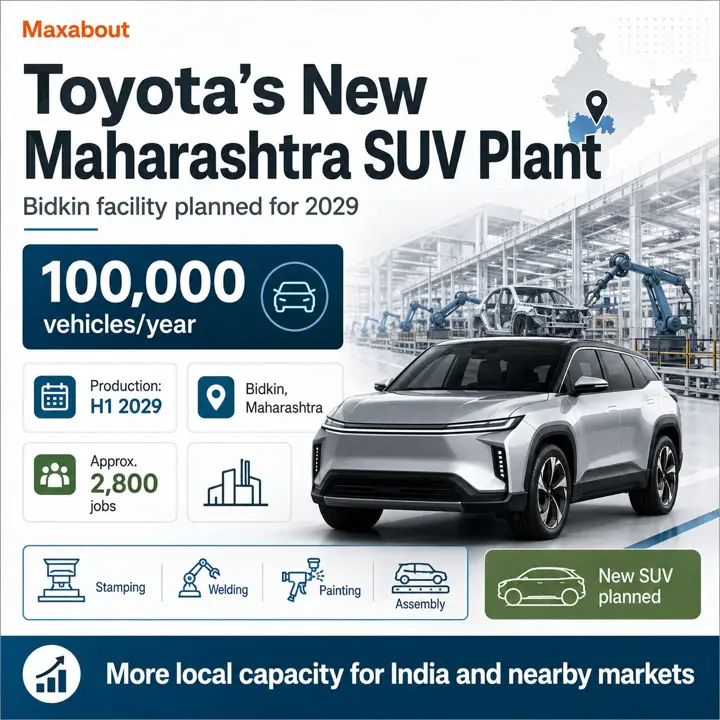 From a purely strategic standpoint, Andhra Pradesh makes real sense. Proximity to the Krishnapatnam and Gangavaram ports means easier export logistics, which matters if Toyota intends to use this plant as a regional export hub alongside domestic supply. That's a combination manufacturers genuinely look for.
On investment figures, industry reports suggest the commitment could run into several thousand crores, though confirmed specifics remain limited at this stage. Production capacity details are similarly preliminary — what's clear is that the scale being discussed points toward high-volume output, not a niche assembly operation.
It's worth being honest here: some aspects remain speculative. Final location confirmation, exact production timelines, and which specific models will roll off this new line are still unconfirmed. What does appear solid is Toyota's intent and the broad geography in discussion.
Why Is Toyota Doubling Down on India Right Now?
The timing here isn't accidental. India recently overtook Japan to become the third-largest automotive market in the world — and Toyota clearly sees what that means for the next decade. This isn't a company chasing a trend. It's a company that's been watching, waiting, and now moving with real conviction.
From what industry analysts have consistently pointed out, India's middle class is expanding in ways that directly translate to vehicle demand. First-time car buyers in cities like Pune, Hyderabad, and Lucknow are increasingly looking beyond entry-level options. They want reliability. They want something that holds its value. That's a space Toyota has quietly owned for years.
The government's PLI scheme for automotive manufacturing has also changed the math considerably. Local production incentives make building here genuinely attractive — not just for domestic sales, but for exports. India is already a competitive manufacturing base, and Toyota appears to be positioning itself to use this new facility as a regional supply hub.
Then there's the hybrid story. Toyota's early and aggressive push into hybrid technology — seen clearly in the Innova HyCross and Urban Cruiser Hyryder — aligns almost perfectly with where India's emission norms are heading. The Fortuner continues to hold strong brand equity in the premium segment. These aren't just sales numbers; they represent genuine customer trust built over years.
Expanding manufacturing capacity here simply makes strategic sense right now.
What Might Actually Roll Out of This New Plant?
This is where things get genuinely interesting — and I want to be clear upfront that what follows is informed speculation, not confirmed news. But connecting the dots between Toyota's global roadmap and India's current market appetite does paint a fairly compelling picture.
The most logical candidate, in my view, is an affordable entry-level SUV. The segment dominated by the Maruti Suzuki Brezza and Hyundai Creta is enormous, and Toyota currently has no direct answer below the Hyryder's price point. Local manufacturing could change that math significantly — potentially bringing a compact SUV closer to the ₹10–12 lakh range, which is where the real volume sits.
Then there's the Suzuki-Toyota alliance factor. Shared platforms like the one underpinning the Hyryder and Grand Vitara have already proven workable. A new facility could expand that partnership further, supporting higher hybrid production volumes at lower costs — something both companies benefit from as emission regulations tighten.
Global models like the Toyota Yaris Cross have also been quietly discussed in industry circles as potential India candidates. Local production would be the key that unlocks realistic pricing for such vehicles.
None of this is confirmed. But the pieces do fit together rather neatly.
What This Means for Toyota's Pricing and Affordability in India
This is the question most Indian buyers will ask first. And honestly, it deserves a straight answer rather than optimistic assumptions.
Local manufacturing does reduce costs in measurable ways. Import duties on fully built vehicles in India can reach up to 100%, depending on engine size and value. Even for cars assembled locally using imported parts, duty structures are significantly more favorable. Add reduced logistics costs, shorter supply chains, and lower currency exposure — and the savings on paper can be substantial.
But here is the honest part: manufacturers do not always pass those savings to buyers in full. Some of it gets absorbed into higher margins. Some goes toward recovering the plant investment itself. History in India shows mixed results — a few brands did lower prices meaningfully after local production started, while others simply improved their margins without moving the price tag much.
Where Toyota buyers may see a more immediate benefit is waiting periods. Anyone who tried booking an Innova HyCross or Hyryder over the past two years knows the frustration of waiting months for delivery. Higher production capacity directly addresses that problem, even if prices stay where they are.
So the realistic expectation is this — moderate price adjustments on specific models, and noticeably better availability. That combination alone would make a real difference for buyers who have grown tired of both the premiums and the wait.
Jobs, Economy, and the Bigger Picture for India's Auto Industry
Step back from the buyer angle for a moment, and this investment starts to look like something much larger than just more cars rolling off a line.
A greenfield manufacturing plant of this scale doesn't just create jobs inside the factory gates. The ripple effect runs deep. Think about the ancillary supplier units that will set up nearby — component manufacturers, stamping facilities, wiring harness suppliers, rubber and glass vendors. Each of those operations needs its own workforce. Then add logistics companies, trucking contractors, warehouse operators, and the expanded dealership and service networks that follow increased production volume. Conservative estimates for projects of this size typically point to tens of thousands of direct and indirect jobs, spread across multiple states.
This also fits into a much bigger national ambition. India has been quietly but seriously positioning itself as a global auto manufacturing hub, and the numbers back that up. Hyundai expanded its Tamil Nadu operations significantly. Suzuki committed to a massive new Gujarat facility. Kia built an entire township around its Anantapur plant in Andhra Pradesh. These aren't isolated decisions — global automakers are clearly reading India's trajectory and betting on it.
Toyota's investment adds credibility to that story. When a manufacturer with this level of quality reputation doubles down on Indian production, it signals confidence in local supply chains, skilled labor availability, and long-term market growth. That kind of validation matters when India is competing against Vietnam, Thailand, and Indonesia for global manufacturing mandates.
That said, large industrial projects carry real responsibilities. Infrastructure demands — power, water, roads, waste management — can strain local systems if not planned carefully. Environmental clearances need genuine scrutiny, not just paperwork. The communities near these facilities deserve transparent commitments on both ecological impact and local hiring. Enthusiasm for growth is healthy, but responsible execution is what separates a lasting win from a short-term gain.
How Toyota's Expansion Stacks Up Against the Competition
Toyota is not entering a quiet market. It is stepping into one of the most fiercely contested manufacturing landscapes in the world, where Maruti Suzuki has spent decades building an almost unassailable production base, Hyundai has poured serious investment into its Pune operations, and Tata Motors is aggressively pushing EV manufacturing as its core identity. So where does Toyota's new plant actually fit in this picture?
Maruti's advantage is frankly difficult to replicate overnight. Their supplier networks, workforce depth, and sheer volume output are built over generations. Toyota knows this. Which is likely why their bet is not on volume competition alone — it is on technology differentiation through hybrids.
From what industry observers are saying, that hybrid-first strategy seems pragmatic given Indian realities. Charging infrastructure outside major metro corridors remains genuinely patchy. Range anxiety is not imaginary. For a buyer in Nagpur or Coimbatore, a strong hybrid still makes more practical sense today than a full EV.
That said, Tata's EV momentum is real and growing. If infrastructure development accelerates faster than expected, Toyota's hybrid window could narrow. It is a calculated risk, not a guaranteed win.
Final Thoughts: Should Indian Car Buyers Be Excited?
Honestly? Yes — but with measured expectations. A new manufacturing plant is genuinely good news, not just corporate noise. More local production typically means shorter waiting periods, better parts availability, and over time, pricing that reflects Indian realities rather than heavy import costs.
For buyers who have watched Innova Hycross wait times stretch for months, or wondered why Toyota's lineup feels thinner than it should in a market this large — this investment signals that Toyota is treating India seriously, not as an afterthought.
That said, manufacturing announcements and showroom benefits are separated by years, sometimes many years. Groundbreaking ceremonies do not immediately translate into more affordable vehicles or expanded model ranges. The gap between intent and delivery is where many promises quietly fade.
So stay engaged, but stay grounded. Track official Toyota India announcements rather than speculation. The real verdict on this investment will come from the actual vehicles produced, the price tags attached to them, and whether service networks genuinely strengthen in smaller cities beyond the usual metro bubble.
This is a promising development. Whether it becomes a genuinely transformative one depends entirely on execution.
No comments yet
Be the first to share your thoughts!
Want to read more automotive news?
Stay updated with the latest car launches, reviews, and industry insights.
Browse All News