
Toyota Fortuner Price Hike May 2026: Up To ₹87,000 Increase
Toyota Fortuner Price Hike in India: The Third Increase of 2026In a move that's raised quite a few eyebrows, Toyota has announced yet another price increase for the Fortuner SUV - the third one already this year. The latest hike goes up to a substantial ₹87,000, putting additional pressure on prospe...
Editorial Team
Toyota Fortuner Price Hike in India: The Third Increase of 2026
In a move that's raised quite a few eyebrows, Toyota has announced yet another price increase for the Fortuner SUV - the third one already this year. The latest hike goes up to a substantial ₹87,000, putting additional pressure on prospective buyers considering this popular SUV.
The Fortuner has long been the undisputed king of the premium SUV segment in India, commanding both respect and aspirational value despite its already premium pricing. With this latest adjustment, the entry point to Fortuner ownership moves further upward, potentially pushing it beyond reach for some would-be buyers.
 What makes this particularly noteworthy is the frequency - three price hikes in less than five months signals either significant input cost pressures or a strategic repositioning. For Indian customers who typically plan vehicle purchases months in advance, especially in the ₹30-50 lakh bracket, these rapid price movements create genuine budgeting challenges.
The timing is especially interesting given the increasing competition from both established rivals and newer entrants in the premium SUV space, all vying for attention in a market where brand loyalty is being tested by rising ownership costs.
Breaking Down the Latest Price Increase
The May 2026 price hike for the Toyota Fortuner lineup shows a carefully calculated pattern across its variants. Looking at the numbers closely, the base 4x2 petrol manual variant now costs ₹36.92 lakh, up from ₹36.25 lakh – a relatively modest increase of ₹67,000. However, the top-end Legender 4x4 diesel automatic sees the most substantial jump, priced at ₹51.83 lakh versus the previous ₹50.96 lakh – translating to an ₹87,000 increase.
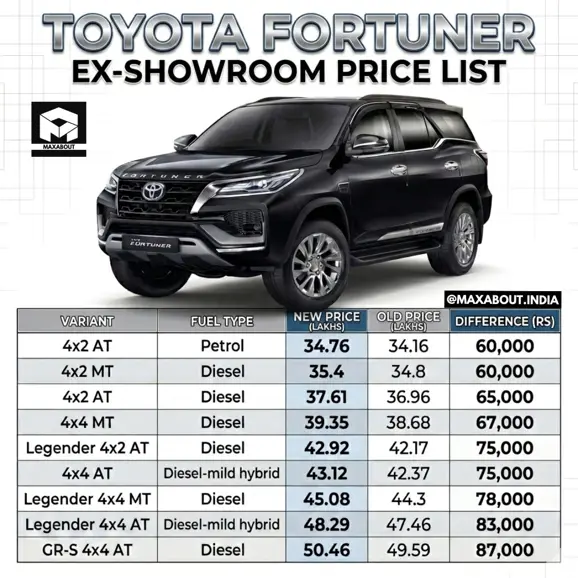 In percentage terms, the mid-range variants appear most affected. The 4x2 diesel automatic variant, popular among urban buyers, has increased by approximately 2.3% – higher than the lineup's average of 1.8%. Meanwhile, the 4x4 manual diesel variant saw the smallest percentage increase at about 1.4%.
Variant Old Price New Price Increase 4x2 Petrol MT ₹36.25 lakh ₹36.92 lakh ₹67,000 4x2 Diesel MT ₹38.63 lakh ₹39.42 lakh ₹79,000 4x4 Diesel MT ₹42.81 lakh ₹43.41 lakh ₹60,000 Legender 4x4 AT ₹50.96 lakh ₹51.83 lakh ₹87,000
What makes this May adjustment particularly notable is its timing – coming just three months after the previous February increase and barely five months into 2026. This suggests Toyota might be implementing a quarterly price revision strategy rather than the traditional annual cycle most manufacturers follow in India.
Pattern of Price Hikes: January, March, and Now May 2026
Looking at Toyota's pricing strategy for the Fortuner in 2026, a clear pattern emerges. We're seeing a shift from annual price revisions to what appears to be a quarterly adjustment model. The three consecutive hikes in January, March, and now May represent a cumulative increase of approximately 8.2% across the lineup in just five months.
The top-end Legender 4x4 AT variant has been hit the hardest, with a total increase of ₹2.15 lakh since December 2025. In contrast, the entry-level 4x2 MT diesel variant has seen a more modest but still significant ₹1.45 lakh increase during the same period.
What's interesting is how this approach differs from Toyota's strategy with other models in India. The Innova Crysta and Hyryder have only seen one price adjustment this year (approximately 3-4%), while the Glanza has remained mostly stable with a minimal 2% increase. This suggests Toyota is positioning the Fortuner in a premium bracket where they believe customers have more price elasticity.
In my view, this aggressive pricing strategy reflects both rising input costs and Toyota's confidence in the Fortuner's brand equity in the Indian market. Despite these increases, the waiting period for certain Fortuner variants still extends to 2-3 months in major cities, indicating strong demand persisting even at these elevated price points.
Market Factors Behind Toyota's Pricing Strategy
Looking at the bigger picture, several market factors appear to be driving Toyota's aggressive pricing strategy for the Fortuner in 2026. Raw material costs have surged considerably across the automotive industry, with steel prices up nearly 15% since January. In a recent industry briefing, Toyota officials cited these escalating input costs as a primary factor behind the price adjustments.
Currency fluctuations have also played a significant role. The rupee has weakened against the yen by approximately 7% this year, directly impacting Toyota's import components for the Fortuner. While the vehicle enjoys substantial localization, critical electronic components and specialized materials still come from Japan.
The global semiconductor shortage continues to persist in 2026, though less severely than previous years. This ongoing supply constraint has created production bottlenecks, forcing manufacturers like Toyota to adjust pricing to balance supply-demand equations.
I've noticed that these price hikes align with broader industry trends. Several premium SUV manufacturers have implemented similar increases, with Mercedes and BMW raising prices by 5-8% already this year. Toyota seems to be following this industry-wide pattern while leveraging the Fortuner's strong brand position in the Indian market.
Impact on Fortuner's Competitive Position in India
This third price hike puts the Fortuner in a tricky spot within India's premium SUV segment. With a cumulative increase of nearly ₹2 lakh this year alone, the value proposition is definitely being stretched thin. The Fortuner now starts at around ₹35.5 lakh and extends to ₹51 lakh (ex-showroom), making it significantly pricier than most competitors.
When compared to the MG Gloster, which offers similar space and better technology at about ₹3-4 lakh less, the Fortuner's premium becomes harder to justify. Similarly, the Jeep Meridian delivers superior driving dynamics and brand cachet while undercutting the Fortuner by approximately ₹2 lakh. The recently relaunched Ford Endeavour also presents stiff competition with its compelling feature set.
I think Toyota is banking heavily on the Fortuner's legendary reliability and strong resale value to maintain its position. In metropolitan areas like Delhi and Mumbai, the Fortuner remains a status symbol, but in tier-2 cities, these repeated price hikes might push buyers toward alternatives offering better value.
Based on market trends, I expect the Fortuner's segment share to drop by 5-7% over the next two quarters, particularly affecting the middle variants. The top-end Legender and base variants will likely retain their customer base – loyalists who prioritize the Toyota badge and long-term ownership benefits over initial purchase price.
The critical question is whether Toyota's exceptional service network and the Fortuner's proven durability on Indian roads continue to outweigh the increasingly premium pricing.
Buyer Perspective: Value Proposition After the Price Increase
Looking at the Fortuner's value proposition now, I'm seeing a tough equation for potential buyers. The recent price hike puts the Fortuner at a significant premium even compared to similarly capable SUVs like the MG Gloster and Jeep Meridian.
That said, the Fortuner still maintains several compelling advantages in the Indian context:
Exceptional resale value - Fortuners typically retain 60-65% value even after 5 years, unmatched in the segment
Proven reliability - Particularly important on Indian highways and rough rural roads
Widespread service network - With 419 Toyota service centers across India, including tier-2 and tier-3 cities
The maintenance costs remain reasonable at approximately ₹25,000-₹30,000 annually, which I consider fair given the vehicle size. However, the fuel efficiency of 10-12 km/l (diesel) is increasingly problematic with rising fuel prices.
From my perspective, the Fortuner makes most sense for buyers planning 7+ years of ownership, where the higher upfront cost amortizes through lower depreciation and repair expenses. For shorter ownership periods, this price hike significantly weakens its case against competitors offering more features at lower price points.
Expected Market Response and Sales Projection
These consecutive price hikes for the Fortuner could prove to be a tipping point for Toyota in India. Based on historical patterns, the previous two price increases already caused a noticeable dip in monthly sales—dropping from approximately 2,000 units to around 1,750 units per month according to industry reports.
I believe we'll see two distinct customer reactions. The hardcore Fortuner loyalists will likely absorb the increase, viewing it as the cost of ownership for what they consider the ultimate SUV. However, the fence-sitters will increasingly look toward alternatives like the MG Gloster, Jeep Meridian, and upcoming Mahindra models.
Dealerships across metros like Delhi and Mumbai are reportedly already experiencing booking cancellations in the 15-20% range. Waiting periods, previously 2-3 months, have shortened to 3-4 weeks in many cities—a telling sign of cooling demand.
Toyota risks overestimating brand loyalty in a market where value consciousness remains paramount. While Toyota's reliability reputation offers some buffer against market sensitivity, three hikes in a single year tests even the most devoted customer base. I suspect Q3 2026 will show Toyota either adjusting strategy or introducing special editions to reignite interest.
Future Outlook: Will Prices Stabilize or Continue to Rise?
Looking ahead, I believe Toyota faces a strategic crossroads with the Fortuner's pricing. While another increase in 2026 isn't impossible, the diminishing returns of their current approach suggest we might see a temporary stabilization in prices—at least through Q1 2027.
Several factors will likely influence Toyota's decision-making:
The anticipated Fortuner hybrid – Expected to launch in late 2026, this could justify a premium positioning while allowing current models to maintain stable pricing
Competitive pressure from refreshed MG Gloster and upcoming Mahindra Scorpio XUV variants
Production adjustments at Toyota's Karnataka facility that might improve cost efficiency
For potential buyers, this volatile environment presents a dilemma. Those who can wait might benefit from year-end discounts that Toyota dealers will likely offer to clear inventory before any refresh. However, if you need an SUV immediately, I'd suggest exploring the mid-variant Fortuner GX, which offers the best value proposition at approximately ₹42 lakh and seems least affected by these incremental hikes.
The broader economic indicators point to stabilizing raw material costs, which could ease pressure on manufacturers. That said, Toyota's premium positioning strategy appears deliberate rather than purely reactionary to input costs.
Explore the story
Related news




Share your view and join the discussion.
Earn reward points for every comment and get a chance to win ₹1,000 in our weekly lucky draw. Sign in with Google in one tap.
Start the conversation
No one has commented on this article yet. Be the first to share your view.
Want to read more automotive news?
Stay updated with the latest car launches, reviews, and industry insights.
Browse All News