
Top Selling Cars FY2026 By Powertrain – Maruti to MG
Something interesting happened in the Indian car market in FY2026. Buyers stopped just asking "which car should I buy?" and started asking "which type of car makes sense for me?" That shift in thinking – from body style to powertrain – is arguably the biggest story of the year.Petrol still rules, no...
Editorial Team
Something interesting happened in the Indian car market in FY2026. Buyers stopped just asking "which car should I buy?" and started asking "which type of car makes sense for me?" That shift in thinking – from body style to powertrain – is arguably the biggest story of the year.
Petrol still rules, no question about that. But the numbers tell a more nuanced story. CNG registrations have climbed sharply, driven largely by buyers in Delhi, Pune, and Mumbai who are simply tired of watching fuel costs eat into their monthly budgets. Hybrids, once considered a niche choice for the environmentally conscious, are now showing up in serious sales volumes – largely thanks to Toyota's strong-hybrid push. And EVs? They are growing, steadily if not dramatically, as range anxiety slowly gives way to range acceptance.
What makes FY2026 particularly interesting is how clearly the market has sorted itself. Maruti Suzuki dominates petrol and CNG. Mahindra owns the pure SUV conversation. Toyota is pulling ahead in hybrids. MG is making a real case in the EV segment. Four brands, four powertrain stories, one market.
From what industry reports and sales data suggest, Indian buyers are now thinking seriously about running costs, longer city commutes, and fuel price uncertainty before signing on the dotted line. Bengaluru's infamous traffic alone has probably converted more than a few buyers toward hybrids and CNG.
This post breaks down exactly how FY2026 shaped up – powertrain by powertrain, brand by brand.
Petrol Still Rules – And Maruti Is the Undisputed King
For all the noise around EVs and hybrids, petrol vehicles quietly continued to dominate FY2026 sales volumes. No drama, no headlines – just consistent numbers month after month. And sitting right at the top of that pile, as it has been for decades, is Maruti Suzuki.
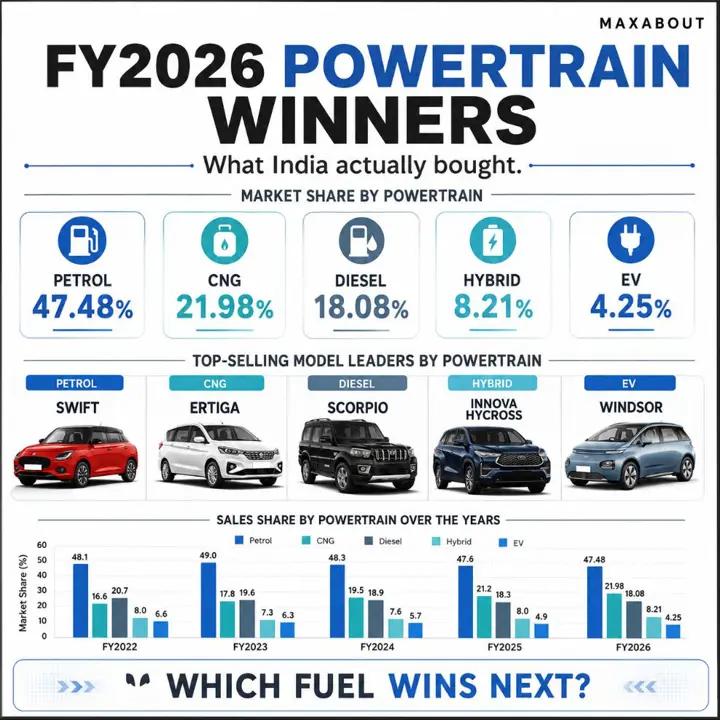
The Wagon R, Swift, Brezza, and Dzire collectively moved enormous volumes this fiscal year. The Swift's refresh gave it a second wind, the Brezza held firm in a crowded compact SUV segment, and the Wagon R – that tall-boy workhorse – remained a top choice for first-time buyers from Patna to Pune. These are not exciting cars in the conventional sense. But they sell because they make complete, practical sense for a very large section of Indian buyers.
Why does petrol still work? A few honest reasons. The upfront cost is lower compared to CNG variants or hybrids. Petrol pumps are everywhere – in smaller towns, Tier 2 and Tier 3 cities, along highway stretches where CNG stations simply do not exist yet. Ownership is straightforward, servicing is familiar, and resale values on Maruti products remain strong almost everywhere.
That last point connects directly to Maruti's service network advantage – something competitors genuinely struggle to replicate. With thousands of service touchpoints across India, even a buyer in a smaller city feels covered. That confidence factor should not be underestimated when someone is spending ₹6 to ₹12 lakh.
The concern side is real though. Petrol running costs are noticeably higher than CNG or strong hybrids, especially for buyers clocking 1,500 kilometres or more monthly in city traffic. Fuel prices remain unpredictable. For high-usage buyers, the lower purchase price can quietly disappear over two to three years of ownership.
Still, for millions of buyers across India, petrol remains the most sensible, accessible choice – and Maruti knows exactly how to serve that buyer better than anyone else.
CNG Sales Surge – Maruti and Hyundai Fight It Out
If there is one powertrain story that genuinely surprised people in FY2026, it is how aggressively CNG adoption has grown. This is not a niche segment anymore. In cities like Mumbai, Delhi, Ahmedabad, and Pune – where CNG pump infrastructure has matured considerably – buyers are actively choosing CNG over petrol at the dealership level. The numbers back this up.
Maruti remains the undisputed leader here. The Wagon R CNG continues to be a volume workhorse, particularly among cab aggregator fleets and daily office commuters clocking 60 to 80 kilometres each day. The Ertiga CNG has found a loyal audience among larger families who want seven seats without spending ₹3,000 or more on fuel every week. Factory-fitted CNG options across Maruti's lineup have genuinely changed the conversation around safety – a concern that older aftermarket kits rightfully attracted.
Hyundai is pushing hard too. Their factory-fitted CNG offerings have gained visible traction, and the brand's service network gives buyers reasonable confidence about long-term ownership.
The practical math is compelling for high-mileage users. Running costs drop significantly compared to petrol. But the trade-offs are real – boot space takes a noticeable hit, highway driving remains a genuine concern given sparse CNG availability outside major corridors, and there is a slight performance dip that spirited drivers will notice.
For the right buyer, though, CNG simply makes financial sense that is hard to argue against.
The Hybrid Revolution – Why Toyota Is Winning the Long Game
If CNG appeals to the budget-conscious buyer, strong hybrids are speaking to an entirely different mindset – someone who wants efficiency and refinement, without the anxiety of plugging anything in.
Toyota's FY2026 numbers tell a clear story. The Innova HyCross and Urban Cruiser Hyryder have pushed the brand into genuinely impressive sales territory. The reason is straightforward – strong hybrids charge themselves. The battery replenishes through braking and the engine, meaning the driver does nothing differently. In Bengaluru's brutal stop-and-go traffic or Mumbai's perpetually crawling highways, that electric motor quietly handles low-speed movement where petrol engines are at their least efficient. Real-world fuel efficiency figures that owners report are hard to dismiss.
For buyers curious about EVs but nervous about charging infrastructure outside metros, hybrids feel like an intelligent middle ground. The range anxiety simply disappears. You fill petrol like always, but burn considerably less of it.
There is also a meaningful tax advantage in several states, where strong hybrids attract lower registration costs compared to conventional ICE vehicles – which quietly reduces the effective price premium.
That premium is real, though. A strong hybrid commands significantly higher upfront cost, which genuinely limits accessibility. Maruti's mild hybrid systems, available across multiple Suzuki models, offer a more affordable entry point – though fuel savings are modest compared to Toyota's full hybrid technology.
Toyota is playing a patient game. And right now, it appears to be working.
Mahindra's SUV Surge – Petrol and Diesel Holding Strong
While Toyota plays the long hybrid game, Mahindra has taken a completely different route – and it is working remarkably well. FY2026 has been a strong year for the brand, driven by sustained demand for the XUV700, Scorpio-N, and Thar, alongside genuine early interest in the newer BE 6e and XEV 9e electric series.
What stands out is how Mahindra has managed to keep diesel relevant. For buyers who regularly cover long highway stretches – think Mumbai to Pune, Delhi to Jaipur, or Bengaluru to Coorg – the fuel efficiency advantage of a diesel engine on open roads is genuinely hard to argue against. Running costs stay lower, range anxiety stays non-existent, and the pulling power on gradient roads feels reassuring. That equation still makes practical sense for a large segment of Indian buyers.
Petrol variants have also held their ground, particularly in urban markets where diesel's advantages narrow considerably in stop-and-go traffic. Mahindra has been smart about offering both options across most of its lineup rather than forcing buyers toward one powertrain.
The brand's appeal is straightforward – space, road presence, and genuine capability. These are vehicles that feel substantial. Buyers who want something that commands attention on the road, carries a full family comfortably, and handles rough terrain without complaint, tend to gravitate naturally toward Mahindra's portfolio.
Ownership costs, however, deserve an honest look. Service experience has improved meaningfully over the past few years, but Mahindra's network still lags behind Maruti in depth and reach, particularly in smaller towns. And the waiting period issue remains a genuine frustration – popular variants of the XUV700 and Scorpio-N have consistently stretched delivery timelines, sometimes uncomfortably so.
From what most owners report, the ownership experience is broadly positive once the vehicle is in hand. It is getting there that tests patience.
Electric Vehicles in FY2026 – MG and Tata Lead, But Challenges Remain
The EV story in FY2026 is genuinely interesting, though not quite the revolution some predicted. Tata Motors and MG Motor continue to dominate this segment, with the Nexon EV, Punch EV, Windsor, and ZS EV accounting for the bulk of electric passenger car sales. The numbers are growing, but the context matters.
From what the sales data shows, EVs are working well in a fairly specific set of circumstances. Urban buyers in metros like Bengaluru, Delhi, and Pune – particularly those with home charging setups and predictable daily commutes under 50 kilometres – are genuinely happy. Corporate fleet operators have also taken to EVs enthusiastically, drawn by lower running costs.
MG's battery subscription model on the Windsor deserves mention. By separating the battery cost from the vehicle price, MG brought the upfront purchase figure down meaningfully, which opened the door for buyers who were otherwise priced out. It is a clever approach, and it has clearly moved numbers.
But real barriers remain. Public charging infrastructure outside major cities is still unreliable. Long highway drives still carry genuine range anxiety. Resale value uncertainty quietly worries many prospective buyers. And the sticker price, even after subsidies, remains a stretch compared to equivalent petrol options.
EVs are promising and the trajectory is positive. The mass market moment, however, is still building – not fully arrived.
Which Powertrain Makes the Most Sense for Indian Buyers Right Now?
Honestly, there is no clean universal answer here. India is too varied – in geography, income levels, driving patterns, and infrastructure – for any single powertrain to win outright. But from what the data suggests, some clear patterns are emerging for different buyer profiles.
The budget-conscious urban commuter – someone covering 30 to 50 kilometres daily in Pune, Hyderabad, or Bengaluru – is arguably the strongest candidate for an EV right now. Short, predictable distances, home charging access, and near-zero running costs make the math genuinely compelling over three to four years. The higher upfront cost stings, but the monthly savings are real.
The highway road-tripper who regularly drives between cities is better served by a strong hybrid or a modern petrol-automatic at this point. Charging infrastructure along national highways is improving but remains inconsistent. A hybrid delivers excellent fuel efficiency without the anxiety.
The family SUV buyer in a Tier-2 city should strongly consider CNG or petrol, given service network reliability and resale familiarity. Based on how the market is moving, strong hybrids are also becoming a credible option here as prices gradually ease.
The eco-conscious urban professional with a stable home charging setup and a secondary vehicle for long trips is genuinely well-positioned for an EV purchase today.
Different powertrains will co-exist in India for many more years. That is not a failure – it is simply the reality of a vast, diverse market finding its own pace.
What FY2026 Sales Trends Tell Us About Where Indian Cars Are Headed
The numbers from FY2026 are telling a clear story, even if the full chapter is still being written. India's car market is shifting – not dramatically overnight, but in ways that are real, measurable, and increasingly hard to ignore.
CNG has proven it is not a transitional footnote. It is firmly embedded in how middle-income India thinks about fuel costs, and manufacturers have responded accordingly. Maruti and Hyundai continue expanding their CNG portfolios precisely because demand is consistent and predictable.
Strong hybrids, led largely by Toyota and now drawing interest from other manufacturers, are gaining ground in a segment that once seemed exclusively petrol territory. Government policy is quietly accelerating this. Stricter CAFE norms pushing into the next phase, the PLI scheme encouraging localised battery and component manufacturing, and tightening emission regulations are all nudging automakers toward cleaner drivetrains whether they planned for it or not.
EVs are growing, just not explosively. Infrastructure remains uneven outside major cities, and range anxiety is still a genuine concern on longer inter-city routes. However, the next two to three years should bring meaningful improvements – more mid-segment hybrid options as localisation reduces costs, expanded public charging networks, and possibly flex-fuel vehicles entering serious consideration as that policy framework develops.
India's automotive transition will not mirror Europe or China. It will be layered, pragmatic, and shaped by uniquely Indian realities – fuel prices, road diversity, income variation, and a buyer base that makes careful, long-term decisions. That is not a weakness. It is simply how a market this complex finds its own honest path forward.
Explore the story
Related news
Share your view and join the discussion.
Earn reward points for every comment and get a chance to win ₹1,000 in our weekly lucky draw. Sign in with Google in one tap.
Start the conversation
No one has commented on this article yet. Be the first to share your view.
Want to read more automotive news?
Stay updated with the latest car launches, reviews, and industry insights.
Browse All News