
Tata Sierra EV Launch Confirmed for Q2 FY2026-27
Some nameplates just never leave you. The Tata Sierra was one of those vehicles — boxy, bold, unmistakably Indian, and genuinely ahead of its time when it first rolled out in the early 1990s. For a generation of car enthusiasts who grew up watching it navigate city streets and mountain roads alike, ...
Editorial Team
Some nameplates just never leave you. The Tata Sierra was one of those vehicles — boxy, bold, unmistakably Indian, and genuinely ahead of its time when it first rolled out in the early 1990s. For a generation of car enthusiasts who grew up watching it navigate city streets and mountain roads alike, the Sierra wasn't just a car. It was a statement.
Now it's coming back. And this time, it's electric.
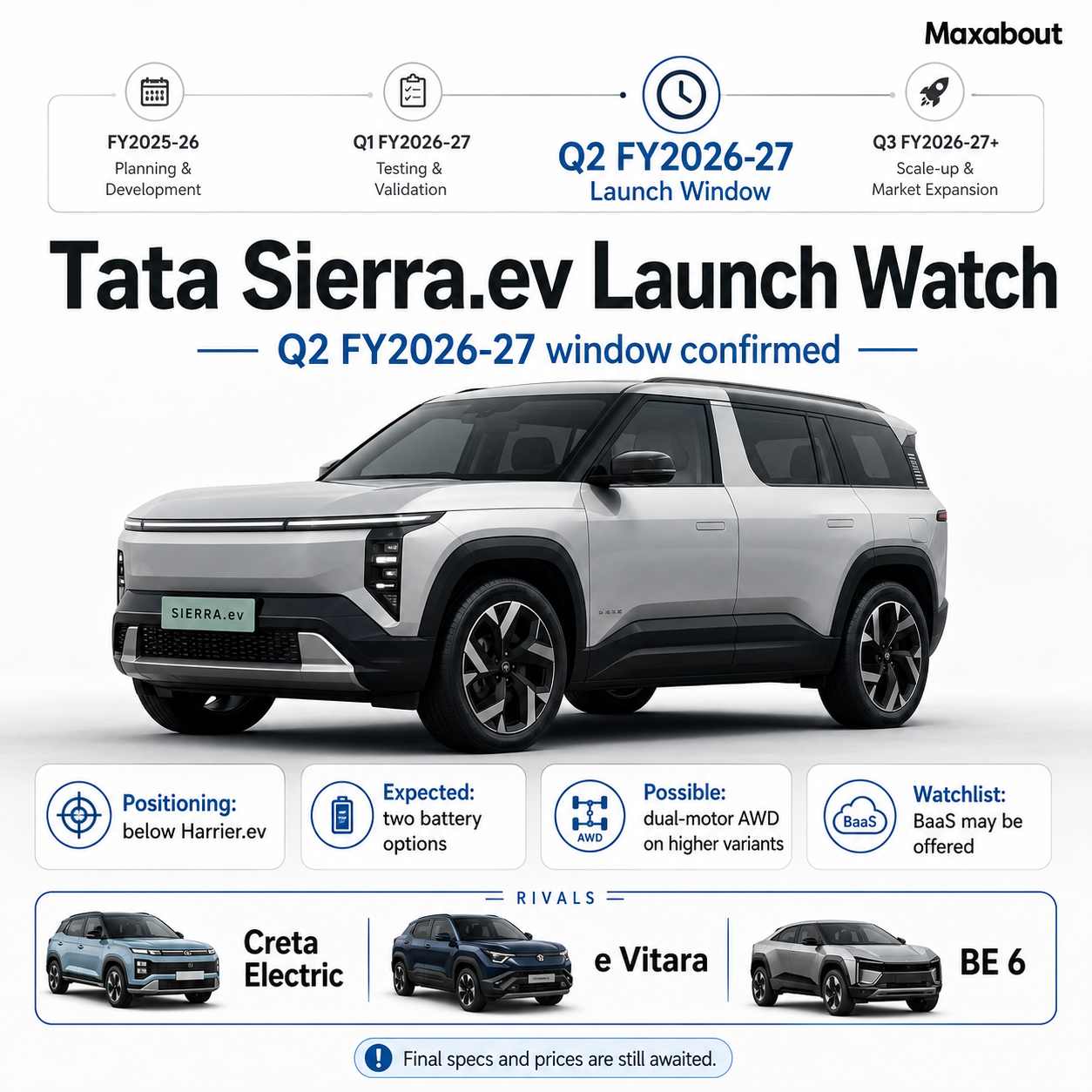
Tata Motors has officially confirmed the Sierra EV launch for Q2 of FY2026-27, which puts it roughly in the July–September 2025 window. That's not far off. From what industry sources indicate, this launch has been carefully timed — not rushed — and that deliberate approach says something about how seriously Tata is treating this one.
This isn't just another EV being added to an already crowded segment. Tata is clearly positioning the Sierra EV as its flagship electric SUV, something that can anchor the premium end of its growing electric lineup. In a market where buyers are increasingly willing to spend more for the right product, that ambition makes sense.
And honestly, the timing fits India's broader EV story rather well. Charging infrastructure is improving, buyer confidence is rising, and the segment above ₹20 lakh is finally opening up for electric options. The Sierra EV steps right into that space.
A Name That Carries Weight: The Legacy of the Original Tata Sierra
If you grew up in India during the 1990s, the original Tata Sierra probably left some kind of impression on you. That distinctive three-door body, the large wraparound rear glass, the slightly rugged stance — it looked like nothing else on Indian roads at the time. In a market dominated by the Ambassador and the Premier Padmini, the Sierra felt genuinely bold. Almost adventurous.
 It wasn't a perfect vehicle by any measure. But it had character, and that counted for a lot. The Sierra developed a quiet cult following — the kind that doesn't fade easily, even after the model itself does.
Tata knows exactly what it's doing by reviving that name. The Auto Expo concept version generated real excitement, not just from automotive enthusiasts but from people who remembered the original fondly. That kind of emotional recall is difficult to manufacture and even harder to buy.
That said, it's worth being clear: the new Sierra EV shares very little with its predecessor beyond the name and a certain spirit of standing apart. This is a fully modern electric SUV built on current architecture, with contemporary technology and a completely different purpose. The nostalgia is the conversation starter. What actually matters is whether the product behind that name can deliver.
Expected Specifications and Features: What We Know So Far
So what is Tata actually putting under that distinctive body? Based on available information and official announcements, the Sierra EV is expected to be built on Tata's Acti.ev platform — the same architecture underpinning the Curvv EV and the updated Nexon EV. That matters more than it might sound.
The Acti.ev platform is purpose-built for electric vehicles, not adapted from an existing petrol car's underpinnings. That means better structural rigidity, optimised battery placement for a lower centre of gravity, and genuine room to grow — both in terms of future variants and technology updates over the vehicle's lifecycle.
Industry sources suggest the Sierra EV could arrive with two battery pack options — a mid-size pack in the 45–50 kWh range and a larger option potentially pushing beyond 60 kWh. Estimated real-world range figures, based on Tata's recent performance with the Curvv EV, could realistically land between 400 km and 500 km on the larger pack under standard Indian driving conditions. That said, these remain unconfirmed numbers at this stage.
On the charging front, DC fast charging support is expected as standard, with AC home charging capability included. Tata has been progressively improving charging speeds across its lineup, so competitive fast-charge performance seems likely.
Feature-wise, expect a large touchscreen infotainment system, a panoramic sunroof, an ADAS suite with autonomous emergency braking and lane assist, and Tata's connected car technology. Nothing surprising there — but executed well, it should be a strong package.
Pricing Expectations and Where It Will Sit in the Market
Most industry watchers are placing the Sierra EV somewhere between ₹25 lakh and ₹35 lakh at launch, and honestly, that range makes sense given where Tata needs to position this vehicle. It cannot be a Nexon EV competitor — that would undercut its own lineup. And it cannot reach Kia EV6 territory either, because then the value argument simply collapses for most Indian buyers.
This puts the Sierra EV squarely in a space that is genuinely underserved right now. Buyers who have outgrown the Nexon EV but find fully imported electric SUVs financially unrealistic — that is exactly who Tata is speaking to here.
Tata's recent pricing behaviour with the Punch EV and Curvv EV tells an interesting story. Both were positioned more aggressively than many expected, with Tata clearly prioritising volume and accessibility over pure margin. The Sierra EV, being a flagship statement product, may carry slightly firmer pricing — but the competitive pressure from upcoming domestic rivals means Tata cannot afford to be complacent.
For Indian buyers, the value equation at this price point is straightforward: real-world range above 400 km, a feature list that justifies every rupee, and after-sales support that does not require driving 80 kilometres to the nearest service centre. Tata's expanding service network is a genuine advantage here — something imported alternatives simply cannot match at this price.
Real-World Practicality: How the Sierra EV Might Perform on Indian Roads
Specifications look great on paper. Indian roads, however, have a way of telling a different story entirely. So let me shift focus to what actually matters for daily ownership.
Ground clearance will be critical here. If Tata delivers something in the 200mm or above range — which the Sierra's SUV stance strongly suggests — most city roads should pose little trouble. Mumbai's notorious monsoon potholes, Bengaluru's crater-riddled IT corridors, Pune's aggressive speed breakers — all manageable with decent clearance and a well-tuned suspension setup.
Charging infrastructure is where honesty matters most. Metro cities are reasonably covered. Delhi, Mumbai, Bengaluru, and Pune have growing fast-charger networks, and Tata.ev's own charging points have expanded meaningfully. But travel beyond these bubbles — smaller towns, highway stretches through less-developed corridors — and the picture gets thinner quickly.
Then there is range anxiety. A claimed 400–500 km range realistically translates to roughly 300–360 km in genuine stop-and-go city conditions, with air conditioning running. That is still respectable, but buyers should mentally budget for that gap.
Home charging remains the most practical solution for most owners. An overnight charge covers daily urban commutes comfortably. For a premium product like the Sierra, this convenience factor could genuinely outweigh infrastructure concerns for the right buyer profile.
After-Sales Support and Long-Term Ownership Costs
Buying a premium EV is one decision. Living with it for seven to ten years is another conversation entirely. And honestly, this is where Tata Motors has a genuine structural advantage over most rivals entering the electric space.
Tata's service network spans over 3,500 touchpoints across India, including meaningful presence in Tier 2 and Tier 3 cities — places where a newer EV brand simply cannot reach yet. If you are based in Nashik, Coimbatore, or Bhubaneswar, that coverage actually matters in a very real, practical sense.
Based on Tata's existing EV policy across the Nexon EV and Punch EV lineup, the Sierra will almost certainly carry an 8-year or 1.6 lakh km battery warranty, whichever comes first. That is a reasonable safety net for a ₹25–30 lakh investment, though buyers should read the fine print around capacity retention thresholds.
Annual service costs for Tata EVs have generally stayed lower than petrol equivalents — fewer moving parts, no oil changes, simpler brake wear due to regenerative braking. From what owners of the Nexon EV have reported, yearly maintenance typically runs between ₹4,000 and ₹8,000 for routine checks.
Resale value remains the honest weak spot. Tata EVs have held value reasonably well compared to some competitors, but the used EV market in India is still maturing. Battery health certification programs, if Tata introduces them for the Sierra, could meaningfully strengthen resale confidence over time.
Who Should Wait for the Tata Sierra EV — and Who Should Not
This is where honest advice matters more than enthusiasm. The Sierra EV is genuinely exciting, but it is not the right choice for everyone — and in my view, acknowledging that upfront saves a lot of frustration later.
The Sierra EV makes strong sense if you are an urban professional based in Bengaluru, Pune, Mumbai, or Delhi with reliable home charging access. If you already own a Nexon EV or Tiago EV and want to move up significantly in space, style, and technology, this feels like a natural progression within the same ecosystem. And if design genuinely matters to you — if you want something that turns heads rather than blends into traffic — the Sierra's retro-modern silhouette is difficult to ignore.
But in my view, certain buyers should pause before committing. If you live in a Tier-2 or Tier-3 city where public charging remains unreliable and home charging is complicated, the ownership experience could feel unnecessarily stressful. Similarly, families needing a proper seven-seat configuration may find the Sierra's likely five-seat layout limiting for longer road trips.
Budget-conscious buyers should also be realistic. The Sierra EV will almost certainly be priced at a premium. If stretching finances feels uncomfortable, waiting a year for prices to settle or alternatives to emerge is perfectly sensible advice.
Final Thoughts: Is the Tata Sierra EV Worth the Excitement?
Honestly? Yes — with eyes wide open.
The Sierra EV launch feels like more than just another product announcement. It represents something genuinely meaningful for Indian electric mobility. A nameplate with real emotional history, reimagined for a cleaner future, built on improving domestic technology. That combination does not come along often.
Will there be risks? Absolutely. Delays are always possible in this segment. Real-world range, build quality, and after-sales experience will only reveal themselves after the car actually reaches owners. And with competition intensifying across the premium EV space, Tata cannot afford to deliver anything half-baked.
But if the Sierra delivers even seventy percent of what the early signals suggest, it could genuinely shift how Indian buyers perceive homegrown electric vehicles.
My honest advice — stay curious but patient. Follow official Tata Motors announcements closely, wait for independent test drives to emerge post-launch, and if possible, experience one yourself before committing. The Sierra EV looks promising. Whether it truly delivers is a story still being written.
And personally, I cannot wait to see how that story ends.
Explore the story
Related news

Share your view and join the discussion.
Earn reward points for every comment and get a chance to win ₹1,000 in our weekly lucky draw. Sign in with Google in one tap.
Start the conversation
No one has commented on this article yet. Be the first to share your view.
Want to read more automotive news?
Stay updated with the latest car launches, reviews, and industry insights.
Browse All News