
Tata Punch EV Recalled: What Owners Need to Do About the Rear Brake Issue
Tata Motors has issued an official recall for the Tata Punch.EV, citing a defect in the rear braking system. According to official announcements, the recall affects a specific batch of units and was initiated as a precautionary measure after the issue was identified during internal quality checks. O...
Editorial Team
Tata Motors has issued an official recall for the Tata Punch.EV, citing a defect in the rear braking system. According to official announcements, the recall affects a specific batch of units and was initiated as a precautionary measure after the issue was identified during internal quality checks. Owners of affected vehicles are being contacted directly by the company for inspection and rectification — free of charge.
Brakes are not something anyone should take lightly. On Indian roads especially, where traffic conditions can shift dramatically within seconds — think Mumbai's Western Express Highway during peak hours, or navigating a crowded Bengaluru intersection — a braking system that behaves unpredictably is a genuine safety concern.
That said, it's worth putting this in perspective. A recall is not automatically a mark of failure. In many ways, it reflects manufacturer accountability. The fact that Tata Motors identified and acted on this issue rather than letting it quietly circulate is, from what industry observers note, the responsible path forward.
But here's why this particular recall deserves close attention — the Punch.EV sits at a critical moment in India's EV adoption curve. Many buyers are making their first-ever switch from petrol or diesel vehicles, and confidence in electric technology is still being built. Any safety-related issue, however swiftly addressed, shapes that trust significantly.
The Rear Brake Problem Explained: What Exactly Goes Wrong
So what is actually happening with these brakes? Based on official announcements and industry reports surrounding the recall, the issue centres on the rear brake assembly — specifically a component or calibration within the system that may not perform consistently under certain conditions.
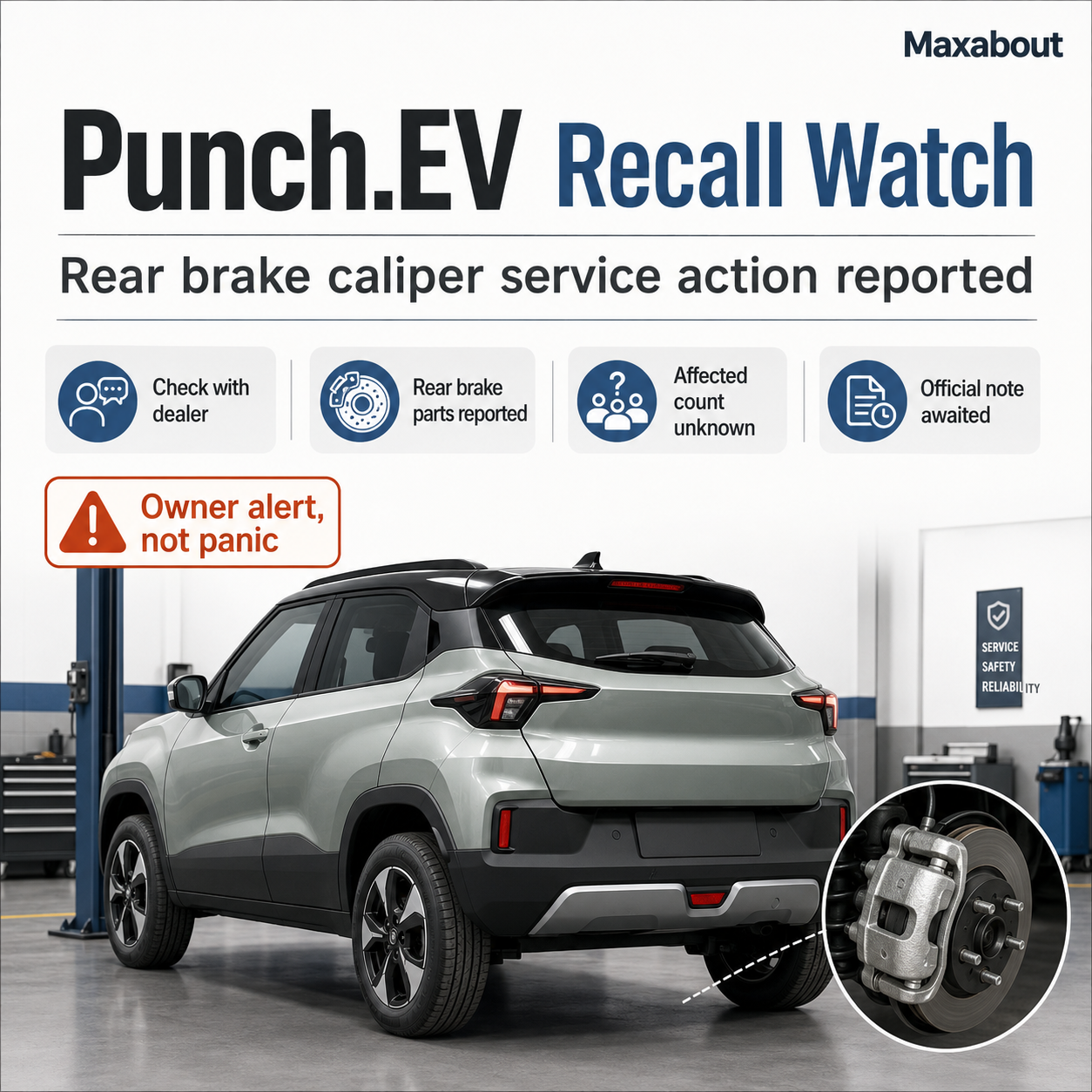 In simple terms, the rear brakes on the Punch.EV are responsible for sharing braking force with the front axle when you slow down. In an electric vehicle, this system is more complex than on a conventional car. It has to coordinate between regenerative braking — where the motor recaptures energy during deceleration — and the traditional hydraulic disc or drum brakes at the rear. Getting that balance right is critical.
From what industry reports indicate, the defect appears to be rooted in either a manufacturing inconsistency or a calibration mismatch in the rear brake components — rather than a fundamental design failure. Think of it like this: the system is designed correctly on paper, but something in the production process or software mapping has introduced variation that could affect braking response.
The concern becomes most pronounced during hard braking events — sudden stops in heavy traffic, emergency situations, or downhill stretches where rear brake contribution matters most. In everyday slow city driving, you may never notice anything unusual. But in a genuine emergency, inconsistent rear brake response is not a minor inconvenience. It directly affects stopping distance and vehicle stability.
This is precisely why the issue is classified as a safety recall rather than a routine service update.
Which Variants and Batches Are Affected
Tata Motors has not publicly released a specific VIN range, but the recall covers select production batches of the Punch.EV manufactured during a particular window. Both the Medium Range and Long Range variants appear to be included, though the exact scope depends on when your vehicle rolled off the production line.
If your Punch.EV was delivered in the earlier batches — particularly vehicles registered in late 2023 through mid-2024 — there is a reasonable chance it falls within the affected group. Later production units may have already incorporated the fix at the factory level.
How to check if your vehicle is affected:
Tata Motors is directly contacting owners via SMS and email registered at the time of purchase
Dealers are also reaching out through their own service networks
You can visit any authorised Tata Motors service centre and provide your Vehicle Identification Number (VIN) — typically found on the dashboard near the windshield or inside the driver-side door jamb
The entire inspection and rectification process is completely free of charge. This is standard practice for manufacturer-initiated safety recalls in India — owners bear no cost whatsoever.
How to Get Your Tata Punch.EV Fixed: The Recall Process in India
If you own a Punch.EV and are wondering what to do next, the process is fairly straightforward. Start by calling Tata Motors' customer care helpline or visit the nearest authorised service centre with your VIN ready. The service advisor will confirm whether your specific vehicle falls within the affected batch.
From what owners have reported, most recall repairs for brake-related issues are completed within a single day — sometimes just a few hours. That said, be realistic. If a large number of vehicles come in around the same time, wait times could stretch. Booking a prior appointment is genuinely the smarter move here.
On the convenience side, Tata Motors typically offers pickup and drop service in metro areas like Mumbai, Delhi, and Bengaluru. Smaller cities may vary, so it is worth confirming this when you call ahead.
Carry these when you visit:
Vehicle Registration Certificate (RC)
Your purchase invoice or ownership documents
A valid photo ID
Tata's service network is reasonably wide across India, covering most Tier-2 cities as well. However, in smaller towns, trained EV technicians can sometimes be limited. Being patient and scheduling early will save you unnecessary frustration.
Should You Be Worried? An Honest Assessment
Let me be straightforward here. A brake-related recall sounds alarming, and your concern is completely valid. But context matters enormously before you let anxiety take over.
Braking systems in electric vehicles are genuinely more complex than in conventional cars. The Punch.EV uses regenerative braking alongside traditional hydraulic brakes, and these two systems must work in precise coordination. Electronic brake distribution adds another layer. When software or hardware calibration in this setup drifts even slightly, manufacturers catch it through monitoring data and issue a recall. That is actually the system working as intended.
This is not the same as discovering a structural crack in your chassis. Brake calibration issues and component replacements are among the more straightforward defects to address. Global automakers including Hyundai, Volkswagen, and even Tesla have issued similar brake-related recalls on EVs, followed them through efficiently, and seen no lasting safety impact for owners.
In India specifically, Tata has handled previous recalls on the Nexon EV without significant incidents reported post-fix. That track record offers some reasonable reassurance.
The honest advice? Do not ignore this recall, but do not catastrophise either. Get the fix done promptly, drive with normal caution in the meantime, and trust that a manufacturer issuing a proactive recall is demonstrating responsibility, not incompetence.
Tata Punch.EV's Overall Track Record: Putting This Recall in Context
Step back from this recall for a moment and look at the bigger picture. The Tata Punch.EV has, by most reasonable measures, been a genuine success story in India's still-maturing electric vehicle market. Since its launch, it has consistently figured among the top-selling electric passenger vehicles in the country — a meaningful achievement given how price-sensitive and skeptical Indian buyers tend to be toward new technology.
What has driven that acceptance? A few things stand out. The real-world range on the longer-range variant has drawn broadly positive feedback, particularly from urban owners in cities like Pune, Hyderabad, and Bengaluru who charge overnight and rarely stress about daily commutes. The feature set — connected car technology, a decent touchscreen interface, multiple drive modes — feels genuinely competitive at its price point rather than stripped down to hit a number.
Pricing has also worked in its favour. Positioned accessibly relative to rivals, it brought electric mobility within reach for buyers who found other options a stretch.
That said, ownership reports have flagged occasional software glitches and some inconsistency in after-sales service quality depending on location. These are not catastrophic concerns, but they are real. Tata's service network, while expanding, remains uneven outside major metros.
The honest assessment? This recall does not erase a largely positive track record. It is one chapter, not the whole story.
What This Recall Means for EV Buyers in India Going Forward
Recalls are routine in mature automotive markets. In the United States or Europe, manufacturers issue them regularly, buyers respond without panic, and the process moves efficiently. In India, we are still building that muscle. Many buyers hear the word "recall" and immediately assume the worst. That instinct is understandable, but it is worth stepping back.
The bigger concern here is not the recall itself. It is whether Indian EV buyers have reliable, timely access to recall-related information. Honestly, that system still needs work. Government bodies and industry groups like SIAM have frameworks in place, but awareness at the ground level remains inconsistent. A first-time EV buyer in a smaller city may simply never hear about an active recall unless the manufacturer reaches out directly.
This is exactly why vehicle registration accuracy matters more than people realise. If your contact details on record are outdated, critical service communications never reach you. It sounds basic, yet it catches buyers off guard more often than it should.
When purchasing any new EV, staying engaged with the manufacturer beyond the showroom visit is genuinely important. Follow official announcements, keep your service history updated, and do not ignore dealer communications, even the ones that seem routine.
The Indian EV market is maturing fast. Recalls, handled responsibly, are actually a sign of accountability, not failure.
Final Thoughts: Stay Calm, Stay Informed, Get It Fixed
Here is the straightforward summary: the Tata Punch.EV recall is real, it involves a genuine safety concern with the rear braking system, and it needs your attention. Not tomorrow, not next week.
That said, there is no reason to panic. Tata is addressing this through authorised service centres, the fix is covered at no cost to you, and affected vehicles remain usable in most normal conditions. What matters now is that you act on the information rather than set it aside.
Check your VIN against the official recall list, contact your nearest Tata dealer, and book your service appointment promptly. The process is straightforward, and the correction, once done properly, should restore your confidence in the vehicle completely.
The broader Punch.EV story remains compelling. Strong range, practical dimensions, and a growing service network make it a solid choice for urban and semi-urban buyers. One recall does not change that picture, provided the fix is carried out correctly and thoroughly.
If you know other Punch.EV owners, share this information with them directly. Not everyone reads official notices carefully. A simple message to a fellow owner could genuinely matter.
Explore the story
Related news

Share your view and join the discussion.
Earn reward points for every comment and get a chance to win ₹1,000 in our weekly lucky draw. Sign in with Google in one tap.
Start the conversation
No one has commented on this article yet. Be the first to share your view.
Want to read more automotive news?
Stay updated with the latest car launches, reviews, and industry insights.
Browse All News