
Tata Nexon Gets Panoramic Sunroof Under ₹10 Lakh
For the longest time, a panoramic sunroof in India was simple: you either paid a premium for it, or you went without. We're talking about a feature that has traditionally sat behind a ₹12 lakh to ₹15 lakh price wall, tucked into higher trims of the Hyundai Creta, Kia Seltos, or Maruti Grand Vitara. ...
Editorial Team
For the longest time, a panoramic sunroof in India was simple: you either paid a premium for it, or you went without. We're talking about a feature that has traditionally sat behind a ₹12 lakh to ₹15 lakh price wall, tucked into higher trims of the Hyundai Creta, Kia Seltos, or Maruti Grand Vitara. It was aspirational by design — something younger buyers in Bengaluru or Pune would scroll past on brochures, knowing it was just out of reach.
That changes now. Tata has introduced a new Nexon variant that brings a panoramic sunroof under the ₹10 lakh mark — and this is not a gimmick or a cleverly worded marketing headline. It is a genuine first in the Indian SUV segment.
Why does this matter? Because the sunroof, fairly or not, carries real aspirational weight for Indian buyers — especially first-time SUV owners in metro cities. It signals a certain lifestyle. Weekend drives on the Expressway out of Delhi, open skies on a coastal road near Mumbai. That feeling has always come at a cost. Until now.
This is worth examining honestly — what Tata is actually offering, what the trade-offs might be, and whether this move genuinely reshapes the sub-₹10 lakh SUV conversation.
What Is the New Nexon Variant and What Does It Actually Offer?
Tata has introduced the Nexon Creative+ S variant, slotting it into the mid-tier section of the lineup — positioned above the base Creative trims but leaving room for the higher Pure S and Fearless grades above it. The pricing sits just under the ₹10 lakh mark, which is precisely the point Tata is making with this launch.
The headline addition is, of course, the panoramic sunroof — a single-pane unit that stretches generously across the roofline. For a vehicle in this price bracket, that alone is a genuine first. No other SUV in the sub-₹10 lakh space has offered this feature from a mainstream manufacturer.
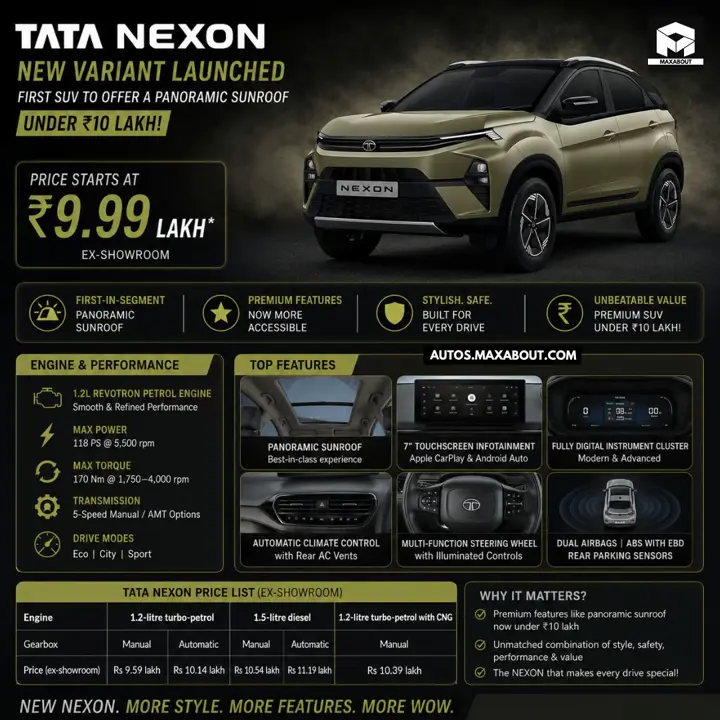 Beyond the sunroof, the variant bundles in a reasonably useful feature set. You get a 10.25-inch touchscreen infotainment system, wireless phone charging, a PM2.5 air purifier, and automatic climate control. The ventilated front seats, which buyers often associate with premium segments, are also part of this package.
On the powertrain front, the Creative+ S is available with both the 1.2-litre turbocharged petrol and the 1.5-litre diesel engine options. However, transmission choices are worth noting — the petrol is offered with a manual gearbox, while the diesel gets both manual and automatic options. Tata appears deliberate here, keeping the entry price accessible while letting buyers step up for the convenience of an automatic.
That kind of strategic bundling is something Tata has refined over recent years with the Nexon.
How Does the Pricing Stack Up Against the Competition?
This is where things get genuinely interesting. Tata has priced this new variant at roughly ₹9.99 lakh (ex-showroom), and that positioning is quite deliberate. To put it in perspective, the Hyundai Venue and Kia Sonet both offer panoramic sunroofs, but you are looking at crossing the ₹12–13 lakh mark to get there. The Maruti Fronx similarly reserves its sunroof for higher trims, pushing past ₹11 lakh. The Volkswagen Taigun is even further up the ladder at ₹13 lakh-plus for comparable features.
So the Nexon is undercutting the competition by a meaningful margin — not a token few thousand rupees, but ₹1.5 to ₹3 lakh depending on which rival you compare it against.
That said, it is worth being honest here. The Nexon achieves this price partly by trimming certain features found in pricier variants and rivals — think ventilated seats, connected car tech, or a more premium sound system. It is a trade-off, and buyers need to weigh whether the panoramic sunroof alone justifies the choice over a feature-richer alternative slightly above the ₹10 lakh ceiling.
Still, for a first-time SUV buyer in cities like Pune, Jaipur, or Lucknow, where budget sensitivity is real, this pricing makes the decision considerably easier.
The Panoramic Sunroof Experience in Indian Conditions: Is It Practical?
Here is where things get genuinely interesting — and honestly, a little complicated. A panoramic sunroof sounds wonderful in theory. Open skies, highway wind, that premium feeling. But India has a way of stress-testing every feature in ways European or Japanese engineers probably never anticipated.
Let's start with the obvious concern: heat. If you live in Hyderabad, Chennai, or Nagpur, summers are brutal. Parking under direct sunlight turns any car into an oven, and a large glass panel overhead only accelerates that process. Most panoramic sunroofs in this price segment do come with UV-resistant coating and a retractable shade, which helps considerably. But "helps" is doing a lot of work in that sentence. From what reviewers and long-term owners consistently report, the cabin still heats up noticeably faster compared to a standard roof, and your air conditioning works harder to compensate — which impacts fuel efficiency in city traffic.
Monsoon season introduces a different set of worries. Dust sealing and water leakage are the most common complaints among sunroof owners across India. Over time, the rubber seals wear down, drainage channels get clogged with debris, and suddenly you have a slow drip problem that no one wants to deal with. Motor failures after three to four years are also a reported issue, and replacement costs are not insignificant.
Where the sunroof genuinely earns its place is on evening highway drives — think the Pune-Mumbai expressway or stretching out on NH48 after sunset. That experience is real and worth something.
Honestly, for most Indian buyers, this remains a lifestyle feature first, a functional one second. And there is nothing wrong with that.
What You Give Up: The Trade-Offs in This New Variant
Every compromise has a price. In this case, the price is headroom. The panoramic sunroof structure adds bulk to the roofline from the inside, and in a compact SUV like the Nexon, that matters more than people initially realize. If your family regularly seats someone above six feet, rear seat comfort becomes a genuine conversation worth having before signing the dotted line.
This is not a hypothetical concern. Indian families often travel with elderly passengers or taller relatives squeezed into the back. That slight reduction in overhead clearance, maybe 30 to 40mm in practice, can shift a comfortable journey into an uncomfortable one on longer drives.
Then there is the question of what else was quietly left out to keep this variant priced under ₹10 lakh. From what industry observers have noted, this specific variant sits below the trim levels that offer connected car technology and Tata's ADAS suite. So you are trading advanced safety assistance features for the sunroof experience. For some buyers, that is a reasonable swap. For others, especially those prioritizing active safety, it deserves serious thought.
Ventilated seats also remain absent here — and given Indian summers, that omission stings more than it might in any other market.
In short, this variant makes one bold promise and keeps it. Everything else is a calculated reduction.
Tata Nexon's Track Record: Safety, Service, and Long-Term Ownership
Beyond any single variant or feature headline, the Nexon has built something genuinely valuable over the years — a reputation. And in the Indian market, where long-term ownership anxiety is very real, that matters enormously.
The 5-star Global NCAP safety rating remains one of the Nexon's most powerful selling points. It was a landmark moment for Indian cars when it happened, and it continues to influence buyer confidence today. Families in particular cite this rating as a primary reason for choosing the Nexon over similarly priced competitors.
On the reliability front, existing owners generally report positive experiences. The petrol engine has proven durable across varied conditions — from Mumbai's stop-and-go coastal humidity to the dusty stretches around Jaipur and Nagpur. The electric variant has its own loyal following, though that is a separate conversation.
Service network coverage has expanded meaningfully across Tier 2 cities in recent years. Places like Coimbatore, Bhopal, and Lucknow now have dedicated Tata service infrastructure, which reduces the anxiety of owning a Tata product outside major metros.
Maintenance intervals are reasonable, and spare parts availability has improved considerably. Insurance costs sit in a predictable range given the segment. From what owners commonly report, after-sales experiences are largely consistent — not perfect, but dependable enough to build trust over time.
Who Should Buy This Variant — And Who Should Look Elsewhere?
If you are a young professional living in Bengaluru, Pune, or Mumbai, driving mostly on city roads and expressways, and you want that open-roof feeling without crossing the ₹10 lakh mark — this variant was essentially designed for you. First-time SUV buyers who want a premium experience on a realistic budget will find this genuinely hard to argue against.
Lifestyle matters here too. If weekend drives, rooftop parking lot moments, and the general aesthetic of a sunroof-equipped SUV appeal to you, this makes complete sense. The value proposition is difficult to ignore at this price point.
However, this variant is not for everyone. Be honest with yourself before buying:
Taller passengers or families with children will notice the reduced headroom that a panoramic sunroof typically introduces
Buyers who prioritize ADAS features like lane assist or autonomous emergency braking will need to look at higher trims or other options
If you frequently travel on dusty highways or rural roads, sunroof seals and tracks demand regular attention — something worth considering seriously
In my view, this variant rewards urban buyers who know exactly what they want. It asks you to make trade-offs, and not everyone should accept them.
Final Verdict: A Smart Move by Tata or Just a Marketing Play?
Honestly? It is both — and that is not necessarily a bad thing.
Bringing a panoramic sunroof under ₹10 lakh is genuinely significant. This is not a gimmick dressed up as progress. It shifts a feature that Indians have historically associated with premium segments into genuinely accessible territory. Competitors will notice. Some are probably already reworking their variant strategies as a response.
But does this make it the smartest Nexon to buy? Not automatically. If you want the most complete package — better safety tech, more comfort features, stronger long-term satisfaction — the mid-to-upper trims still present a stronger overall case. The sunroof variant wins on one specific, very visible front.
From where I stand, this addition does shift the Nexon's positioning meaningfully. It gives the nameplate a stronger emotional hook at an entry-friendly price, which matters enormously in India's crowded compact SUV space.
But here is the thought I would leave you with — a sunroof catching sunlight on your morning drive feels wonderful until it does not. Evaluate what your daily driving actually demands. Mumbai traffic, Bangalore rain, Rajasthan dust — your city and lifestyle should drive this decision, not a spec sheet moment that looks impressive at first glance.
Buy the Nexon that fits your life. Not the one that fits your Instagram.
Explore the story
Related news

Share your view and join the discussion.
Earn reward points for every comment and get a chance to win ₹1,000 in our weekly lucky draw. Sign in with Google in one tap.
Start the conversation
No one has commented on this article yet. Be the first to share your view.
Want to read more automotive news?
Stay updated with the latest car launches, reviews, and industry insights.
Browse All News