
Tata Motors PV Strategy: The Fight for 20% Market Share and Higher Margins
Tata Motors Passenger Vehicles has set a bigger FY30 ambition for India: an 18-20 percent passenger vehicle market share and a double-digit EBITDA margin. The plan is backed by a reported Rs 33,000-35,000 crore investment across passenger vehicle and electric vehicle operations over the next five ye...
Editorial Team
Tata Motors Passenger Vehicles has set a bigger FY30 ambition for India: an 18-20 percent passenger vehicle market share and a double-digit EBITDA margin. The plan is backed by a reported Rs 33,000-35,000 crore investment across passenger vehicle and electric vehicle operations over the next five years, with SUVs, CNG models and EVs forming the core growth pillars.
What you need to know
FY30 target: Tata Motors PV is aiming for 18-20 percent market share and double-digit EBITDA margin.
Investment plan: The company plans to spend around Rs 33,000-35,000 crore across PV and EV operations over five years.
EV roadmap: Tata plans five new EVs by FY30, while continuing to strengthen charging and battery-assurance support.
FY26 base: Tata PV sold 641,586 passenger vehicles in FY26, up 15 percent year on year.
Why Tata's FY30 target matters
The target is significant because Tata is not relying on only one trend. The company is positioning SUVs, CNG vehicles and EVs as parallel growth engines, which gives it a wider path to market-share gains even if one powertrain segment slows temporarily.
In the second half of FY26, Tata's PV market share reached 14.1 percent. Moving from that level to the 18-20 percent range by FY30 would require stronger product cadence, better supply readiness and continued traction in the high-growth SUV and electric vehicle categories.
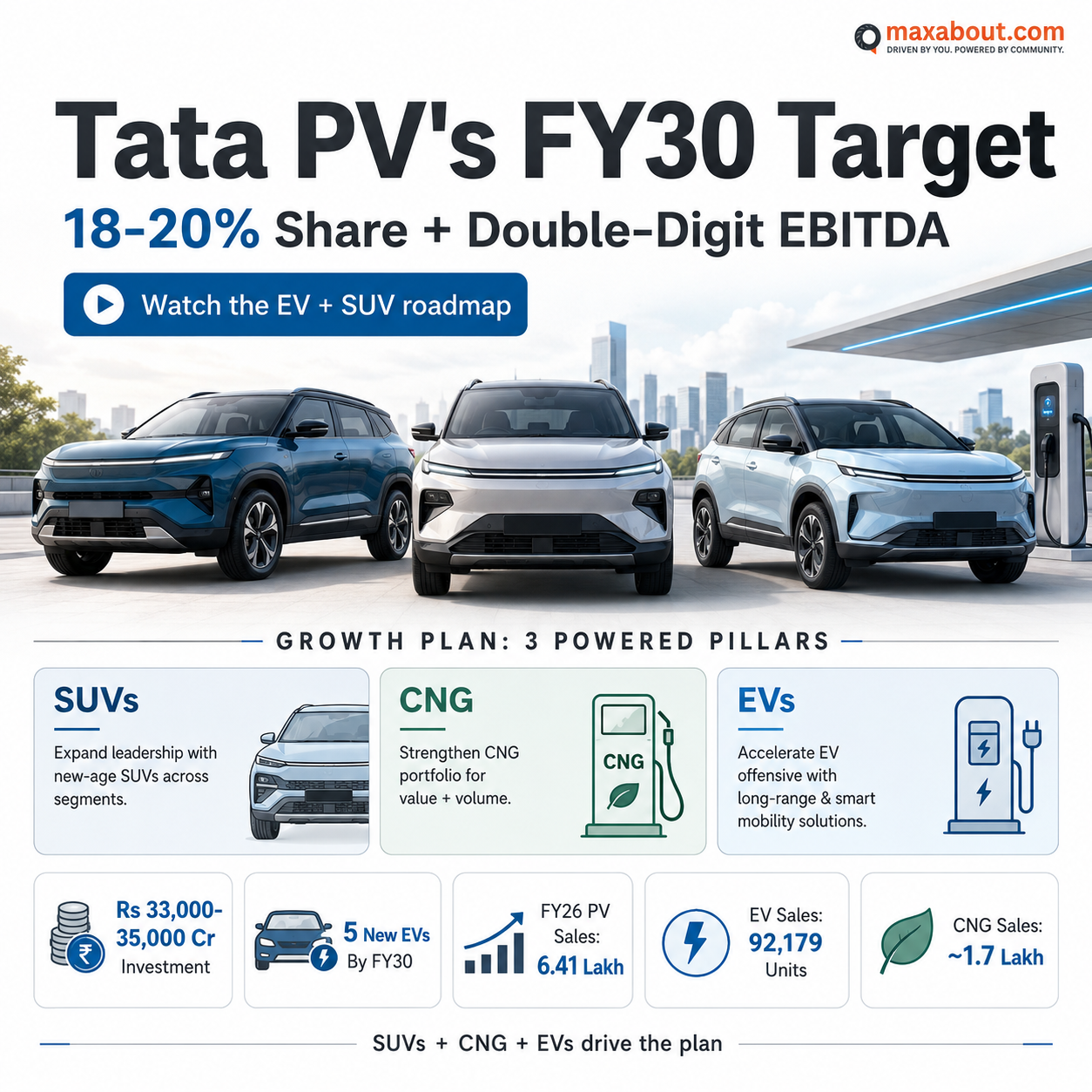
Key numbers from Tata's FY26 roadmap
| Metric | Reported figure | Why it matters |
|---|---|---|
| FY30 market-share target | 18-20 percent | Shows Tata wants to move beyond its current mid-teen share base. |
| PV and EV investment | Rs 33,000-35,000 crore | Supports product development, capacity expansion and electrification. |
| FY26 PV sales | 641,586 units | A 15 percent year-on-year rise, ahead of the broader industry growth cited in the source. |
| FY26 EV sales | 92,179 units | Up 43 percent year on year, with Tata retaining a strong domestic EV position. |
| Domestic EV market share | 40.2 percent | Gives Tata a leadership base as competition in electric cars increases. |
| CNG vehicle sales | About 170,000 units | Shows CNG remains an important bridge fuel for cost-conscious buyers. |
SUVs, CNG and EVs form the three-part plan
Tata's growth story is increasingly built around portfolio breadth. SUVs continue to drive the Indian passenger vehicle market, CNG models help address running-cost concerns, and EVs support the company's long-term electrification push.
The company is also focusing on reducing the ownership-cost gap between EVs and internal combustion engine vehicles. That includes expanding charging infrastructure and strengthening battery assurance programmes, both of which are important for buyers still comparing EVs with petrol, diesel and CNG options.
Five new EVs by FY30, but model details remain unconfirmed
The source report says Tata plans to launch five new EVs by FY30. However, specific model names, final launch timelines and variant details should be treated as unconfirmed unless Tata announces them separately. For now, the stronger confirmed takeaway is the direction of travel: Tata wants to defend and expand its EV lead while scaling the overall PV business.
What it means for Indian buyers and industry watchers
For buyers, the roadmap signals more choice across powertrains rather than a sudden EV-only shift. Tata is likely to keep serving mainstream petrol, diesel and CNG demand while using new EVs to strengthen its technology image and long-term market position.
For the industry, the investment number is the bigger signal. A Rs 33,000-35,000 crore plan suggests Tata expects India's passenger vehicle market to keep rewarding companies that can launch quickly, localise intelligently and support EV ownership beyond the showroom.
FAQs
What is Tata Motors PV's FY30 market share target?
Tata Motors Passenger Vehicles is targeting an 18-20 percent market share by FY30.
How much does Tata plan to invest in PV and EV operations?
The reported investment plan is around Rs 33,000-35,000 crore across passenger vehicle and electric vehicle operations over five years.
How many new EVs is Tata planning by FY30?
Tata plans to launch five new EVs by FY30, but the specific model-by-model details should be treated as unconfirmed until official announcements are made.
Why is CNG part of Tata's growth plan?
CNG remains important because many Indian buyers still prioritise lower running costs. Tata's reported FY26 CNG sales of about 170,000 units show that the segment continues to have scale.
Conclusion
The Tata Motors PV FY30 market share target is best read as a broad growth roadmap rather than a single launch story. If Tata can convert its planned investment into timely SUVs, CNG models and EVs, the company has a credible path to expanding its India passenger vehicle share while keeping profitability in focus.
Explore the story
Related news





Share your view and join the discussion.
Earn reward points for every comment and get a chance to win ₹1,000 in our weekly lucky draw. Sign in with Google in one tap.
Start the conversation
No one has commented on this article yet. Be the first to share your view.
Want to read more automotive news?
Stay updated with the latest car launches, reviews, and industry insights.
Browse All News