
Tata Motors Expands AI Integration Across Vehicle R&D and Manufacturing Process
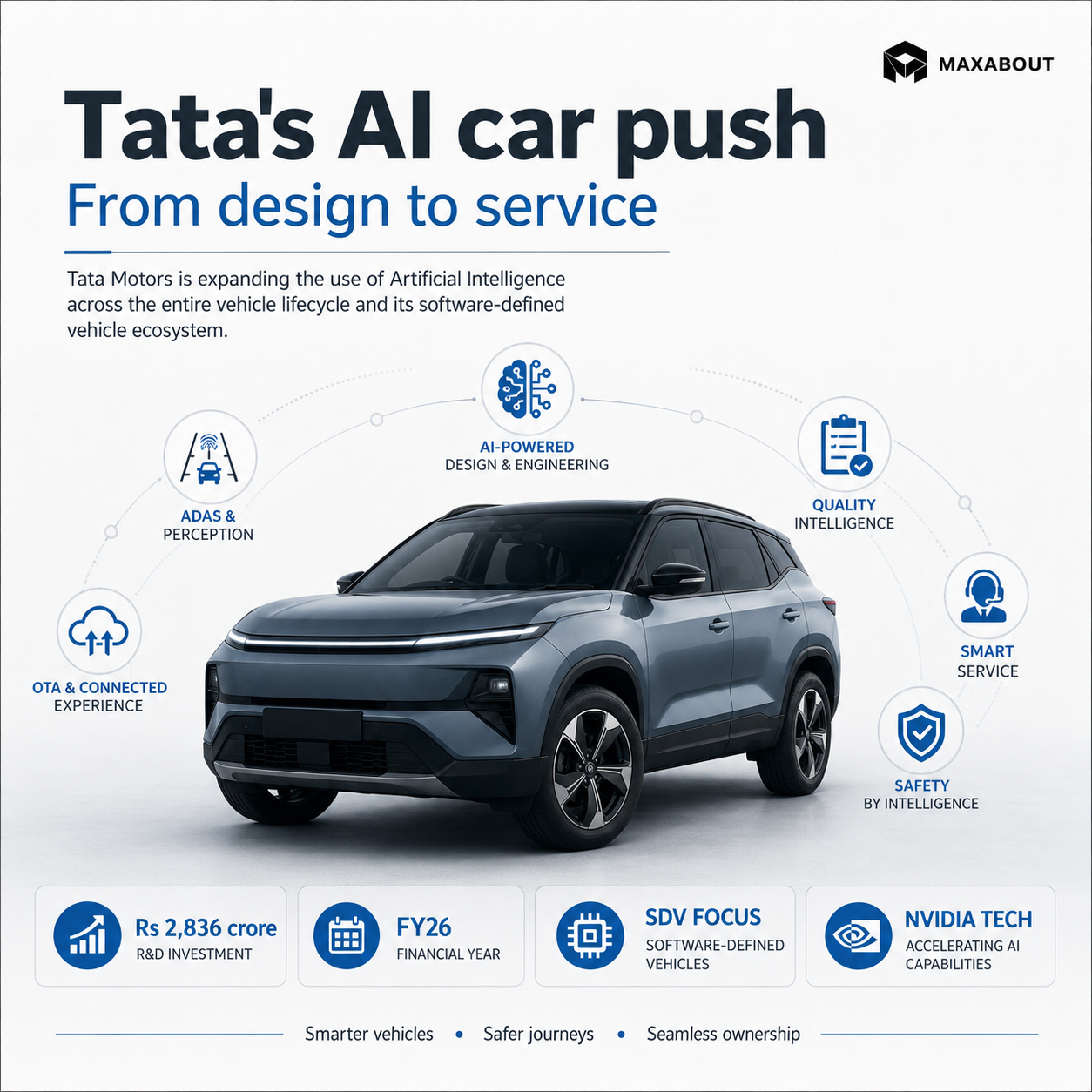
Tata Motors Passenger Vehicles is expanding the use of artificial intelligence across vehicle development, manufacturing, quality control, customer intelligence, service support and software-defined vehicle work. The company’s FY26 technology push is not only about adding digital buzzwords to future...
Editorial Team
Tata Motors Passenger Vehicles is expanding the use of artificial intelligence across vehicle development, manufacturing, quality control, customer intelligence, service support and software-defined vehicle work. The company’s FY26 technology push is not only about adding digital buzzwords to future cars; it points to a deeper shift in how Tata plans to design, build, update and support its next-generation passenger vehicles.
What you need to know
AI use cases: product development, market intelligence, quality checks, service support, safety and workforce tools.
R&D spend: Tata Motors Passenger Vehicles spent Rs 2,836 crore on R&D during FY26.
Software focus: software-defined vehicles, advanced electronics and connected systems are key focus areas.
Technology partner: the NVIDIA collaboration supports ADAS, connected functions, digital twins and AI-driven engineering.
What is not confirmed: the update does not confirm a model-wise rollout date for individual features.
Where Tata is using AI
The AI expansion covers both front-end and back-end operations. On the development side, AI can help engineers analyse data, simulate designs, validate vehicle systems and accelerate decisions. In manufacturing, computer vision and monitoring tools can help identify defects earlier and improve process consistency.
In customer-facing areas, AI can support service advisory functions, spare-parts forecasting, repair assessment and dealer performance tracking. That matters because a connected vehicle strategy is only useful if after-sales systems can keep pace with the technology inside the car.
How this connects to software-defined vehicles
A software-defined vehicle relies more heavily on software architecture to manage features, connectivity, driver assistance, updates and system behaviour. Tata’s AI push supports that shift because future vehicles will need cleaner data pipelines, smarter validation and more update-ready electronics.
| Focus area | Why it matters |
|---|---|
| ADAS and safety | Supports smarter driver-assistance and monitoring systems |
| OTA-capable platforms | Allows features and fixes to improve after purchase |
| Digital twins | Helps simulate factories and vehicle development processes |
| Quality inspection | Can detect defects earlier in production |
| Customer intelligence | Improves product planning from real-world feedback |
What it means for Indian buyers
For buyers, the immediate takeaway is not that every upcoming Tata car will suddenly become fully autonomous or AI-driven. The more realistic benefit is gradual improvement: smarter connected features, better diagnostics, faster service decisions, safer manufacturing processes and vehicles built on more flexible electronic architectures.
What remains unconfirmed
The company’s broader AI and SDV direction is clear, but feature-by-feature rollout remains model dependent. Specific ADAS upgrades, OTA feature timelines, pricing impact and availability across variants should be treated as unconfirmed until Tata announces them for individual vehicles.
FAQs
How much did Tata Motors spend on R&D in FY26?
Tata Motors Passenger Vehicles spent Rs 2,836 crore on research and development during FY26.
Does Tata’s AI push mean fully autonomous cars are coming immediately?
No. The current update points to broader AI use across development, manufacturing, service and software-defined vehicle systems, not an immediate fully autonomous launch.
Why is NVIDIA relevant to Tata Motors?
The NVIDIA collaboration supports advanced driver-assistance systems, connected features, digital twin tools and AI-led engineering work.
Tata Motors AI vehicle development is becoming a key part of the brand’s future-product strategy. The biggest impact may be less visible than a new exterior design, but it can influence how future Tata cars are engineered, updated, serviced and improved over time.
Explore the story
Related news
Share your view and join the discussion.
Earn reward points for every comment and get a chance to win ₹1,000 in our weekly lucky draw. Sign in with Google in one tap.
Start the conversation
No one has commented on this article yet. Be the first to share your view.
Want to read more automotive news?
Stay updated with the latest car launches, reviews, and industry insights.
Browse All News