
Tata Motors CV Capex FY27: ₹3,000 Crore Plan Explained
Tata Motors' commercial vehicle division has decided to hold its FY27 capital expenditure at approximately ₹3,000 crore — broadly unchanged from earlier plans, but now wrapped in a noticeably cautious outlook. The company is not slashing budgets dramatically, but it is clearly watching every rupee m...
Editorial Team
Tata Motors' commercial vehicle division has decided to hold its FY27 capital expenditure at approximately ₹3,000 crore — broadly unchanged from earlier plans, but now wrapped in a noticeably cautious outlook. The company is not slashing budgets dramatically, but it is clearly watching every rupee more carefully than before.
The trigger? The ongoing West Asia crisis. Disruptions in that region are rippling outward — affecting freight rates, fuel supply chains, and global trade confidence. For a company whose trucks and buses literally keep India moving, that kind of external uncertainty is impossible to ignore.
Now, you might wonder why this matters beyond boardroom discussions and investor calls. It actually goes much further than that. Think about the fleet operator running ten trucks between Mumbai and Delhi. Or the cold-chain logistics company moving vegetables from Punjab farms to metro supermarkets. Their decisions — whether to expand fleets, upgrade vehicles, or sit tight — are directly shaped by what manufacturers like Tata Motors signal about the road ahead.
When a company of this scale turns cautious, it reflects something real about ground-level economic confidence. This is as much a story about Indian roads, supply chains, and everyday prices as it is about corporate finance.
Understanding the ₹3,000 Crore Capex Plan and What It Covers
So what does ₹3,000 crore actually mean in practical terms? For most of us, it's just a large number. But for a commercial vehicle manufacturer operating at Tata Motors' scale, it represents the financial fuel that keeps product pipelines moving, factories modernising, and service networks expanding.
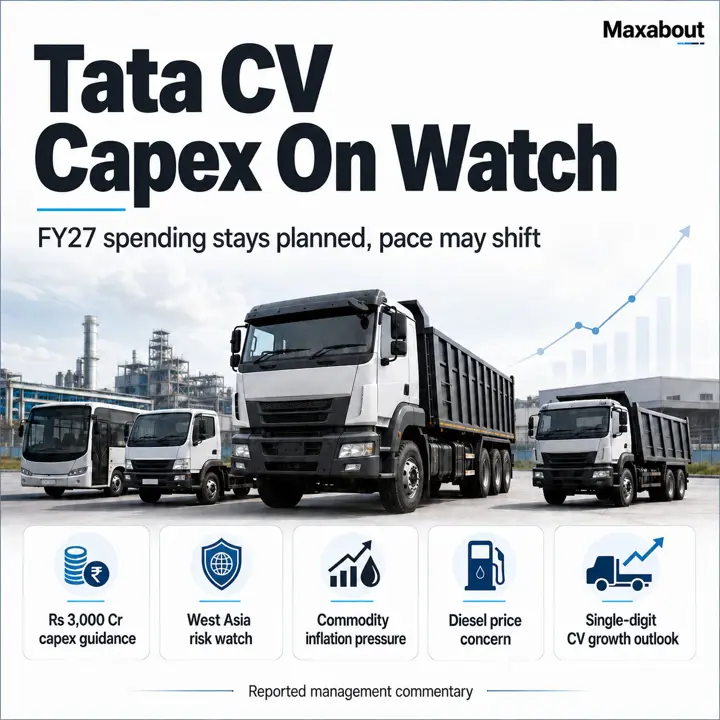 Capital expenditure in the CV space typically gets allocated across several critical areas. New product development — designing next-generation trucks, buses, and electric platforms — is expensive and time-consuming. Then there are manufacturing capacity upgrades at plants like Pune and Jamshedpur, where tooling, automation, and assembly line improvements require constant investment. Add to that the cost of regulatory compliance — BS6 Phase 2 and OBD norms have pushed engineering costs significantly higher across the industry.
From what industry observers note, ₹3,000 crore is neither extravagant nor minimal for a player of this size. It's a working figure — enough to maintain momentum without making aggressive bets. The key signal here is that Tata Motors chose to retain this number rather than increase it. That distinction matters. It's a deliberate pause, not a withdrawal. The company isn't cutting back; it's simply choosing not to accelerate during a period of external uncertainty.
Think of it like a long-distance truck driver easing off the accelerator on a foggy highway. You're still moving forward — just more carefully.
The West Asia Crisis Factor: How a Distant Conflict Hits Indian Trucking
It might seem strange at first. A conflict thousands of kilometres away, in the Middle East, somehow influencing whether a truck operator in Nagpur can afford to expand his fleet. But that's exactly how interconnected modern economies are — and Tata Motors clearly understands this.
The most direct hit comes through crude oil prices. West Asia supplies a significant chunk of India's crude imports. When that region turns volatile, oil markets get nervous, prices spike, and diesel costs follow. For a long-haul trucker running the Delhi-Mumbai corridor or the Chennai-Kolkata stretch, diesel isn't just an expense — it's the difference between profit and loss on every single trip.
When fuel costs climb unpredictably, fleet operators do what any sensible business would do. They defer new vehicle purchases. They delay upgrades. They squeeze more life out of existing trucks rather than committing to fresh EMIs. That directly softens demand for new commercial vehicles — which is precisely Tata Motors' core business.
Beyond fuel, there's the freight rate volatility problem. Disrupted shipping lanes and uncertain export markets make logistics planning genuinely difficult. Indian exporters hesitate. Cargo volumes fluctuate. And when freight confidence drops, the ripple reaches every truck, every bus, every logistics company operating domestically.
Raw material sourcing and semiconductor supply chains also carry indirect exposure to regional instability — something Tata Motors, from experience, takes seriously.
What This Means for Tata's Commercial Vehicle Product Roadmap
Holding capex steady at around ₹3,000 crore sounds stable on paper. But in practice, cautious spending during a period of rapid product transition carries real consequences for what fleet operators and logistics businesses can expect from Tata's CV lineup over the next two to three years.
Electric commercial vehicles are arguably the most vulnerable segment here. Tata has been pushing electric buses and light trucks with genuine momentum. Any slowdown in R&D allocation could mean stretched timelines for next-generation electric freight platforms — vehicles that smaller fleet operators are genuinely waiting on.
CNG truck variants and next-generation heavy trucks also sit within this uncertainty. From what industry observers suggest, competitors in the CV space are continuing to invest aggressively in alternative fuel platforms. A cautious Tata could find itself playing catch-up rather than leading.
That said, this is not necessarily alarming. Strategic recalibration often produces sharper priorities — fewer scattered bets, more focused execution. A leaner capex cycle might actually accelerate decisions on which platforms genuinely deserve investment.
For fleet operators running high-mileage intercity routes, the ask is simple — efficient, reliable, affordable options delivered on time. Whether a capex freeze delays that or simply refines it remains the real question worth watching.
The Broader Indian Commercial Vehicle Market: Growth or Slowdown Ahead?
The Indian CV market heading into FY27 is genuinely a mixed picture. There are real growth drivers at work, but the headwinds are not trivial either. Understanding which force dominates helps explain whether Tata's cautious capex stance reflects the wider industry mood or is simply an internal conservative call.
On the positive side, the government's infrastructure momentum remains significant. Highway construction continues at a serious pace, with official announcements pointing to sustained National Infrastructure Pipeline investments. Active mining corridors in states like Odisha, Rajasthan, and Jharkhand are keeping heavy-duty tipper demand reasonably firm. Meanwhile, e-commerce expansion — particularly faster delivery expectations in Tier 2 and Tier 3 cities — is genuinely lifting last-mile light commercial vehicle volumes. State transport undertakings are also showing renewed interest in bus fleet renewals, which had been stagnant for years.
But the headwinds deserve equal attention. Fleet financing remains expensive, with interest rates still elevated enough to squeeze smaller operators who depend heavily on borrowed capital. Fuel costs add further pressure on margins. Driver shortages, a persistent structural problem on Indian highways, are limiting fleet expansion ambitions even when demand exists.
Industry reports suggest overall CV volume growth may moderate compared to the sharp post-pandemic rebound years. This broader softening context matters — Tata's capex caution likely reflects genuine market-level uncertainty, not just company-specific conservatism.
Impact on Fleet Operators, Transporters, and the Logistics Sector
For a truck fleet owner running ten vehicles out of Ludhiana or managing a small logistics operation in Rajkot, Tata's capex decisions are not abstract boardroom numbers. They translate into very real, practical consequences at the ground level.
Consider delivery timelines. When a manufacturer slows capacity expansion, order-to-delivery windows for new trucks tend to stretch. A transporter in Hyderabad planning to add four vehicles before the peak freight season may find himself waiting longer than anticipated, disrupting growth plans that were built around specific timelines.
Then there is the spare parts question. Capex restraint often means slower rollout of upgraded service infrastructure — fewer new dealer workshops, delayed parts inventory expansion in smaller towns. For a driver stranded on the Nagpur-Mumbai stretch with a component failure, that gap between intent and infrastructure is very real money lost.
Older fleet models staying on the road longer is another consequence worth noting. From a fuel efficiency and emissions standpoint, this is genuinely problematic.
Electric Commercial Vehicles: Will Caution Slow Down India's EV Trucking Push?
This is arguably where the stakes get highest. India's electric commercial vehicle segment has been building genuine momentum — electric buses under PM e-Bus Sewa, electric three-wheelers dominating last-mile delivery corridors in cities like Bengaluru and Pune. Tata Motors has been a central player in that story. A cautious capex posture now raises a fair question: does restraint here cost more later?
Electrifying commercial vehicles isn't like flipping a switch. Battery technology investment, new manufacturing lines, and charging infrastructure partnerships all require sustained, forward-looking capital commitment. Pausing or trimming that pipeline — even temporarily — can push product timelines out by 12 to 18 months. In a segment moving this quickly, that gap matters.
For fleet operators planning transitions to electric trucks or buses, uncertainty from a key manufacturer is genuinely disruptive. Procurement cycles for large fleets run years in advance. If Tata's EV roadmap signals even mild delays, operators may defer commitments or look elsewhere.
That said, spending recklessly during a period of genuine macroeconomic stress isn't wisdom either. Targeted, disciplined investment in EV platforms — rather than broad capex — could actually sharpen focus. The risk is whether that discipline holds firm on electrification specifically, or whether EV programs quietly absorb the cuts.
Final Thoughts: Reading Tata Motors CV's Cautious Stance the Right Way
Holding capex at ₹3,000 crore is not a retreat. It is a deliberate pause — and in the current environment, that distinction matters more than it might seem.
Global uncertainty is real. West Asia tensions, volatile oil prices, and softening freight demand are not manufactured concerns. Tata's CV arm is simply acknowledging what the data is already showing.
The signals worth watching over the next two or three quarters are fairly specific. Oil price trajectories will shape fleet operator sentiment directly. Government infrastructure disbursements — road contracts, logistics corridor progress — will tell us whether domestic demand has genuine support beneath it. And Tata's own dispatch numbers and order book depth will be the clearest indicator of whether this caution is temporary positioning or something more structural.
For India's broader automotive and logistics landscape, this moment is genuinely instructive. Discipline at the top tends to set the tone across the industry.
The more interesting story isn't what Tata spends this year. It is where that spending goes when confidence returns — and whether electrification remains the priority it was promised to be.
Explore the story
Related news


No comments yet
Be the first to share your thoughts!
Want to read more automotive news?
Stay updated with the latest car launches, reviews, and industry insights.
Browse All News