
Tata Harrier & Safari Red Dark Diesel Variants: Premium Edition Launch
Tata's Bold Move: Red Dark Editions Hit the Indian MarketTata Motors has recently expanded its premium SUV lineup with the launch of the Harrier and Safari Red Dark diesel variants. Unveiled in early 2023, these special editions represent Tata's growing commitment to the upscale SUV segment in India...
Editorial Team
Tata's Bold Move: Red Dark Editions Hit the Indian Market
Tata Motors has recently expanded its premium SUV lineup with the launch of the Harrier and Safari Red Dark diesel variants. Unveiled in early 2023, these special editions represent Tata's growing commitment to the upscale SUV segment in India. What makes these Red Dark editions particularly noteworthy is their striking aesthetic appeal combined with enhanced feature sets.
The timing couldn't be better, as Indian buyers increasingly look for SUVs with distinctive personality. From what I've observed, these Red Dark variants target discerning customers who want something beyond the standard offerings—those who appreciate both visual drama and functional upgrades in their vehicles.
These editions form an important part of Tata's strategy to move upmarket while maintaining their strong value proposition. With competitors like Mahindra and MG pushing into premium territory, Tata's response with these Red Dark variants shows they're serious about retaining their foothold in the ₹20-30 lakh segment.
The special editions also indicate Tata's understanding of the Indian premium SUV buyer who wants exclusivity without stepping into luxury brand territory—something particularly relevant in tier 1 and tier 2 cities where status symbols matter.
Design Evolution: What's New in the Red Dark Editions
The Red Dark editions of the Harrier and Safari represent a significant visual upgrade over their standard counterparts. The most striking element is the deep Oberon Black exterior paint complemented by bold Carnelian Red accents that trace the vehicle's character lines, creating a sophisticated yet aggressive stance on Indian roads.
The front fascia features darkened chrome elements and a distinctive Red Dark badge that immediately sets these editions apart in traffic. I particularly like the 18-inch Charcoal Black alloy wheels with red brake calipers peeking through—a sporty touch rarely seen in this segment.
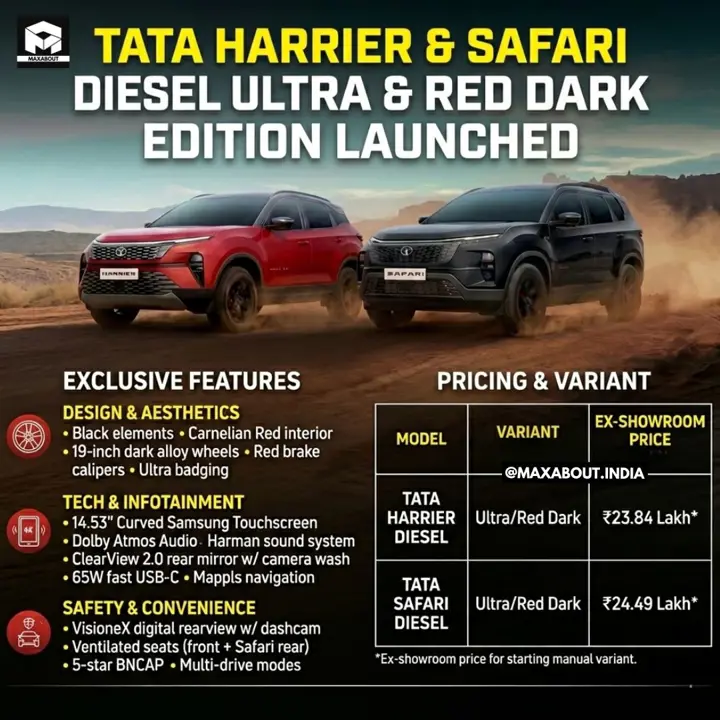 Inside, the cabin transformation is equally impressive. The red and black theme continues with:
Carnelian Red leatherette seats with contrast stitching
Dark chrome accents replacing conventional bright chrome
Red ambient lighting that creates a premium atmosphere
Unique piano black dashboard inserts with subtle red detailing
The cabin materials feel noticeably upgraded, with softer touch surfaces and more substantial switchgear. During a recent dealership visit in Bangalore, I was impressed by how these design elements elevate the interior ambiance—something particularly valuable during long commutes in congested urban traffic.
The Red Dark editions manage to strike that difficult balance between flashy and sophisticated—perfect for buyers in cities like Delhi, Mumbai and Hyderabad who want their SUV to stand out without appearing gaudy. In a market where personalization is becoming increasingly important, these design tweaks deliver a genuinely distinctive presence on Indian roads.
Tech Upgrades: Features That Justify the Premium
The Red Dark editions don't just look premium—they're packed with meaningful tech upgrades that actually enhance the driving experience. The centerpiece is the larger 10.25-inch infotainment system, which offers noticeably better responsiveness than the standard variants. I find this particularly useful when navigating through Bangalore's confusing one-ways or Mumbai's dense traffic.
Perhaps the most significant addition is the ADAS (Advanced Driver Assistance Systems) suite with features like:
Autonomous emergency braking
Lane keep assist
Blind spot detection
Forward collision warning
These aren't just luxury gimmicks—they're practical safety features for our chaotic traffic conditions. The 360-degree camera is another standout, making it dramatically easier to navigate tight parking spots in crowded markets and apartment complexes.
Ventilated front seats are a godsend in our climate, especially during those sweltering summer traffic jams in cities like Chennai or Delhi. The wireless charging pad eliminates cable clutter, while the 9-speaker JBL audio system delivers impressive sound quality—something I think enhances those long highway drives to weekend getaways.
Compared to the standard variants, these additions represent approximately ₹1.5-2 lakh in added value, making the premium pricing structure feel justified rather than excessive. These aren't just superficial additions but thoughtful improvements addressing specific Indian driving needs.
Performance Analysis: The Diesel Engine Experience
At the heart of both the Harrier and Safari Red Dark editions sits a robust 2.0-liter Kryotec diesel engine producing 170 PS and 350 Nm of torque. The power delivery feels confident, with a satisfying surge once you cross the 1800 RPM mark—particularly useful when overtaking on highways like the Mumbai-Pune Expressway.
The 6-speed automatic transmission in these models deserves special mention. It shifts smoothly and intelligently, especially in city traffic conditions like those in Bangalore or Delhi. The manual option offers better control for enthusiasts, though I find the clutch slightly heavy for bumper-to-bumper situations.
Fuel efficiency hovers around 14-15 km/l on highways and 10-12 km/l in city conditions—respectable figures considering the vehicles' size and weight. This matters significantly when you're covering long stretches between cities where fuel stations can be sparse.
What's interesting is Tata's commitment to diesel when competitors are scaling back. For long-distance travelers covering 1500+ km monthly, the diesel economics still make perfect sense in the Indian context. The engine refinement has improved noticeably from earlier iterations, with reduced vibration and cabin noise.
The multi-drive modes (Eco, City, Sport) genuinely alter the vehicle's character—not just gimmicks as in some competitors. Sport mode transforms these SUVs, making them surprisingly nimble for their size when navigating through ghat sections or hilly terrain.
Value Proposition: Pricing and Positioning
The Red Dark editions command a premium of approximately ₹25,000-30,000 over their regular Dark Edition counterparts, which I think is reasonable considering the comprehensive upgrades. The Harrier Red Dark starts at ₹21.85 lakh and goes up to ₹25.85 lakh for the top variant, while the Safari Red Dark ranges from ₹22.35 lakh to ₹26.35 lakh (all ex-showroom).
When compared to similarly equipped competitors like the Jeep Compass (₹24.95-29.95 lakh) or MG Hector (₹18.8-24.7 lakh), the value proposition becomes clearer. The Tata twins offer ADAS features at a price point where most rivals don't even include them as options.
Beyond the upfront cost, these diesels typically deliver lower long-term ownership costs in India. Tata's extensive service network—over 400 touchpoints across the country—provides accessibility that European competitors simply can't match. Maintenance packages range between ₹25,000-45,000 for 3-year comprehensive coverage, which is competitive for this segment.
Resale value is another strong point. Based on market trends, these premium Tata SUVs typically retain 65-70% of their value after three years, outperforming many competitors in the segment by 5-10 percentage points.
Competitive Landscape: How They Stack Against Rivals
When comparing the Red Dark editions against competitors, the landscape becomes quite interesting. The Tata Harrier and Safari have carved out a unique position with these special editions, particularly in the styling department. I find that while the MG Hector offers a more tech-loaded package with its massive touchscreen and connected features, it doesn't quite match the premium feel of the Red Dark's interiors.
The Jeep Compass remains the driver's choice with superior handling dynamics and off-road capabilities, but comes at a significantly higher price point—starting around ₹20 lakh and climbing well past ₹30 lakh for higher variants. The Red Dark editions deliver about 80% of that experience at a more accessible price.
Against the Mahindra XUV700, which has been a runaway success, the Safari Red Dark offers comparable space but with more distinctive styling. The XUV700 counters with ADAS features that Tata doesn't yet offer in this segment, giving it a technological edge.
The Hyundai Tucson stands out with its avant-garde design and refined driving experience, but its pricing (starting around ₹29 lakh) puts it in a different bracket altogether.
Where Tata really scores is in the value proposition. For buyers seeking presence, spacious cabins, and distinctive styling without breaking the bank, the Red Dark editions hit a sweet spot that competitors struggle to match in the Indian context.
The Ownership Experience: What to Expect
When investing in a Tata Harrier or Safari Red Dark edition, the ownership package is quite comprehensive. Tata offers a standard 2-year/1,00,000 km warranty that can be extended up to 5 years, providing peace of mind for long-term ownership.
Service intervals typically come every 15,000 km or annually, which is competitive for the segment. Based on owner feedback, maintenance costs for these diesel variants hover around ₹8,000-12,000 for regular services, which is reasonable considering their size and technology.
Tata Motors has significantly expanded their service network in recent years, with over 800 touchpoints across India. This expansion has addressed one of the historical concerns about Tata ownership – service accessibility in smaller cities.
Waiting periods for the Red Dark editions currently range from 2-8 weeks depending on location, with metro cities typically seeing longer queues. From what I've gathered, Red Dark owners receive priority service appointments and a dedicated customer relationship manager – small touches that enhance the premium ownership experience.
Parts availability has improved substantially, though some electronics components occasionally face delays. The Red Dark editions use the robust and well-established 2.0L Kryotec diesel engine, which has proven relatively trouble-free based on existing owner experiences.
Conclusion: Are the Red Dark Editions Worth Considering?
After weighing all factors, I think the Red Dark editions offer compelling value for specific Indian buyers. These variants make the most sense for those who appreciate distinctive aesthetics and premium features without stepping into luxury brand territory.
The Red Dark models shine for family buyers who want a vehicle that stands out in crowded apartment parking lots while delivering practical benefits like the sturdy diesel powerplant and enhanced safety features. However, they're less suited to budget-conscious buyers, as the price premium requires justification beyond the cosmetic upgrades.
In the broader picture, these special editions represent Tata's growing confidence in the premium SUV space. With their blend of visual drama, feature enhancements, and mechanical refinement, the Red Dark variants demonstrate how far Indian manufacturers have come. I believe these editions will strengthen Tata's position as they continue challenging established players in the ₹20+ lakh segment.
Explore the story
Related news

Share your view and join the discussion.
Earn reward points for every comment and get a chance to win ₹1,000 in our weekly lucky draw. Sign in with Google in one tap.
Start the conversation
No one has commented on this article yet. Be the first to share your view.
Want to read more automotive news?
Stay updated with the latest car launches, reviews, and industry insights.
Browse All News