
Tata EV Roadmap FY2027: Sierra, Safari EV & Avinya
There's a moment when you stop calling a brand an "underdog" and start calling it a leader. For Tata Motors in India's EV space, that moment has already passed. Quietly, almost methodically, Tata has built a commanding presence in electric mobility — and now, heading into FY2027, the company looks r...
Editorial Team
There's a moment when you stop calling a brand an "underdog" and start calling it a leader. For Tata Motors in India's EV space, that moment has already passed. Quietly, almost methodically, Tata has built a commanding presence in electric mobility — and now, heading into FY2027, the company looks ready to push even harder.
The roadmap is genuinely interesting. We're looking at the Sierra EV making its long-awaited production debut, a Safari EV bringing electric power to one of India's most beloved SUV nameplates, facelifts that should sharpen the existing Nexon and Punch EV lineup, and somewhere on the horizon — the Avinya, a concept that feels almost too futuristic until you realise Tata is actually serious about it.
Why does this matter for regular Indian buyers? A few reasons. Charging infrastructure, while still imperfect, has expanded meaningfully across metros and major highways. Government policy continues favouring EV adoption. And perhaps most importantly, the competition has finally arrived — MG, Hyundai, and a resurgent Mahindra are no longer playing catch-up quietly.
Tata's response to that pressure is this roadmap. Whether it's enough to hold the ground they've earned — that's exactly what makes the next two years worth watching closely.
Sierra EV: The Nostalgic Nameplate With a Modern Mission
Of everything in Tata's FY2027 pipeline, the Sierra EV is the one that generates the most conversation. And honestly, that's not surprising. The original Sierra — boxy, distinctive, unapologetically bold — holds a particular place in Indian automotive memory. Bringing that name back, and doing so as an electric vehicle, is either a stroke of brilliance or a gamble. Possibly both.
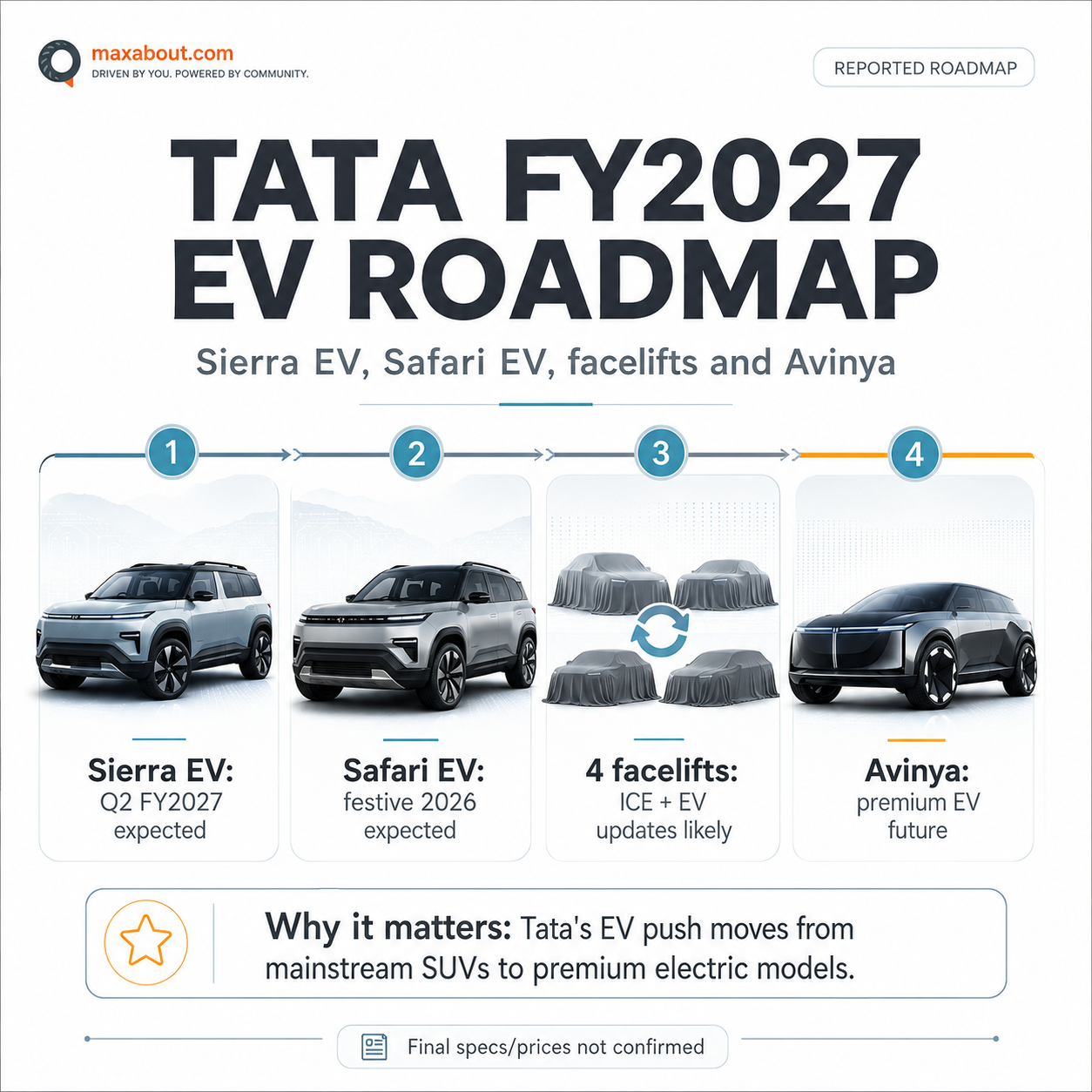
From what official announcements and industry reports indicate, the Sierra EV will be built on Tata's Acti.ev platform — the same architecture underpinning the Curvv EV. Expected range figures are likely to sit in the 400–500 km bracket, which, if achieved in real-world Indian conditions, would be genuinely competitive. The design language shown in concept form leans heavily into the original's silhouette — squared shoulders, a strong greenhouse, that unmistakable upright stance. It looks purposeful rather than pretty, which feels like the right call.
The target buyer here is fairly specific. Tata isn't pitching this at the practical family looking for the most sensible option. This is aimed at younger, aspirational buyers — someone in their early thirties, probably in Bangalore or Pune, who wants an SUV with personality rather than just a spec sheet. Someone who appreciates the heritage angle without necessarily having lived through it.
Pricing is expected to land in the ₹25–35 lakh range, which puts it in direct conversation with the MG ZS EV and whatever Mahindra brings forward with its BE and XEV series. That's a crowded, fiercely contested space. Tata will need more than nostalgia to win there — the product has to genuinely deliver on range, refinement, and ownership experience.
And that's where my honest concern sits. At ₹30 lakh-plus, buyers expect a certain level of after-sales polish. Tata's service network, while vast, has faced consistent criticism for inconsistency — quality varies significantly between a well-run dealer in Chennai and a smaller outlet in a Tier-2 city. Charging infrastructure has improved, but fast-charging reliability on longer routes is still patchy enough to matter.
On the nostalgia question — I think it will resonate, but perhaps not in the way Tata expects. Most buyers actually considering this vehicle won't have a personal memory of the original Sierra. What the name does, though, is signal character. In a segment filling up with vehicles that look broadly similar, a nameplate with a story attached is a genuine differentiator. Whether the final product backs that story up is the real question worth asking.
Safari EV: Electrifying India's Favourite Family SUV
The Safari carries weight that most nameplates simply don't. For a large section of Indian families — particularly in Delhi, Bengaluru, and Mumbai — it isn't just a vehicle. It's the car that does the school run on Tuesday and the Manali trip in June. Electrifying that nameplate is either a bold, smart move or a significant gamble, depending on who you ask.
From what industry sources indicate, the Safari EV is expected to arrive with a battery pack in the 60-70 kWh range, targeting a real-world range of roughly 450-500 km. On paper, that sounds sufficient. In practice, on a Delhi-Jaipur run with three kids, luggage, and the air conditioning working hard through a May afternoon, that number will compress. Range anxiety isn't irrational — it's just honest.
Tata's Supercharger network expansion is the critical variable here. The infrastructure story in metros looks reasonable by FY2027, but highway corridors remain the weak point. Mumbai-Pune is manageable. Less-travelled routes to hill stations or tier-2 destinations? That's where families will genuinely hesitate before booking.
Compared to the petrol Safari, the EV version offers something real: smoother power delivery, near-silent cabin, and significantly lower running costs for city-heavy usage. What buyers lose is flexibility — the freedom to refuel anywhere in three minutes and cover 600 km without a second thought.
Pricing expectations hover around ₹28-35 lakh, which puts it well above the petrol variant. Justifying that premium depends almost entirely on your usage pattern. High-mileage city families will likely find the economics compelling over five years. Occasional long-distance users might not.
I think Tata understands that the Safari EV doesn't need to convert everyone — it needs to convince the right buyers. The challenge is being honest with the rest.
Facelifts in the Pipeline: Nexon EV, Punch EV, and Tiago EV Updates
New launches grab headlines. But the quieter work of refreshing existing models often matters more. Tata's bread-and-butter EVs — the Nexon EV, Punch EV, and Tiago EV — collectively account for the bulk of the company's electric sales. Keeping them competitive isn't optional. It's essential.
The Nexon EV facelift is the one most buyers are watching. Current owners have been vocal about a few recurring frustrations — software inconsistencies, regenerative braking that feels abrupt in certain modes, and rear seat space that feels tighter than the petrol version suggests it should be. From what reported owner feedback consistently shows, the infotainment system has occasional sync issues, and over-the-air updates have been uneven in actually resolving them. Whether a mid-cycle refresh fixes software at a fundamental level is genuinely uncertain. Facelifts refresh surfaces. They rarely rewire foundations.
That said, the expected updates sound meaningful on paper. A bump in range toward 500 km WLTP, faster AC charging support, and revised interior materials are all reportedly in consideration. ADAS features — currently limited on the Nexon EV compared to fresher rivals — may finally see proper attention here.
The Punch EV refresh is arguably more straightforward. It's a newer platform, so the pain points are fewer. Buyers mostly want slightly better real-world range and a more premium cabin feel at higher trims. Both seem achievable without structural changes.
The Tiago EV sits in a tough spot. It's the entry point, and that's genuinely valuable. But the charging speed limitations and modest range make it feel dated as competition stiffens. A facelift that adds even 15-20 km of real-world range and faster DC charging would go a long way.
In my view, these updates matter precisely because they signal whether Tata treats early EV buyers as long-term customers or just early adopters to move past.
Avinya: Tata's Bold Bet on the Premium EV Future
If the facelifts and Sierra represent Tata's near-term thinking, the Avinya represents something else entirely — a statement of ambition. When the concept was revealed, it genuinely turned heads. Not because it was flashy in a desperate way, but because it felt considered. Purposeful. Like someone at Tata finally said, let's stop playing catch-up and actually lead.
The Avinya is built on what Tata calls its Gen 3 EV platform — a ground-up architecture that has nothing in common with the Gen 1 or Gen 2 underpinnings you find beneath the Nexon or Punch EV. That distinction matters more than it sounds. Gen 1 was essentially adapted from existing combustion platforms. Gen 2 brought improvements but still carried legacy constraints. Gen 3 is a clean slate — designed from the start around battery packaging, software integration, and cabin-first thinking.
What makes Avinya genuinely interesting is where its priorities seem to lie. The exterior design is dramatic without being impractical. But more significantly, the focus on interior experience — the lounge-like cabin concept, the emphasis on passenger comfort over driver-centric layouts — suggests Tata understands that buyers spending ₹40–50 lakh and above aren't just buying range or acceleration. They're buying a feeling.
That said, the timeline is where honest skepticism is warranted. FY2027 is an ambitious target. From what industry observers have noted, translating a design-forward concept into a production-ready vehicle — one that meets safety regulations, maintains build quality, and delivers reliable software — is an enormous leap. Tata has shown it can build EVs at volume. It has not yet shown it can build a premium EV that competes with the refinement buyers at this price expect.
And that's the real question. Would someone spending ₹45–50 lakh choose an Avinya over a BMW iX1, a Volvo EX40, or even a Hyundai IONIQ 6? Honestly, I'm not sure. Buyers in that bracket tend to be brand-conscious in ways that can't be overcome purely through design or specs. The badge still carries weight in Mumbai showrooms and Bengaluru tech parks alike.
But perhaps that's slightly beside the point. Avinya is as much a brand repositioning exercise as it is a commercial product. It tells the market — and Tata's own engineering teams — where the company wants to go. Sometimes that kind of signal is worth more than quarterly sales numbers.
The Infrastructure Question: Can Tata's Charging Network Keep Pace?
Here's the thing nobody wants to say out loud in Tata's boardroom: you can launch five brilliant EVs by FY2027, but if someone in Nagpur or Coimbatore can't reliably charge one, the whole roadmap starts looking shaky.
Tata Power currently operates a reasonably sized public charging network, with stronger coverage in metros like Mumbai, Delhi, Bengaluru, and Pune. In those cities, the density is genuinely improving. But step outside that comfort zone — into Tier 2 cities, highway stretches, or smaller towns — and the picture changes considerably. Industry data consistently shows that charging infrastructure drops off sharply beyond major urban centres. That gap matters enormously when Tata is simultaneously trying to sell the idea of EVs to first-time buyers who don't have the luxury of dismissing range anxiety.
The apartment complex problem is particularly stubborn. A large portion of urban India lives in housing societies where dedicated charging points simply don't exist. Installing home chargers requires society approvals, electrical upgrades, and cooperation from building management — none of which move quickly. Without overnight home charging, the EV ownership experience becomes genuinely inconvenient for many buyers.
Long highway drives remain another honest concern. From what reviewers and early owners have reported, planning a trip from Hyderabad to Vijayawada or Jaipur to Jodhpur still requires careful charger mapping. By 2027, that situation should improve — but should and will are different words entirely.
The ambition is real. The timeline is tight.
Competitive Landscape: Can Tata Hold Its EV Crown Through FY2027?
Tata Motors built its EV dominance almost by default — it showed up early, committed seriously, and the competition simply wasn't ready. That luxury is disappearing fast.
Mahindra's BE 6e and XEV 9e have genuinely changed the conversation. These aren't cautious entries — they're technology statements with sophisticated software, striking design, and serious range figures. Hyundai's Creta Electric arrived with the brand trust and service network that buyers already respect. MG Windsor redefined value expectations almost overnight. By FY2027, this competitive pressure will only intensify, with more global manufacturers eyeing India seriously.
Tata's genuine strengths remain substantial, though. First-mover advantage built real brand familiarity — thousands of Indian families already have a Nexon EV in the driveway, and that comfort matters. Localised manufacturing keeps pricing competitive in ways that fully imported rivals struggle to match. And Tata's service network, spread across smaller cities and towns, is something newer entrants simply cannot replicate quickly.
But the vulnerabilities are honest ones. The software and technology perception gap is real — Tata's cabin technology feels a generation behind what Mahindra and Hyundai are now offering. Build quality consistency remains a persistent concern based on owner feedback across forums and reviews. These aren't dealbreakers, but they're friction points that competitors will exploit aggressively.
In my view, Tata will retain meaningful leadership through FY2027 — but market share erosion is almost certain. Holding 60-70 percent of India's EV market was never sustainable. The real question is whether Tata lands at a healthy 40 percent or slides further. That answer depends entirely on execution.
Final Thoughts: Should Indian Buyers Get Excited About Tata's FY2027 EV Roadmap?
Honestly? Cautiously, yes. There is genuine substance here worth paying attention to. The Sierra EV brings real design ambition. The Safari EV addresses a volume segment Tata hasn't cracked electrically yet. And Avinya, if executed well, could fundamentally change how the world perceives Indian electric vehicles.
But excitement and commitment are different things. Right now, confirmed specifications remain thin, pricing is unannounced, and timelines carry the usual uncertainty. If your need for a vehicle is immediate, the current Nexon EV or Punch EV lineup makes practical sense. Waiting on roadmap promises is rarely a smart financial decision.
What genuinely needs watching is the infrastructure story, after-sales consistency, and whether Tata can hit these launch windows without the delays that have occasionally frustrated buyers before.
FY2027 could either cement Tata as India's undisputed EV benchmark — or mark the opening of a far more competitive, unforgiving chapter where promises alone no longer move buyers. That outcome is still unwritten.
Which model from this lineup excites you most? Drop your thoughts below.
Explore the story
Related news

Share your view and join the discussion.
Earn reward points for every comment and get a chance to win ₹1,000 in our weekly lucky draw. Sign in with Google in one tap.
Start the conversation
No one has commented on this article yet. Be the first to share your view.
Want to read more automotive news?
Stay updated with the latest car launches, reviews, and industry insights.
Browse All News