
Tata EV Bookings Triple in Six Months as Production Caps Growth
Tata Motors says its electric-vehicle bookings have tripled in six months, while production capacity is limiting how quickly the company can serve that demand. The disclosure points to a demand-led phase for India's mass-market EV segment, but it also raises a practical question for buyers: how much...
Editorial Team
Tata Motors says its electric-vehicle bookings have tripled in six months, while production capacity is limiting how quickly the company can serve that demand. The disclosure points to a demand-led phase for India's mass-market EV segment, but it also raises a practical question for buyers: how much of the booking momentum can turn into timely deliveries?
What Tata has reported
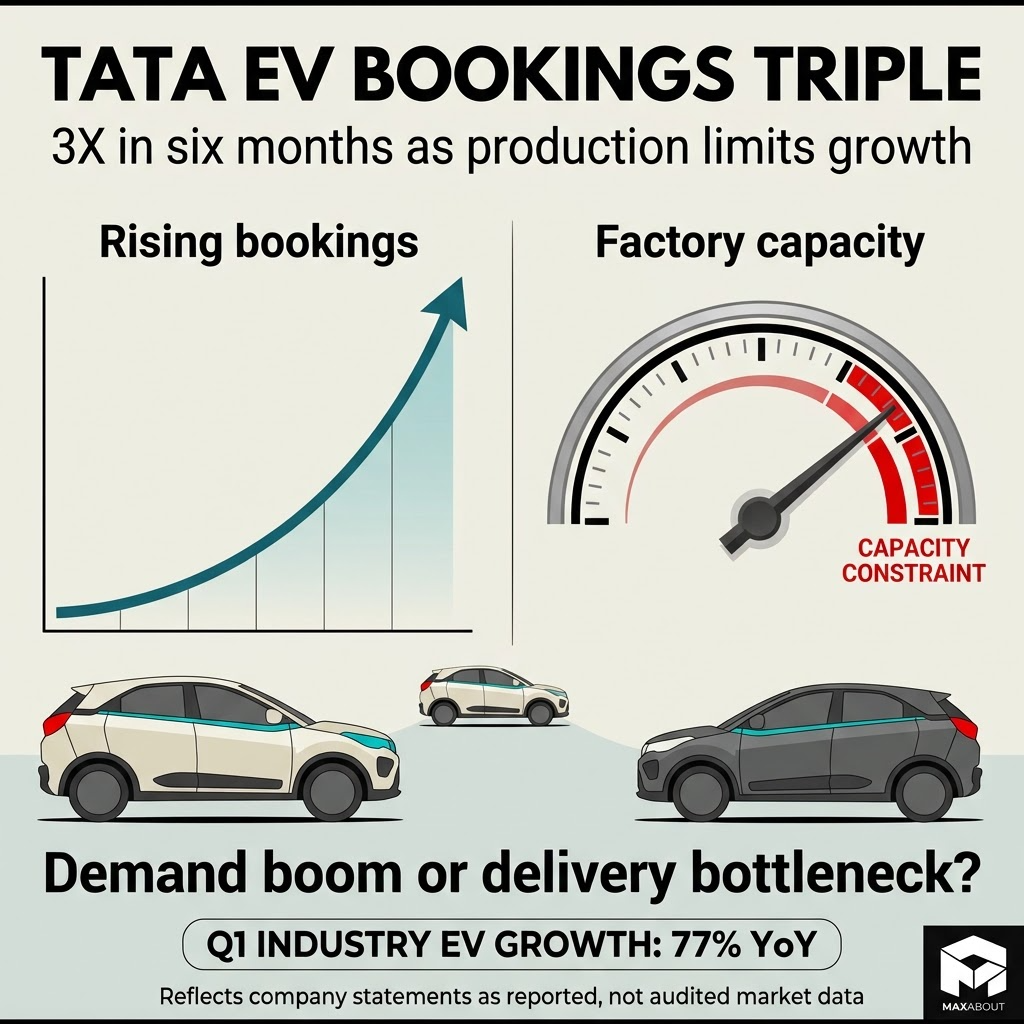
EV bookings have grown three-fold over the past six months.
The company says its EV market-share position has improved month by month.
The wider electric-vehicle industry recorded 77% year-on-year growth in the cited first-quarter comparison.
Tata expects festive demand to remain strong.
Production capacity, rather than a lack of demand, is described as the immediate limitation.
These are company statements reported through a PTI-syndicated interview. They are useful indicators of current demand, but they are not the same as audited registration data or completed retail deliveries.
Why bookings and deliveries are different
A booking records customer intent. A delivery requires a vehicle to be built, allocated, transported, invoiced and handed over. When demand rises faster than production, booking totals can expand even as waiting periods lengthen. The eventual conversion rate can also vary if customers cancel, change variants or switch to another brand.
That distinction matters because a three-fold increase in bookings should not automatically be described as a three-fold increase in sales. The most responsible reading is that Tata has seen a strong acceleration in demand signals and currently views supply as the bottleneck.
What this could mean for EV buyers
Buyers shopping during the festive period may see uneven availability across models, variants, colours and cities. A vehicle shown as available at one dealership may have a longer allocation timeline elsewhere. The headline booking trend therefore makes a written delivery estimate more important than a general promise of quick supply.
Before paying a non-refundable amount, buyers should confirm the selected variant, expected allocation date, cancellation conditions, applicable incentives and whether the quoted price is protected until delivery. They should also ask whether the vehicle is already in dealer stock or is waiting for production allocation.
Why capacity can become the constraint
Electric-vehicle output depends on more than final assembly. Battery packs, cells, power electronics, motors, software validation and supplier schedules all need to align. Even when a manufacturer has enough assembly-line space, a shortage or delayed component can limit the number of completed vehicles.
Tata's statement does not identify a model-wise bottleneck or promise a specific capacity increase. It simply indicates that near-term demand is running ahead of the production available to meet it.
How to read the 77% industry-growth figure
The cited 77% year-on-year number refers to first-quarter industry EV growth. It provides market context, but it should not be confused with Tata's three-fold booking statement. The two figures measure different things over different periods: one describes broader industry growth, while the other describes company bookings across six months.
Questions buyers should ask the dealership
Is the promised delivery date tied to a confirmed vehicle allocation?
Which variant and battery option is available earliest?
Can the booking be cancelled, and what amount is refundable?
Will any price or incentive change apply before delivery?
When will the VIN and manufacturing month be shared?
Does the quoted waiting period include transport and registration time?
What to watch next
The next useful signals will be monthly retail registrations, model-wise dispatches, waiting-period trends and any official production-capacity update. Those measures can show whether the booking surge is converting into delivered vehicles or creating a longer backlog.
FAQs
Have Tata EV sales tripled in six months?
The cited disclosure says bookings have tripled. It does not say completed retail sales or registrations tripled over the same period.
Why could Tata EV waiting periods rise?
Tata says production is the near-term constraint while demand is strong. Actual waiting periods will still vary by model, variant, city and available dealer allocation.
Does 77% represent Tata's EV growth?
No. The 77% year-on-year figure is cited for first-quarter industry EV growth, while Tata's separate statement concerns its bookings over six months.
Should buyers delay an EV purchase?
The disclosure alone does not justify delaying a purchase. Buyers should compare written delivery estimates, total on-road cost, charging needs and cancellation terms across suitable models.
The central takeaway is clear: Tata EV bookings are rising quickly, and the company's immediate challenge is converting that demand into vehicles customers can receive on time.
Explore the story
Related news

Share your view and join the discussion.
Earn reward points for every comment and get a chance to win ₹1,000 in our weekly lucky draw. Sign in with Google in one tap.
Start the conversation
No one has commented on this article yet. Be the first to share your view.
Want to read more automotive news?
Stay updated with the latest car launches, reviews, and industry insights.
Browse All News