
Tata Electric CV Orders Top 3,400 as Cell Bottleneck Nears Relief
Tata Motors says it secured more than 3,400 electric commercial-vehicle orders across freight, logistics and passenger-mobility segments in Q1 FY27. Demand is strengthening, but deliveries of the Intra EV have been constrained by long lead times for battery cells sourced from China. Management expec...
Editorial Team
Tata Motors says it secured more than 3,400 electric commercial-vehicle orders across freight, logistics and passenger-mobility segments in Q1 FY27. Demand is strengthening, but deliveries of the Intra EV have been constrained by long lead times for battery cells sourced from China. Management expects higher cell orders placed earlier to ease the bottleneck by the end of the current quarter.
What you need to know
Order pipeline: More than 3,400 electric CV orders were reported across segments.
Retail momentum: Electric SCV volumes rose more than four-fold to around 3,200 units in Q1 FY27.
Bus demand: Tata had more than 850 electric-bus orders in hand during the quarter.
Near-term constraint: Imported battery-cell availability, not Tata's in-house vehicle capacity, is limiting Intra EV supply.
Why battery cells are the bottleneck
Commercial EV demand has increased faster than the cell orders that support battery production. Battery cells carry long procurement and logistics lead times: they must be ordered in advance, shipped to India and assembled into packs before vehicles can be completed. Tata says it placed larger orders roughly two months earlier and expects the supply chain to be debottlenecked towards quarter-end.
That distinction matters for fleet buyers. A factory can have space to build more vehicles while a missing imported component still restricts output. The company has said its own Intra EV manufacturing capacity is not the problem.
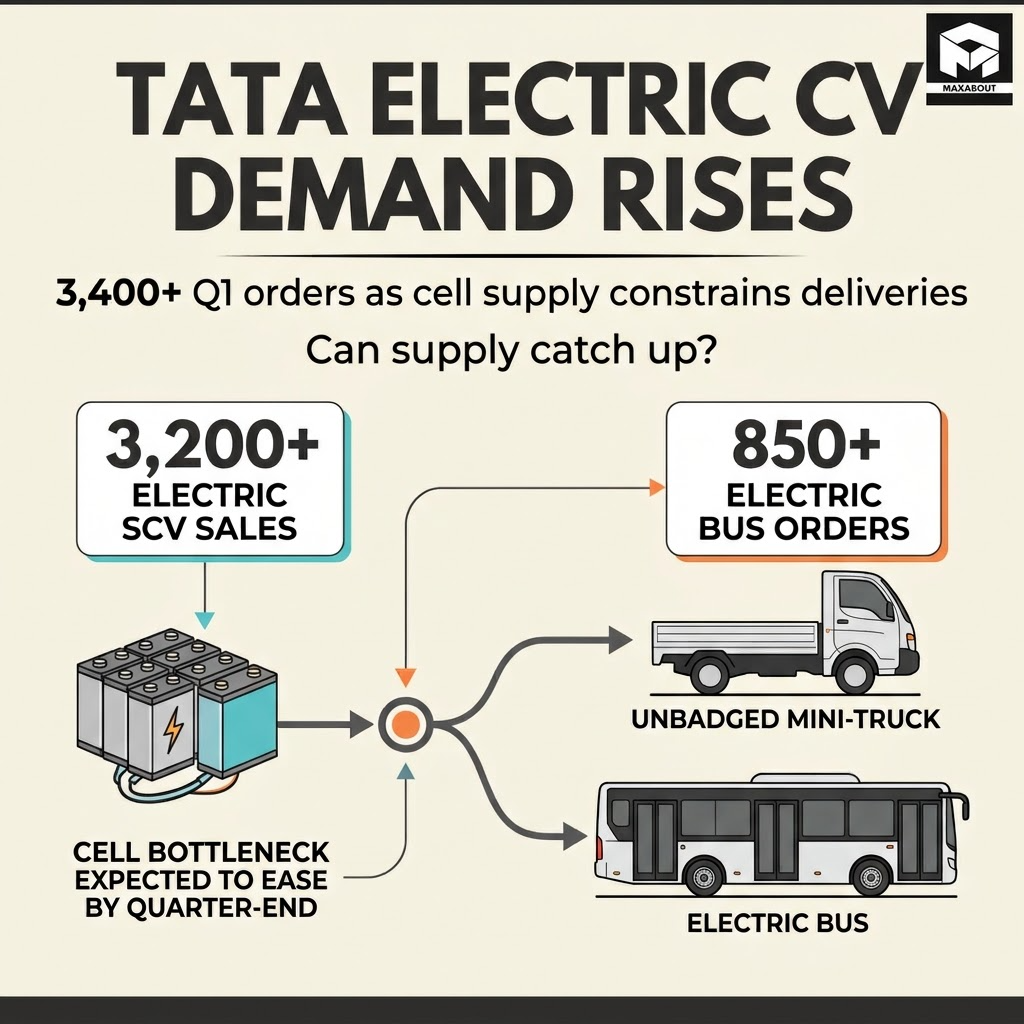
Tata electric CV demand in numbers
| Measure | Company-reported Q1 FY27 position |
|---|---|
| Electric CV orders | More than 3,400 across freight, logistics and passenger mobility |
| Electric SCV retail volumes | About 3,200; more than four-fold growth |
| Electric bus orders in hand | More than 850 |
| Expected cell-supply relief | By the end of the current quarter |
What this means for Indian fleet buyers
Fleet electrification decisions depend on vehicle availability, charging uptime, payload, route length and total cost per kilometre. Tata says total-cost-of-ownership parity for electric Intra and Ace Pro models has become more attractive versus comparable internal-combustion vehicles. Even so, operators should base procurement plans on confirmed delivery schedules rather than the size of the overall order book.
Ask whether the quoted delivery slot has an allocated battery pack.
Model route-level charging time and daily utilisation before ordering.
Compare maintenance, energy and finance costs over the intended holding period.
Keep contingency capacity until vehicle and charger commissioning are complete.
Why the quarter-end timeline matters
If cell deliveries normalise as expected, Tata can convert more of its order pipeline into vehicles without adding in-house assembly capacity. A delay would keep pressure on Intra EV availability and could slow fleet deployment. Buyers and industry watchers should monitor retail deliveries, cell lead times and whether the expected quarter-end improvement appears in subsequent volume disclosures.
FAQs
Has Tata Motors run out of electric CV manufacturing capacity?
No. Management has said in-house capacity is not the constraint; the immediate bottleneck is imported battery-cell availability.
Are all 3,400 orders for small electric trucks?
No. The company says the orders span freight, logistics and passenger mobility, including multiple commercial-vehicle categories.
When should the battery-cell shortage ease?
Tata expects higher orders already placed with suppliers to improve availability by the end of the current quarter. This is management guidance and remains subject to supply-chain execution.
Tata's electric commercial-vehicle demand is moving beyond pilot-scale adoption, but the next test is delivery execution. Quarter-end cell availability will show whether the company can turn its expanding order pipeline into sustained retail growth.
Explore the story
Related news

Share your view and join the discussion.
Earn reward points for every comment and get a chance to win ₹1,000 in our weekly lucky draw. Sign in with Google in one tap.
Start the conversation
No one has commented on this article yet. Be the first to share your view.
Want to read more automotive news?
Stay updated with the latest car launches, reviews, and industry insights.
Browse All News