
Tata eCV Orders Cross 3,400 Units as Fleet EV Adoption Scales Up
Tata Motors has reported a major commercial EV milestone, with over 3,400 electric commercial vehicle orders secured across freight, logistics and passenger mobility use cases. The order book covers small commercial vehicles, pick-ups, trucks and buses, making this more than a single-product update....
Editorial Team
Tata Motors has reported a major commercial EV milestone, with over 3,400 electric commercial vehicle orders secured across freight, logistics and passenger mobility use cases. The order book covers small commercial vehicles, pick-ups, trucks and buses, making this more than a single-product update. It shows how electric commercial vehicles in India are moving from pilot deployments toward larger fleet integration.
What you need to know
3,400+ Tata eCV orders have been reported across freight, logistics and passenger mobility.
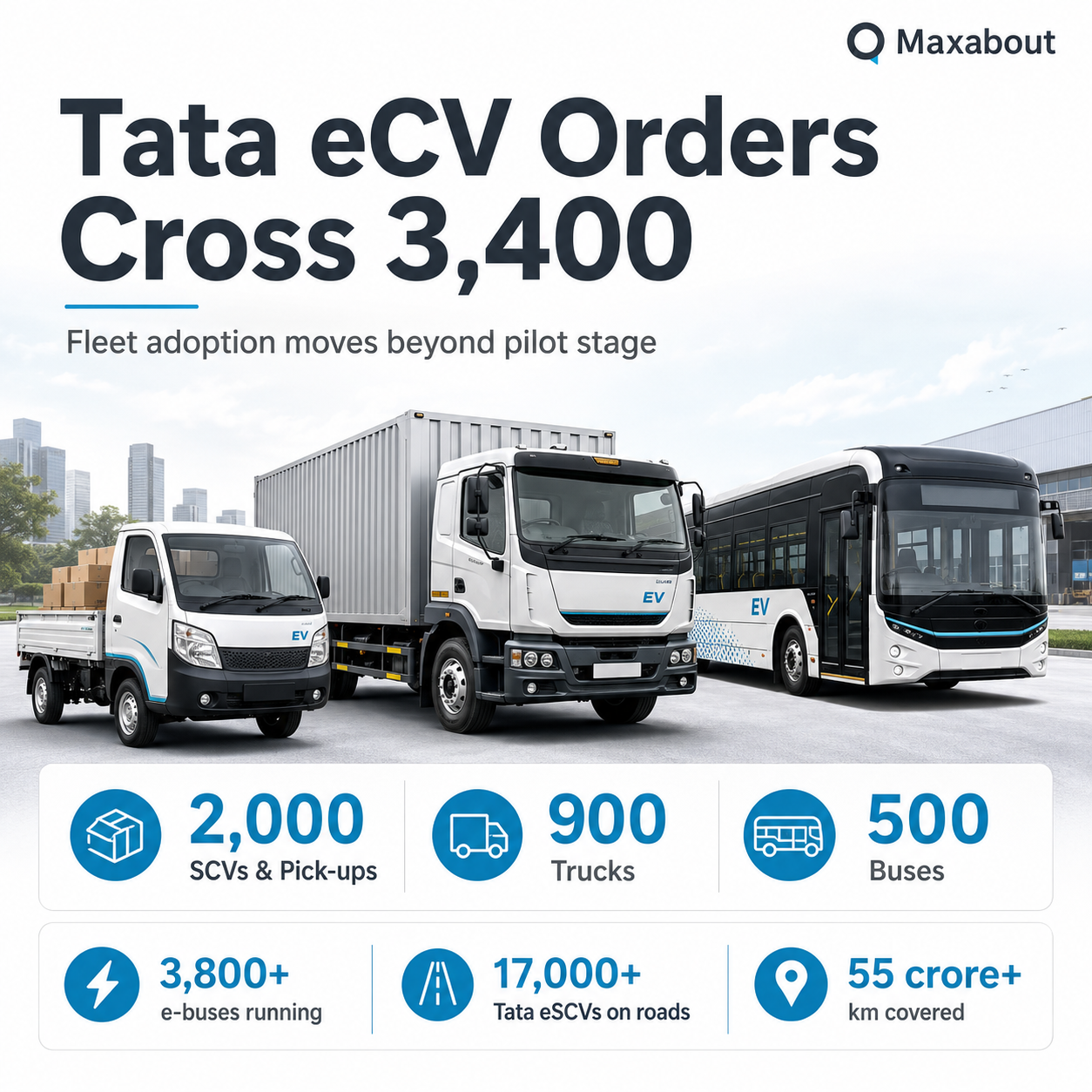
The order mix includes about 2,000 small commercial vehicles and pick-ups, 900 trucks and 500 buses.
Use cases include e-commerce, FMCG/FMCD distribution, cement, steel, mining, tarmac operations and city/intercity passenger transport.
Tata's wider electric commercial vehicle portfolio now spans last-mile delivery, medium/heavy duty movement and passenger buses.
Order split: where the demand is coming from
The biggest share comes from small commercial vehicles and pick-ups, which are central to last-mile and intra-city deliveries. Trucks and buses add weight to the story because they show interest beyond compact urban delivery routes.
| Vehicle category | Reported order count | Likely role |
|---|---|---|
| SCVs and pick-ups | About 2,000 units | Last-mile delivery, intra-city distribution and e-commerce logistics |
| Electric trucks | About 900 units | Freight, industrial movement, tarmac operations and heavier duty cycles |
| Electric buses | About 500 units | Inter-city and intra-city passenger transport |
Why this matters for India's EV market
Passenger EV sales usually get the spotlight, but commercial vehicles can be just as important for real-world electrification. Fleet operators measure uptime, running cost, charging access and load cycles closely. A larger commercial EV order book suggests that more businesses are willing to put EVs into regular operations rather than limiting them to demonstration projects.
For logistics and distribution companies, electric SCVs and pick-ups can reduce urban operating costs if charging and route planning are predictable. For bus operators and city transport agencies, electric buses can cut tailpipe emissions on high-use public routes. For industrial users, electric trucks are more challenging but potentially valuable where routes are controlled and depot charging is available.
Tata's eCV portfolio mentioned in the update
The reported portfolio coverage is broad. In smaller commercial vehicles, Tata's electric range includes the Ace Pro EV, Ace EV and Intra EV. For heavier applications, the update points to the Ultra EV range, Prima EV 55T tractor and Prima EV 28T tipper. Passenger mobility is covered by the Starbus EV and Ultra EV buses.
Fleet support is the real test
The order number is important, but successful deployment depends on the ecosystem around the vehicles. Tata has cited partnerships with 14+ charge point operators, financing arrangements with banks and NBFCs, its Fleet Edge platform and uptime assurance support. Those pieces matter because fleet buyers are not just purchasing vehicles; they are buying predictable operations.
What is confirmed and what is not
The reported figures confirm the scale and category split of the order update, but the source does not provide a full customer-by-customer list, delivery schedule, price details or city-wise deployment plan. Until Tata or fleet partners share those specifics, the safest reading is that this is a strong order-book signal for commercial EV adoption, not a complete deployment timeline.
FAQs
How many electric commercial vehicle orders has Tata Motors secured?
Tata Motors has reportedly secured over 3,400 electric commercial vehicle orders across freight, logistics and passenger mobility segments.
Which Tata eCV categories are included?
The order mix includes around 2,000 SCVs and pick-ups, 900 trucks and 500 buses, covering both cargo and passenger transport use cases.
Why are commercial EV orders important?
Commercial EV orders matter because fleet vehicles often run high daily kilometres. If operators can manage charging, uptime and route planning, electric commercial vehicles can have a large impact on operating cost and urban emissions.
Does this confirm delivery timelines or customer names?
No. The available source confirms the reported order scale and category split, but does not provide complete delivery timelines, buyer-wise details or pricing.
Bottom line: Tata's 3,400+ electric commercial vehicle order update points to a wider shift in India's fleet EV market. The strongest signal is not just the headline number, but the spread across SCVs, trucks and buses, showing that commercial electrification is expanding into multiple duty cycles.
Explore the story
Related news

Share your view and join the discussion.
Earn reward points for every comment and get a chance to win ₹1,000 in our weekly lucky draw. Sign in with Google in one tap.
Start the conversation
No one has commented on this article yet. Be the first to share your view.
Want to read more automotive news?
Stay updated with the latest car launches, reviews, and industry insights.
Browse All News