
Tata Altroz CNG AMT Launched at ₹8.70 Lakh in India
Fuel costs in India have been climbing steadily, and anyone commuting daily in a metro city knows exactly how much that hurts. CNG has been a practical answer for millions of urban buyers — but until recently, it almost always meant compromising on driving comfort or settling for a basic, uninspirin...
Editorial Team
Fuel costs in India have been climbing steadily, and anyone commuting daily in a metro city knows exactly how much that hurts. CNG has been a practical answer for millions of urban buyers — but until recently, it almost always meant compromising on driving comfort or settling for a basic, uninspiring vehicle. That equation may be changing now.
Tata has launched the Altroz CNG AMT at ₹8.70 lakh, and the combination genuinely deserves attention. Here is a premium-feeling hatchback, already well-regarded for its build quality and safety credentials, now available with both CNG efficiency and an automatic gearbox. That is not a small thing.
Think about cities like Mumbai, Delhi, and Ahmedabad — where CNG infrastructure is genuinely solid, pumps are accessible, and the fuel cost advantage is real. Buyers in these markets have long wanted something better than a basic CNG option. The Altroz with AMT speaks directly to that audience — urban professionals who sit in stop-and-go traffic every single day and simply do not want the fatigue of constant clutch work.
At ₹8.70 lakh, the price point is carefully placed. It is not entry-level, but it is reasonable enough to make a strong case for buyers weighing long-term running costs against upfront investment. This launch feels genuinely well-timed.
What Exactly Is the Tata Altroz CNG AMT and Where Does It Fit?
Let me break this down clearly. The Altroz CNG AMT combines two things that have traditionally been offered separately in this segment — a factory-fitted CNG kit and an automated manual transmission. Factory-fitted matters here. This is not an aftermarket conversion. Tata has engineered the CNG system directly into the vehicle, which means better safety standards, warranty coverage, and more predictable performance compared to retrofit jobs.
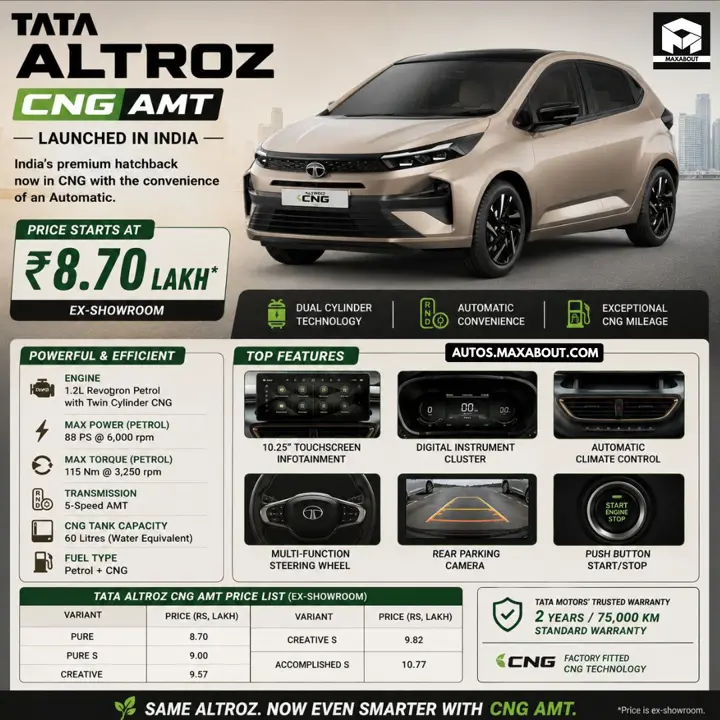 The AMT side of the equation is equally important. Mechanically, it is still a manual gearbox underneath, but the clutch and gear changes are handled automatically by an electronic control unit. So you get reasonable fuel efficiency without sitting in Bengaluru or Gurugram traffic endlessly working the clutch pedal.
Within the Altroz lineup, this variant sits at the mid-range trim level — not the bare-bones base variant, but not the fully loaded top spec either. It is positioned to offer a genuinely usable feature set alongside the powertrain benefits.
The target buyer here is fairly specific — daily office commuters covering 40 to 60 kilometres each day, small families in tier-1 and tier-2 cities, and private buyers who want running cost advantages without sacrificing driving convenience. From what reviews suggest, this combination addresses a real gap that budget-conscious but comfort-aware buyers have been waiting for.
Breaking Down the ₹8.70 Lakh Price Tag: Is It Justified?
Let's talk numbers honestly. The Altroz CNG AMT enters at ₹8.70 lakh (ex-showroom), which sits noticeably above the standard Altroz CNG manual variant priced around ₹7.90 lakh. That roughly ₹80,000 premium is essentially what you are paying for the AMT gearbox convenience. Compared to the petrol AMT version hovering near ₹8.20 lakh, the CNG AMT asks for around ₹50,000 more.
Whether those numbers make sense depends entirely on how you use the car. Consider a typical urban commuter covering around 1,200 to 1,500 kilometres monthly. CNG running costs in most Indian cities currently work out to roughly ₹2 to ₹2.50 per kilometre, compared to approximately ₹6 to ₹7 per kilometre on petrol. That difference translates to monthly savings of anywhere between ₹5,000 and ₹7,000 depending on your city and usage pattern. The AMT premium practically recovers itself within 12 to 14 months.
Then there is the factory-fitted CNG advantage. Aftermarket kits typically cost ₹60,000 to ₹80,000, often void manufacturer warranties, and carry real safety concerns around installation quality. A factory-fitted setup eliminates all of that worry.
In my view, for high-mileage city commuters, the price is genuinely justified. For occasional drivers covering under 800 kilometres monthly, the savings equation becomes less compelling.
Real-World Performance: CNG Plus AMT in Indian Traffic Conditions
This is where things get genuinely interesting — and honest. The combination of CNG and AMT sounds convenient on paper, but Indian roads have a way of exposing every weakness a powertrain carries.
CNG, by its nature, reduces engine output noticeably. The Altroz's 1.2-litre engine, already modest in petrol form, loses roughly 10 to 12 percent of its peak power when running on CNG. In relaxed city driving, this is barely noticeable. Crawling through Bengaluru's Silk Board junction or Pune's FC Road during evening hours, the car simply follows the flow. Nobody is asking for sharp acceleration there anyway.
Highway stretches, however, tell a different story. Overtaking requires patience and planning ahead. Based on observations from other CNG vehicles with similar configurations, quick bursts of speed feel laboured, particularly with the air conditioning running at full load on a hot Delhi afternoon.
The AMT gearbox adds another layer to consider. Hesitation between gear shifts is a known characteristic of most AMT units available in this segment. That brief pause before the next gear engages can feel slightly awkward in stop-and-go traffic — exactly the kind of driving that defines daily commutes across most Indian cities. It is manageable once you anticipate it, but drivers expecting smooth, seamless shifts will need an adjustment period.
Boot space does take a meaningful hit with the CNG cylinder installed. Practical room for a family of four's weekend luggage becomes tight. Grocery runs remain fine, but longer trips require realistic expectations.
Pros and Cons of the Altroz CNG AMT: An Honest Assessment
So where does all of this leave us? Here is my honest read on who this car genuinely works for — and who should probably walk away.
The case for it is real. Running costs on CNG are significantly lower than petrol, and that matters enormously for someone covering 40 to 60 kilometres daily in Pune, Ahmedabad, or Delhi. Factory-fitted CNG is meaningfully safer than aftermarket conversions — the kit is integrated properly, and Tata backs it with a warranty. Add the AMT convenience in crawling urban traffic, and the Altroz's genuinely premium interior feel for this price segment, and the value proposition becomes difficult to dismiss at ₹8.70 lakh.
But the limitations are equally real. Power drops noticeably in CNG mode — highway overtaking requires patience. Outside major metros and key state highways, finding a CNG station remains genuinely stressful. Long-distance travel involves planning around fuel stops in a way petrol drivers simply do not face.
In my view, this car has a clear, specific buyer: the city commuter who wants lower running costs, values the Altroz's build quality, and rarely ventures beyond familiar urban routes. For that person, it makes strong practical sense.
If you frequently travel between cities or live where CNG infrastructure is sparse, a conventional petrol automatic would serve you better.
CNG Infrastructure in India: How Ready Are We Really?
The Altroz CNG AMT makes sense on paper. Whether it makes sense for you depends heavily on one thing: where you actually live and drive.
India's CNG network is genuinely impressive in certain pockets. Delhi-NCR, Mumbai, Pune, Ahmedabad, and Surat have dense station networks — you are rarely more than a few kilometres from a top-up. Gujarat broadly leads the country here, with consistent availability even in smaller towns. Maharashtra is not far behind. These are cities where owning a CNG vehicle feels genuinely effortless day-to-day.
Beyond these strongholds, the picture gets complicated. Cities like Lucknow, Jaipur, and Indore have growing networks but still experience long queues during peak hours. Smaller towns across central and eastern India remain largely underserved. If you are based in a Tier 3 city or a semi-urban area, the nearest CNG station might require a dedicated trip — which defeats the purpose entirely.
The government's city gas distribution expansion program is actively pushing CNG deeper into newer geographies, so the situation is improving. But improving is not the same as ready, and a purchase decision needs to reflect today's reality, not tomorrow's promise.
Highway travel remains the genuine weak point. National highways connecting major metros are still inconsistent for CNG availability, making unplanned long drives genuinely stressful. This is a real, practical limitation worth acknowledging before signing anything.
Who Should Buy the Altroz CNG AMT — and Who Should Skip It?
Let me be direct here, because this decision is genuinely straightforward once you match the car to the right buyer profile.
This car makes strong sense for you if:
You commute 40–60 km daily within a city like Mumbai, Pune, Delhi, Ahmedabad, or Lucknow — places where CNG infrastructure is dense and reliable
You want an automatic gearbox but find petrol running costs increasingly difficult to justify
You're a first-time buyer prioritizing safety ratings, build quality, and a trusted service network over outright performance
Stop-and-go traffic is your daily reality and the AMT removes that frustration meaningfully
Skip it if your situation looks like this:
You regularly travel to smaller towns or highways where CNG stations are genuinely sparse
Boot space matters — the CNG cylinder already compromises what isn't a generous boot to begin with
You enjoy driving for the sake of it. This engine is efficient, not exciting
You're based in a tier-3 city where CNG adoption is still early-stage
From what industry observers consistently note, the Altroz CNG AMT is a commuter's tool, not an all-rounder. Respect that boundary, and it genuinely delivers. Push it beyond its design intent, and the frustrations will follow quickly.
Final Verdict: Does the Tata Altroz CNG AMT Make Sense in 2025?
Here's the honest summary: Tata has done something genuinely useful here. Combining CNG with an automatic gearbox in a premium hatchback isn't a gimmick. For a specific type of buyer, this combination solves real, daily problems.
At ₹8.70 lakh, the pricing sits in a reasonable place. You're getting a car with solid build quality, a refined interior, and running costs that will meaningfully ease monthly expenses — particularly if you're covering long distances in city traffic every single day.
Before you make a decision, ask yourself these questions honestly:
Is most of my driving within city limits, under 80 km/h?
Do I have a reliable CNG station within a reasonable distance from home?
Am I comfortable with a smaller boot for the long term?
Is fuel savings my primary concern over driving excitement?
If you answered yes to most of those, this car is likely a smart, practical choice for 2025. If you hesitated even once, it's worth reconsidering.
Tata is clearly building toward a future where alternative fuels become mainstream rather than niche. This Altroz fits that direction thoughtfully. It's not perfect. But it doesn't pretend to be something it isn't — and that, honestly, counts for quite a lot.
Explore the story
Related news

Share your view and join the discussion.
Earn reward points for every comment and get a chance to win ₹1,000 in our weekly lucky draw. Sign in with Google in one tap.
Start the conversation
No one has commented on this article yet. Be the first to share your view.
Want to read more automotive news?
Stay updated with the latest car launches, reviews, and industry insights.
Browse All News