
Suzuki Swift Hydrogen: Future of Clean Mobility in India
Suzuki Swift Hydrogen: A New Chapter in Eco-Friendly MobilityThe automotive world took notice when Suzuki unveiled its hydrogen-powered Swift at the 2026 Vienna Motor Symposium. This marks a significant milestone for the Japanese manufacturer, which has maintained a dominant position in the Indian m...
Editorial Team
Suzuki Swift Hydrogen: A New Chapter in Eco-Friendly Mobility
The automotive world took notice when Suzuki unveiled its hydrogen-powered Swift at the 2026 Vienna Motor Symposium. This marks a significant milestone for the Japanese manufacturer, which has maintained a dominant position in the Indian market through Maruti Suzuki for decades.
The hydrogen fuel cell technology represents an intriguing alternative in India's growing push for cleaner mobility solutions. Unlike battery electric vehicles that struggle with charging infrastructure challenges across our vast country, hydrogen vehicles offer quick refueling and potentially longer ranges - critical advantages for Indian driving conditions.
What makes this development particularly noteworthy is how it aligns with India's National Hydrogen Mission, which aims to position the country as a global hub for hydrogen production and utilization. For everyday consumers, this could eventually translate to vehicles that combine the convenience of traditional cars with significantly reduced emissions.
As Maruti Suzuki commands nearly 45% of the passenger vehicle market in India, any technological advancement from its parent company carries substantial weight for our automotive landscape. The Swift hydrogen prototype signals a commitment to exploring multiple pathways to sustainability rather than focusing exclusively on battery electric vehicles.
Understanding Hydrogen Fuel Cell Technology
Hydrogen fuel cell vehicles represent a fascinating middle ground between conventional engines and electric vehicles. At their core, these vehicles generate electricity through a chemical reaction between hydrogen and oxygen, with water vapor as the only emission.
Unlike the internal combustion engines we're familiar with on Indian roads, fuel cell vehicles don't burn anything. Instead, they create an electrochemical reaction that powers an electric motor. Think of it as an electric car that makes its own electricity onboard rather than storing it in a massive battery.
The Swift Hydrogen's system appears to use compressed hydrogen stored in specialized tanks. When you need to refuel, the process is remarkably similar to filling up at a petrol pump - taking just 3-5 minutes compared to the extended charging times of battery EVs. From what's been reported, we can expect a driving range comparable to conventional vehicles.
The advantages are compelling for our conditions. No range anxiety during summer AC use, no charging infrastructure concerns in remote areas, and no performance reduction in extreme temperatures. The fuel cell stack maintains consistent output regardless of weather - a significant benefit considering India's diverse climate zones.
The challenge, of course, lies in hydrogen production and distribution. Without a network of hydrogen stations (currently non-existent in India), even the most efficient fuel cell vehicle would be impractical for everyday use.
The Swift Hydrogen's Design and Features
Looking at the Swift Hydrogen prototype, I was impressed by how Suzuki maintained the familiar silhouette while integrating the hydrogen technology. The exterior features subtle blue accents and aerodynamic enhancements that distinguish it from the standard petrol Swift we know in India. There's a slightly revised front grille for better cooling of the fuel cell system, plus "Hydrogen" badging that gives it a unique identity.
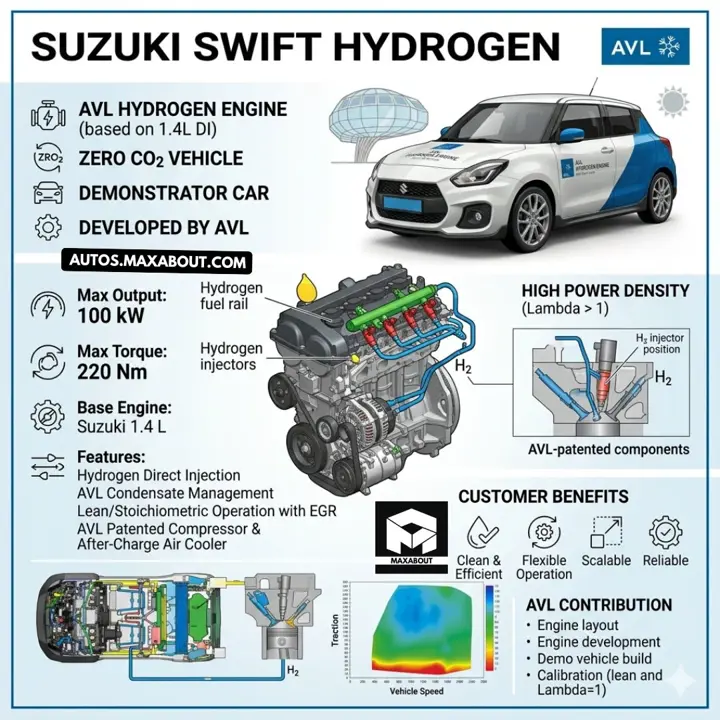 Inside, the cabin largely mirrors the conventional Swift, which is good news for fans of the model. The instrument cluster, however, has been modified to display hydrogen consumption and tank levels instead of the usual fuel gauge. The touchscreen system includes hydrogen station mapping - though that would need significant updating for Indian roads if it ever launches here.
The most significant practical compromise appears to be in boot space. The hydrogen tanks reduce luggage capacity by approximately 30% compared to the standard Swift. For a family weekend trip to Lonavala or Ooty, you'd need to pack more efficiently or use roof carriers.
Safety features specific to the hydrogen system include reinforced tanks, multiple hydrogen leak sensors, and automatic shutoff valves - addressing potential concerns about hydrogen storage. The tanks themselves are positioned under the rear seats and floor, helping maintain the Swift's balanced handling characteristics despite the added technology.
Performance Expectations in Indian Conditions
When it comes to Indian driving conditions, the Swift Hydrogen raises both exciting possibilities and legitimate concerns. Based on available specifications, I expect its power output to be comparable to the current petrol Swift (around 80-90 PS), though with better torque characteristics thanks to the electric motor component in the hydrogen fuel cell system.
In bumper-to-bumper Delhi or Mumbai traffic, the hydrogen Swift should excel with responsive acceleration and zero emissions. However, I'm skeptical about its range in such conditions – likely dropping from the claimed 500km to around 350-400km in real-world urban Indian driving.
The extreme temperature variations across India present challenges too. Summer temperatures exceeding 45°C in cities like Delhi might affect fuel cell efficiency, while monsoon flooding in Mumbai could necessitate additional waterproofing for hydrogen components compared to European models.
On highways, I expect the Swift Hydrogen to offer a more relaxed cruising experience than the petrol version, with less noise and vibration. The instant torque should make overtaking on single-lane highways significantly easier – a major advantage on routes like the Mumbai-Pune Expressway or Bangalore-Mysore corridor.
Efficiency comparison: While the current petrol Swift delivers about 18-21 km/l in mixed driving conditions, the hydrogen version should offer equivalent energy efficiency to approximately 25-28 km/l – a substantial improvement that could offset the initially higher hydrogen fuel costs.
Hydrogen Infrastructure Challenges in India
The hydrogen Swift looks promising on paper, but let's be realistic about India's hydrogen refueling infrastructure – it's virtually non-existent. I think this presents the biggest hurdle for hydrogen vehicles gaining traction in our market.
Currently, India has fewer than 10 hydrogen stations nationwide, mostly serving industrial applications rather than mobility. Compare this to our 84,000+ petrol pumps, and the challenge becomes obvious. Even electric vehicles with 7,000+ charging stations face infrastructure criticism.
Government initiatives: The National Hydrogen Mission launched in 2021 shows some commitment, with ₹19,000 crore allocated for green hydrogen development. However, the focus remains primarily on industrial applications rather than passenger vehicles.
I believe hydrogen vehicles would initially be limited to Delhi-NCR, Mumbai, and perhaps corridors like Delhi-Jaipur where infrastructure development might begin. The geographical constraints mean hydrogen cars would remain impractical for those frequent Manali road trips or Kerala coastal drives many Indians enjoy.
For broader adoption, we would need:
At least 100+ refueling stations across major metros
Significant reduction in hydrogen production costs
Specific automotive subsidies beyond industrial hydrogen focus
Realistically, I don't see hydrogen vehicles becoming mainstream in India before 2030-2032, with limited pilot projects possibly beginning around 2028 in select urban centers.
Cost Implications for Indian Consumers
If the Swift Hydrogen enters the Indian market, pricing will be a critical factor. Based on international hydrogen vehicle trends, I expect it would command a significant premium over conventional models.
The current Swift petrol ranges from ₹6-9 lakh, while a hydrogen variant might initially cost between ₹18-22 lakh due to expensive fuel cell technology and limited scale production. This positions it well above even the premium Swift models but potentially lower than luxury segment offerings.
The total ownership cost equation is complex:
Initial purchase: Higher upfront cost (2-3x traditional Swift)
Fuel expenses: Hydrogen currently costs around ₹1,000/kg in industrial settings - translating to approximately ₹8-10/km versus ₹5-6/km for petrol
Maintenance: Potentially lower than petrol (fewer moving parts) but requiring specialized technicians
Resale value: Likely poor initially until the technology proves itself
For cost parity, we would need substantial government intervention through reduced GST (perhaps 5% versus 28% for luxury vehicles), road tax exemptions, and direct purchase incentives of ₹4-5 lakh - similar to what was previously offered for electric vehicles.
Until these measures materialize, the Swift Hydrogen would remain a premium option for environmentally conscious early adopters rather than a mass-market alternative.
Environmental Impact and Sustainability
The Swift Hydrogen could be a game-changer for our metropolitan areas like Delhi, Mumbai, and Bangalore where air quality has become a serious health concern. Unlike conventional vehicles that emit particulate matter and NOx, hydrogen fuel cell vehicles emit only water vapor - a massive advantage for our congested urban centers.
When comparing carbon footprints, the Swift Hydrogen offers advantages over both petrol vehicles and EVs in the Indian context. While EVs shift emissions to power plants - and let's be honest, our electricity still comes predominantly from coal - hydrogen fuel cells can potentially deliver true zero-emission mobility if the hydrogen is produced through renewable methods.
That's the critical distinction we need to make. "Green hydrogen" produced through electrolysis powered by solar or wind has minimal environmental impact, while "grey hydrogen" from natural gas reforming still creates significant carbon emissions. For India to meet its climate commitments at COP26, we'd need to ensure the hydrogen infrastructure develops around green production methods.
This aligns perfectly with India's National Hydrogen Mission and our target of reducing carbon intensity by 45% by 2030. The Swift Hydrogen represents not just a new vehicle, but potentially part of a more sustainable transportation ecosystem.
Future Outlook: Will Hydrogen Cars Succeed in India?
Looking at Maruti Suzuki's hydrogen ambitions for India, I'm cautiously optimistic but realistic. The Swift Hydrogen represents an interesting direction, but widespread adoption faces significant hurdles in our market.
Maruti seems to be hedging their bets on alternative fuels. While they've been somewhat hesitant with pure EVs (their first is only coming in 2025), they've embraced CNG enthusiastically. Hydrogen could complement this multi-fuel strategy rather than replacing it entirely.
The timeline? I think we're looking at 2028-2030 before hydrogen vehicles gain meaningful traction in India, likely starting with commercial fleets and government vehicles before reaching private buyers. Infrastructure development will be the critical bottleneck.
Price point will determine everything. If Maruti can position hydrogen models within ₹3-5 lakh of equivalent petrol versions, adoption might accelerate in urban centers like Bengaluru, Delhi and Mumbai first.
For the average Indian car buyer, this means more choices but also more complexity. Will hydrogen make more sense than EVs for your daily commute in congested city traffic? Will the refueling network grow fast enough to make intercity travel practical? These are questions we'll need to answer in the coming years as this technology matures.
Explore the story
Related news


Share your view and join the discussion.
Earn reward points for every comment and get a chance to win ₹1,000 in our weekly lucky draw. Sign in with Google in one tap.
Start the conversation
No one has commented on this article yet. Be the first to share your view.
Want to read more automotive news?
Stay updated with the latest car launches, reviews, and industry insights.
Browse All News