
Supreme Court Asks NHAI About Detecting Parked Highway Vehicles: What Is Known
The Supreme Court has asked NHAI about electronic detection of stationary highway vehicles, bringing illegal parking and response time back into focus. A reported court observation questioned why the National Highways Authority of India could not immediately track vehicles found stationary or parked...
The Supreme Court has asked NHAI about electronic detection of stationary highway vehicles, bringing illegal parking and response time back into focus. A reported court observation questioned why the National Highways Authority of India could not immediately track vehicles found stationary or parked on highways. The matter was listed for a further hearing on 13 October. This is a question raised during a road-safety case, not an announcement that a nationwide surveillance system has been approved, funded or installed.
What the court report says
The observation came from a bench of Justices Vikram Nath, Augustine George Masih and Sandeep Mehta in a suo motu matter concerning a November 2025 accident in Rajasthan's Phalodi area. The report says the court's assisting counsel referred to recent accidents involving vehicles parked on highways, while an advocate told the bench that NHAI carries out highway patrolling.
The court reportedly listed the matter for 13 October and said it would address applications concerning removal of highway encroachments. The latest observation focuses on whether electronic monitoring could identify stationary vehicles promptly. It does not specify a technology supplier, installation standard, coverage area, budget or deployment deadline.
A court question is different from a rollout
Reported now: The court sought NHAI's views on possible electronic tracking.
Already described in the case: Inspection and patrolling circulars and earlier interim parking directions.
Not announced in this update: An approved national detection system, operational coverage or a new surveillance-linked penalty.
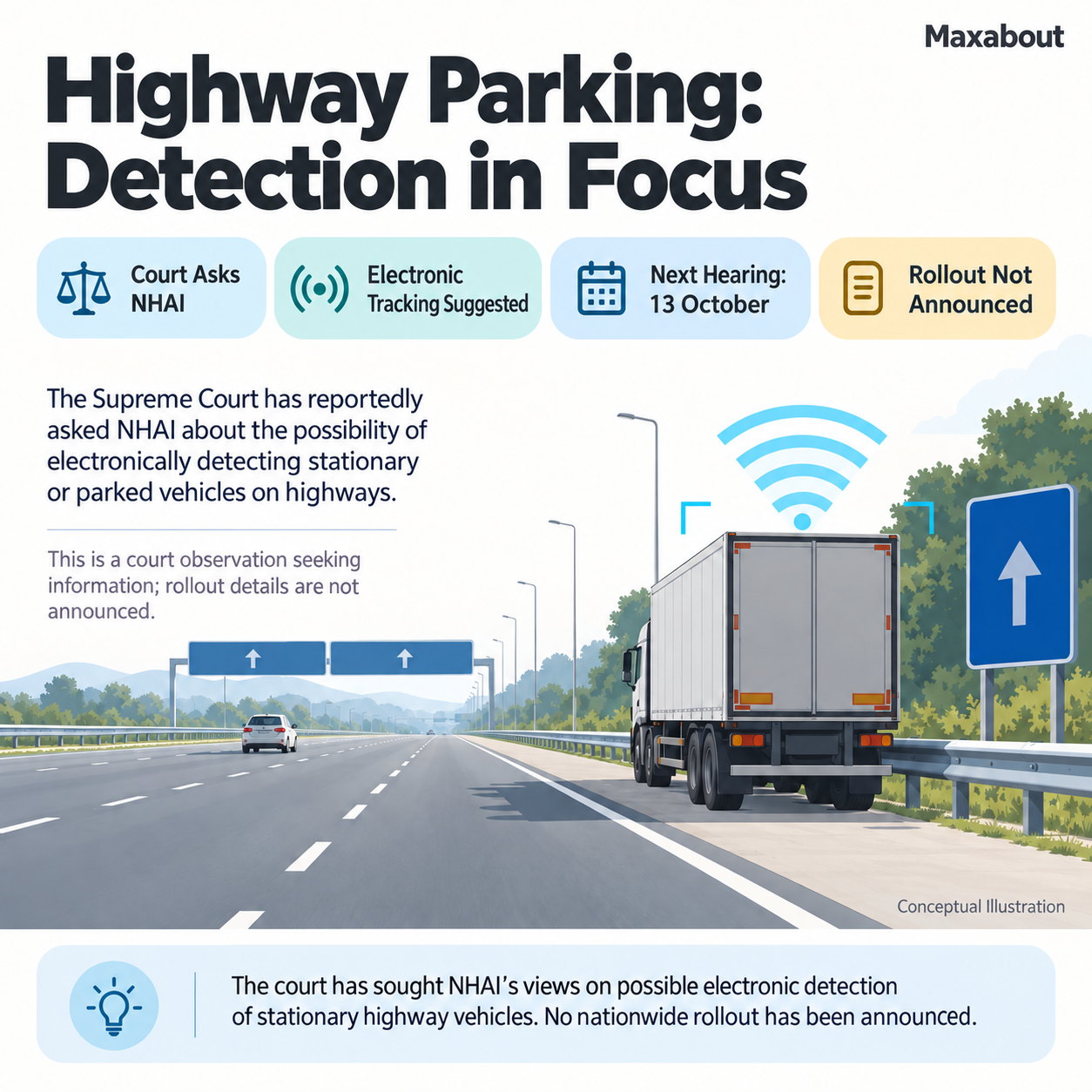
Why identifying a stopped vehicle is only one part of the problem
A monitoring system would need to distinguish a potentially dangerous obstruction from ordinary traffic slowing, an authorised stop or a breakdown. Detection would then need an effective response: notifying the appropriate patrol or operator, verifying the situation and managing the obstruction. Those are practical questions raised by the subject, not specifications confirmed by the court report.
For road users, the important distinction is between a camera or alert illustration and a functioning safety service. An image showing a detection icon cannot establish that a particular highway already has that capability or that an alert reaches a response team immediately.
The earlier parking directions provide the context
The report describes interim directions issued on 13 April, including restrictions on heavy and commercial vehicles parking or stopping on national-highway carriageways or paved shoulders except at designated bays, lay-byes or wayside amenities. It also describes directions concerning highway encroachments and accident blackspots.
Those historical directions should be kept separate from the latest electronic-surveillance observation. The authenticated order text for the current hearing has not been established in this update, so it should not be presented as a new mandatory technology programme or a complete statement of every applicable parking rule.
What to watch at the next hearing
The next useful development would be a formal response or order explaining whether further measures are required and how they relate to existing patrolling and highway management. Clear responsibilities, scope and response arrangements would matter more than a generic promise of surveillance.
FAQs
Has NHAI announced nationwide electronic detection of parked vehicles?
No nationwide rollout is announced in this report. It describes the Supreme Court questioning NHAI about a possible electronic mechanism.
When is the matter due to be heard next?
The report lists the further hearing for 13 October. A later court listing or order would be the authoritative update if the schedule changes.
Does the illustration show a system already installed on a highway?
No. Both visuals are conceptual editorial illustrations. The report does not establish a final technical design or an installed system at the depicted location.
The Supreme Court's highway-detection question to NHAI highlights the need to identify dangerous stationary vehicles and respond effectively. Readers should watch for the next formal decision while keeping the reported observation separate from a confirmed surveillance rollout.
Explore the story
Related news





Share your view and join the discussion.
Earn reward points for every comment and get a chance to win ₹1,000 in our weekly lucky draw. Sign in with Google in one tap.
Start the conversation
No one has commented on this article yet. Be the first to share your view.
Want to read more automotive news?
Stay updated with the latest car launches, reviews, and industry insights.
Browse All News