
Small Car Market Revival: RC Bhargava's Bold Prediction
Maruti Suzuki's Chairman RC Bhargava recently made a statement that caught a lot of attention — he firmly believes the small car segment in India will make a strong comeback. His argument is straightforward: millions of Indian families simply cannot afford what the market is currently offering, and ...
Editorial Team
Maruti Suzuki's Chairman RC Bhargava recently made a statement that caught a lot of attention — he firmly believes the small car segment in India will make a strong comeback. His argument is straightforward: millions of Indian families simply cannot afford what the market is currently offering, and that gap will eventually correct itself.
It's a bold thing to say out loud, honestly. For the past several years, the data has told a very different story. Small cars have been losing ground steadily while SUVs and compact SUVs have dominated showroom floors. Buyers who once gravitated toward entry-level hatchbacks have either stretched their budgets upward or, in many cases, stepped back from buying a new car altogether.
And that second group is the one worth paying attention to. These are real families in Lucknow, Nagpur, Coimbatore, Rajkot — places where a ₹12 to ₹15 lakh car represents an enormous financial decision, not a casual weekend purchase. For them, the new car market has quietly become out of reach.
So when someone at the very top of India's largest carmaker says the small car market will come back — not might, but will — it signals something. Whether that's genuine conviction, market strategy, or both, the prediction carries real weight for millions of buyers still waiting on the sidelines.
How the Small Car Segment Lost Its Way: A Quick Look Back
It didn't happen overnight. The decline of the small car segment in India was slow, almost invisible at first — and then suddenly, obvious to everyone.
Go back to 2017 or 2018, and models like the Maruti Alto, Hyundai Santro, and Tata Indica were fixtures on roads from Coimbatore to Patna. These were not budget compromises. For most buyers, they represented genuine aspiration — owning a car at all was the milestone. The sub-₹5 lakh segment was alive and competitive, with manufacturers fighting hard for every unit.
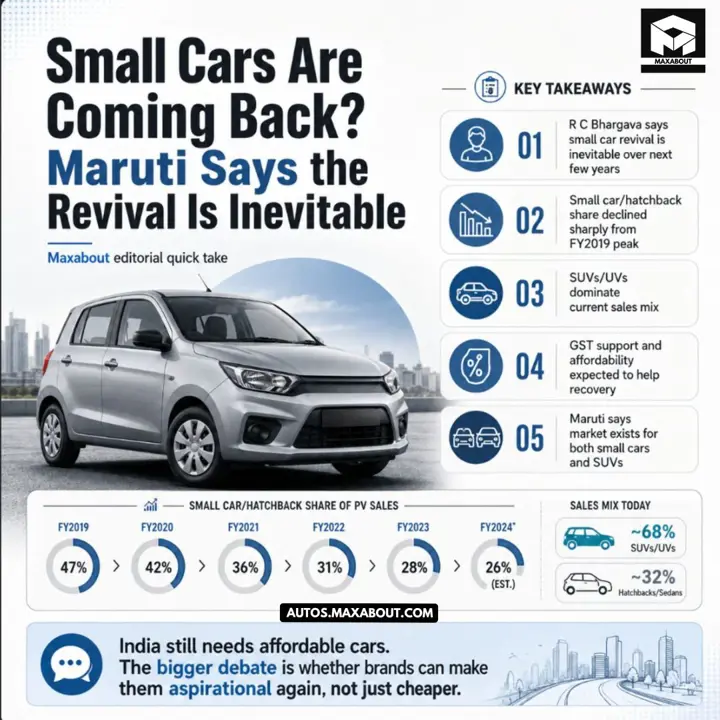 Then several forces converged at once.
The GST structure introduced in 2017 inadvertently tilted the playing field. SUVs above a certain length attracted a compensation cess, but the overall tax math still made compact SUVs feel like reasonable value jumps over hatchbacks. Manufacturers noticed buyer psychology shifting and responded — not by defending small cars, but by chasing the SUV boom aggressively.
Simultaneously, safety and emission regulations — BS6 norms, mandatory airbags, ABS requirements — added real costs to every vehicle. These were necessary improvements, but they hit entry-level cars hardest. A model that once sat comfortably at ₹4 lakh suddenly crossed ₹6 lakh without feeling meaningfully better to buyers comparing it against a stretched budget for something larger.
Rising aspirations played a role too. In cities like Pune, owning a hatchback started feeling like a stepping stone rather than a destination. The segment lost its identity somewhere between necessity and aspiration — and that middle ground is a difficult place to survive commercially.
What Is Actually Driving the Case for Small Car Revival
Despite all the headwinds, the underlying logic for small cars in India remains surprisingly strong. Strip away the sentiment and look at the numbers — the case practically makes itself.
Urban congestion alone tells an interesting story. Anyone who has navigated Bengaluru's Outer Ring Road during peak hours or tried parking near a Mumbai market knows that a smaller footprint genuinely matters. Compact cars are not just cheaper — they are functionally better suited to how millions of Indians actually use their vehicles daily.
Running costs are another honest pressure point. With fuel prices staying stubbornly high, the math on a smaller, lighter engine holds up better over time. For a household managing inflation across groceries, school fees, and EMIs, monthly fuel spend is not abstract — it is felt immediately.
Then there is the first-time buyer reality in smaller cities. Towns like Nashik, Coimbatore, or Lucknow have growing middle-class populations where a ₹6–8 lakh car represents a serious financial decision, not an impulse. That buyer pool is enormous and largely underserved right now.
Urban families increasingly need a practical second car too — something manageable, economical, and easy to park. A large SUV handles the weekend; a compact handles everything else.
CNG and electric options could quietly reshape affordability here. Running costs drop significantly, which effectively lowers the ownership barrier without requiring the purchase price to fall dramatically. That combination might be exactly what revives genuine interest.
The Real Barrier Nobody Talks About: Entry-Level Cars Aren't Cheap Anymore
Here's the uncomfortable truth that gets glossed over in these optimistic revival conversations. A basic hatchback today starts somewhere between ₹5 lakh and ₹7 lakh. A decade ago, that price range bought you a reasonably equipped mid-variant. Now it barely gets you through the showroom door.
That shift is structural, not accidental. BS6 compliance added real costs. Growing pressure around crash test performance and safety equipment — six airbags, stronger body structures — pushed manufacturers to spend more on engineering. Buyers themselves now expect rear parking sensors, touchscreen systems, and connected features even on base variants. The market demanded it, and prices followed.
Nobody can simply reverse this. Regulatory requirements don't disappear. Safety expectations won't retreat. So when industry leaders talk about small car revival, the honest question worth asking is: revival at what price point, exactly?
Because ₹6 lakh is not genuinely entry-level anymore. For a household deciding between this and a used mid-size sedan, the calculation changes entirely. The psychological appeal of "affordable small car" weakens considerably when the number on the invoice looks anything but small.
Manufacturers face a real ceiling here. The revival, if it comes, may simply happen at a higher band — redefining what "affordable" means rather than actually delivering it.
Small Cars vs SUVs: Which Actually Makes More Sense on Indian Roads Today
This is a question I find genuinely difficult to answer cleanly, because the honest answer depends almost entirely on where you live and how you drive.
Take parking in Chandni Chowk, Dadar, or Bengaluru's Chickpet market. A compact hatchback is not just convenient there — it is practically essential. Squeezing into a gap that an SUV cannot even consider, turning around in a narrow lane without a twelve-point maneuver — these are real, daily advantages that no amount of highway performance cancels out.
But step outside these dense urban pockets, and the picture shifts. Many smaller towns have roads that genuinely punish low ground clearance. Monsoon season makes this worse. A flooded stretch that a taller SUV wades through calmly can leave a hatchback driver making difficult decisions.
Running costs tell an equally mixed story. Insurance, tyres, and service bills on a small car are meaningfully lower. Real-world city fuel efficiency on a hatchback also tends to edge ahead in stop-and-go traffic, where larger engines work harder.
I think the SUV's appeal, however, goes beyond pure practicality. The perceived sense of safety, the commanding seating position — these matter to buyers in ways that spreadsheets cannot fully capture.
Neither choice is universally smarter. They simply serve different lives.
Which Upcoming Small Cars Could Actually Spark the Revival
Talking about a revival is one thing. Having the actual products to deliver it is another. So what is realistically in the pipeline?
Maruti Suzuki remains the most consequential player here. Their CNG variants across the Alto K10, Wagon R, and Celerio range have already demonstrated something important — price-sensitive buyers will return to small cars if the running cost equation genuinely works in their favour. CNG is not a temporary workaround. In cities like Delhi, Pune, and Ahmedabad where piped gas infrastructure is solid, it has become a legitimate ownership strategy.
The more interesting conversation surrounds affordable electric hatchbacks. Industry discussions have long pointed toward sub-₹8 lakh electric options as the segment's potential turning point. Whether Maruti's small EV ambitions, developed through their Toyota partnership, can realistically hit that price band remains the critical question. A ₹10-12 lakh electric hatchback helps somewhat. A ₹7-8 lakh one changes everything.
Tata has the Tiago EV already proving that compact electric cars find real buyers. Hyundai and Renault have largely shifted focus upmarket, though Renault's history with value-oriented small cars suggests they could re-enter if the demand signal strengthens.
But here is the honest reality — new models alone will not revive this segment. The pricing has to follow. A smartly designed hatchback launched at ₹9-10 lakh on-road in most cities faces an identity crisis, sitting uncomfortably close to entry SUV territory without offering the perceived status benefits.
The revival, if it comes, will be built on genuine affordability first. Everything else follows from there.
What This Means for You If You Are Sitting on a Buying Decision Right Now
Let me be direct. If you are waiting for this predicted revival before making a purchase, you could be waiting a long time. Predictions from industry chairmen, however well-intentioned, do not translate into showroom reality overnight.
The more practical question is this — what do you actually need the car for? If your daily reality involves navigating crowded lanes in Indore, finding parking in Coimbatore, or managing fuel costs on a modest monthly budget, a well-specced small car today still makes considerable sense. The segment, for all its struggles, has not stopped delivering genuine value.
For buyers in smaller towns especially, the calculus is different from metro buyers. Service network reach matters enormously. A Maruti or Hyundai dealership being thirty kilometres away is a manageable inconvenience. A lesser-known brand's nearest service centre being three districts away is a genuine problem. Prioritise brands with strong regional service presence over flashy features.
On the financial side, avoid fixating on sticker price alone. Look at insurance costs, spare parts availability, and realistic fuel efficiency figures — not manufacturer claims tested under ideal conditions, but numbers reported by actual owners in similar driving environments to yours.
As for whether this revival prediction is genuine or wishful thinking — it is honestly somewhere in between. The intent appears real. The execution remains uncertain.
No comments yet
Be the first to share your thoughts!
Want to read more automotive news?
Stay updated with the latest car launches, reviews, and industry insights.
Browse All News