
Simple Ultra Launched at ₹2.35 Lakh: Longest Range EV Scooter
Simple Energy has just dropped a number that's hard to ignore — ₹2.35 lakh ex-showroom for the new Ultra. In a market where Ola, Ather, and TVS have been trading punches for the past couple of years, a relatively lesser-known name stepping in with a bold range claim and an aggressive price tag is wo...
Editorial Team
Simple Energy has just dropped a number that's hard to ignore — ₹2.35 lakh ex-showroom for the new Ultra. In a market where Ola, Ather, and TVS have been trading punches for the past couple of years, a relatively lesser-known name stepping in with a bold range claim and an aggressive price tag is worth paying close attention to.
The headline figure here is the range. Simple Energy is positioning the Ultra as India's longest range electric scooter — and that phrase alone is going to resonate deeply with everyday Indian commuters. Range anxiety is real. Whether you're navigating stop-and-go traffic in Bengaluru or covering longer stretches on the outskirts of Pune or Hyderabad, the fear of running out of charge before finding a station genuinely shapes buying decisions.
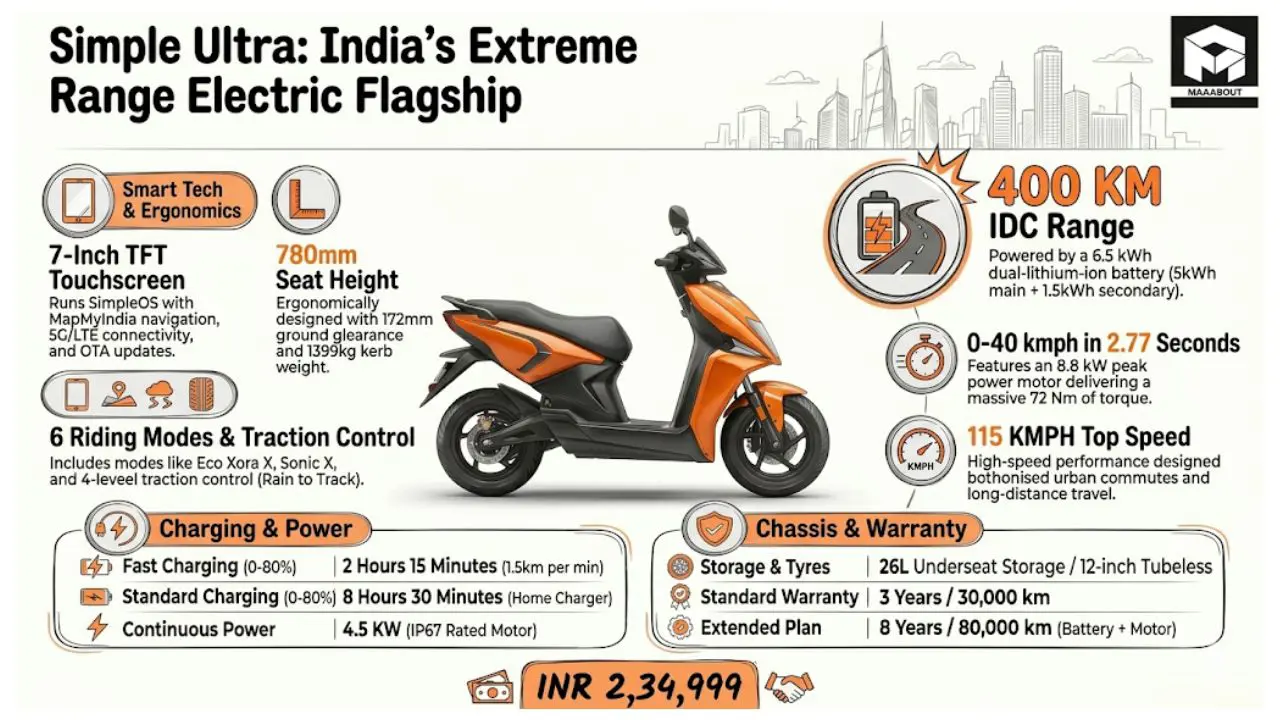 So when a brand leads with range as its core selling point, it's clearly reading the room correctly. The question is whether the real-world performance actually holds up — because claimed figures and actual riding conditions on Indian roads are often very different conversations.
I'm genuinely curious about this one. From what reviews and official announcements suggest, this could either be a serious disruptor or another case of impressive specs that soften under scrutiny. Let's dig into what the Simple Ultra actually brings to the table.
What Makes the Simple Ultra's Range Claim Stand Out
Simple Energy claims the Ultra delivers a certified range of 212 kilometres under IDC testing. That number stops you in your tracks. But here's what most buyers don't fully understand — IDC, or Indian Drive Cycle, is a laboratory-controlled test. Consistent speeds, flat surfaces, ideal temperatures. Real roads aren't that forgiving.
Industry observers generally suggest expecting somewhere between 60 to 70 percent of any IDC figure in actual riding conditions. That would put the Ultra's realistic range closer to 130–150 kilometres on a full charge. Still genuinely impressive for the segment, but worth calibrating expectations before purchase.
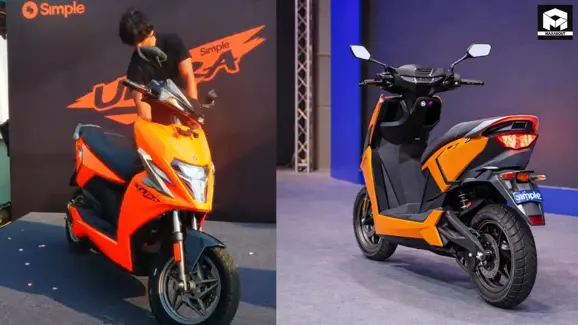 The engineering behind this range matters. The Ultra runs on a 5 kWh battery pack — notably larger than most competitors in this price bracket. The motor is tuned specifically for efficiency rather than outright performance, which is a deliberate trade-off Simple Energy has made. Regenerative braking helps recover energy, especially useful in dense stop-and-go traffic.
Speaking of which — Bengaluru's peak-hour crawl or Mumbai's coastal road congestion actually works in favour of electric scooters. Regenerative systems recover energy during deceleration, something combustion engines simply cannot do. Highway riding at sustained higher speeds, however, drains the battery noticeably faster.
Rider weight also plays a meaningful role. Early reviewer observations suggest heavier riders or those carrying pillion passengers regularly should mentally subtract another 10–15 percent from their realistic range estimate.
Breaking Down the ₹2.35 Lakh Price Tag: Is It Justified?
Let's talk money, because this is where opinions will genuinely divide. At ₹2.35 lakh (ex-showroom), the Simple Ultra positions itself at the sharper end of the premium electric scooter segment. That's a significant ask, and it deserves honest scrutiny.
Consider the competition. The Ather 450X sits around ₹1.55–1.65 lakh, the TVS iQube ST hovers near ₹1.60 lakh, and even the Bajaj Chetak Premium comes in well below this figure. The Ola S1 Pro is arguably the closest rival in pricing, yet still trails the Ultra by a noticeable margin. So what exactly justifies that gap?
From what reviews suggest, the Ultra's primary argument is its range superiority. No other production electric scooter in India currently claims comparable real-world range figures. If you genuinely need that range and want to skip range anxiety entirely, the premium starts making sense on paper.
Battery warranty terms and build quality observations from early reviewers also appear competitive. That said, Simple is a relatively young brand, and buyers paying this price will reasonably expect Ather or TVS-level service network confidence — something still worth researching locally before committing.
On subsidies, state-level EV incentives can meaningfully soften the blow. Delhi, Maharashtra, and Gujarat buyers may see effective costs drop by ₹15,000–25,000 depending on current policy cycles. FAME II applicability should be confirmed with the brand directly, as eligibility criteria have shifted recently per industry reports.
At manageable EMI spreads across 36–48 months, the monthly outflow becomes more digestible. Steep? Yes, slightly. Unjustifiable? Not entirely — if the range promise holds up consistently.
Features, Technology, and Riding Experience: What Reviewers Are Saying
So the price conversation is done. Now the more interesting question — what exactly are you getting for that money? From available test ride impressions and observer reports, the Simple Ultra brings a fairly loaded package to the table.
The centerpiece is a large TFT touchscreen display that handles navigation, ride statistics, and connectivity features. Early reviewers have noted it reads reasonably well in daylight, though direct harsh sunlight — something every Indian rider deals with — can occasionally wash it out. The interface itself appears intuitive enough for daily use without requiring a manual.
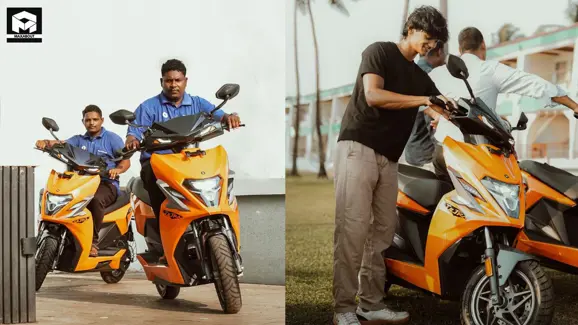 Riding modes span the usual spectrum — Eco, Ride, and Blast modes — allowing riders to trade outright performance for extended range depending on the commute. Eco mode is reportedly where the headline range figures are achieved, so real-world mixed-mode riding will likely settle somewhere more modest. Worth being realistic about that.
On Indian roads specifically, early impressions suggest the suspension handles broken city surfaces and aggressive speed breakers with reasonable composure. Not exceptional, but competent. Seat comfort for solo riders seems adequate for 45–60 minute commutes, though pillion accommodation appears tighter — a recurring observation across reviewer accounts.
The over-the-air update capability is genuinely useful here. Simple Energy has positioned this as a living product, meaning software improvements can arrive without dealership visits — something that looks promising on paper and should age better than fixed-firmware competitors.
Storage is practical. Under-seat space accommodates a half-face helmet, and the overall ergonomics feel upright and city-friendly. One flagged concern across multiple reports — build quality on trim pieces needs monitoring over longer ownership cycles.
Charging Infrastructure and Ownership Practicality
This is honestly where the decision gets real for most Indian buyers. The Simple Ultra bundles a standard charger that works with a 15A socket — the same type used for air conditioners and geysers. Full charge takes roughly 5 to 6 hours, which means an overnight plug-in at home is completely manageable. On paper, that sounds straightforward.
Except India is not all independent houses with private parking.
Consider someone living in a housing society in Pune — sixth floor, shared basement parking, no dedicated power outlet nearby. That overnight charging routine becomes genuinely difficult. Building management committees are notoriously slow about approving electrical modifications, and running an extension cord across common areas is neither safe nor practical. This is a real friction point that Simple Energy cannot solve with software updates.
Contrast that with an independent house owner in Chennai with a covered porch. For them, ownership is almost frictionless. Plug in after returning home, wake up to a full battery. The experience is fundamentally different.
On public charging, Simple Energy's network is still considerably thinner than more established competitors. This gap matters if your daily commute occasionally stretches or travel plans change unexpectedly. Fast charging capability exists on the Ultra, which helps, but only if a compatible station is actually accessible near you — something worth verifying locally before committing.
Simple Energy as a Brand: Can They Deliver on After-Sales and Service?
This is the question that genuinely keeps me cautious about recommending the Ultra without reservation. The scooter itself looks compelling on paper. But Simple Energy is not TVS. It is not Bajaj or Honda. It is a young startup, and that reality carries weight when you are spending ₹2.35 lakh on a vehicle you depend on daily.
Their current service footprint is far more limited than established players. From what is publicly known, Simple Energy operates experience centers and service touchpoints primarily across larger metros and select Tier-1 cities. If you are in Bengaluru, Hyderabad, Chennai, or Pune, your situation looks reasonably manageable. If you are in a smaller city or a Tier-2 town, the picture becomes genuinely uncertain.
We have seen this story before. Ola Electric launched aggressively, delivered at scale, and then faced a very public after-sales crisis — long wait times, unresolved complaints, frustrated owners. It became a cautionary tale for the entire startup EV segment. Simple Energy must have learned something from watching that unfold. Whether those lessons are reflected in their actual service infrastructure is still being tested in real-world conditions.
To their credit, Simple Energy has announced expansion plans for their dealership and service network, according to recent industry reports. But announced plans and ground-level execution are two different things entirely.
Before committing, please verify service availability in your specific city. Ask for the nearest center's address. Visit it if possible. That one step could save significant frustration later.
Who Should Buy the Simple Ultra — And Who Should Wait
With the service network reality in mind, let's be straightforward about who this scooter actually suits right now.
The Ultra makes genuine sense if you:
Commute 40–60 km daily within a city and return home to charge overnight
Live in Bangalore, Hyderabad, Chennai, or another city where Simple Energy already has verified service presence
Consider yourself an early adopter — someone comfortable riding with a brand that's still maturing
Value real-world range above everything else and find the ₹2.35 lakh price point competitive for what's offered
Honestly, consider waiting if you: live in a smaller city with no confirmed service center nearby, prioritize long-established brand reliability, or regularly need to travel intercity where charging infrastructure remains unpredictable.
So, does the Simple Ultra represent a genuine step forward for Indian electric mobility? I think it does — cautiously. The range figures, the pricing, the feature set — these are legitimate achievements, not marketing smoke. Simple Energy has built something that forces the entire segment to reconsider what's possible at this price.
But a promising scooter and a complete ownership experience are different things. The Ultra has earned serious consideration. Whether it's earned your money specifically depends entirely on where you live and how much uncertainty you're comfortable carrying.
Explore the story
Related news

Share your view and join the discussion.
Earn reward points for every comment and get a chance to win ₹1,000 in our weekly lucky draw. Sign in with Google in one tap.
Start the conversation
No one has commented on this article yet. Be the first to share your view.
Want to read more automotive news?
Stay updated with the latest car launches, reviews, and industry insights.
Browse All News