
Royal Enfield Sherpa FT Mk2 Debuts at Flat Track World Championship
Something genuinely exciting happened in the world of motorsport recently. Royal Enfield debuted the Sherpa FT Mk2 at the Flat Track World Championship, and for anyone who follows motorcycle racing, this is a moment worth paying attention to.For the uninitiated, flat track racing is exactly what it ...
Editorial Team
Something genuinely exciting happened in the world of motorsport recently. Royal Enfield debuted the Sherpa FT Mk2 at the Flat Track World Championship, and for anyone who follows motorcycle racing, this is a moment worth paying attention to.
For the uninitiated, flat track racing is exactly what it sounds like. Riders push purpose-built motorcycles around oval dirt tracks at serious speeds, with no front brakes, relying entirely on throttle control and body positioning to slide through corners. It is raw, spectacular, and demands an extraordinary level of skill. The discipline has deep roots in American motorsport but has grown into a genuinely global championship over recent years.
Now here is why this matters. An Indian motorcycle brand, one that most of the world associates with unhurried, character-filled riding, is now competing at the highest level of a demanding international motorsport series. That is not a small thing. Royal Enfield has been quietly building its motorsport credentials over the past few years, from the Continental GT Cup to the Himalayan Rally program, and the Sherpa FT Mk2 feels like a confident step forward in that journey.
From what industry observers and motorsport followers are noting, this debut signals that Royal Enfield is serious about proving its engineering capabilities well beyond what its road bikes suggest.
What Is Flat Track Racing and Why Does It Matter?
If you have grown up watching MotoGP or even local motocross events, flat track racing might seem unfamiliar at first. It looks deceptively simple from a distance. An oval dirt track, riders going in circles, no dramatic jumps. But spend five minutes actually watching it, and you quickly realize this discipline is something else entirely.
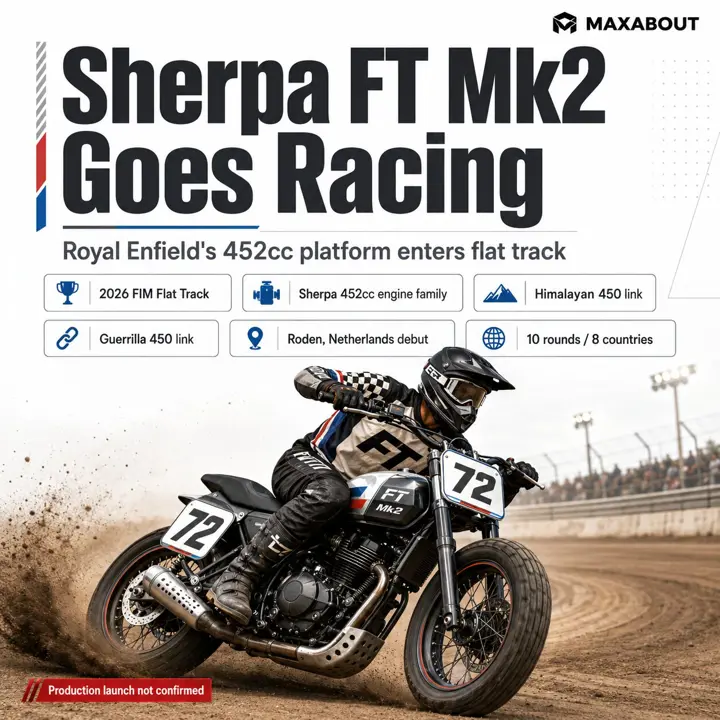 The basic format involves racing on oval or D-shaped dirt tracks where riders must slide their rear wheel through corners at high speed. Here is the part that genuinely surprises most people: traditional flat track machines run no front brakes at all. Riders control their speed and cornering entirely through throttle modulation and deliberate rear wheel slides. The technique demands extraordinary balance, sensitivity, and nerve.
Flat track has deep American roots, stretching back over a century. For decades it was the dominant form of motorcycle racing in the United States, producing legendary riders and pushing engine development hard. In recent years, the discipline has grown into a structured global championship, attracting manufacturers who want to prove mechanical reliability and chassis engineering under genuinely punishing conditions.
That is precisely why Royal Enfield's presence here carries real weight. Competing at this level is not a marketing exercise. Flat track exposes every weakness in a machine's balance, power delivery, and build quality. Surviving it, let alone performing well, tells you something honest about the engineering underneath.
Sherpa FT Mk2: What We Know About the Machine
Royal Enfield has kept specific numbers close to their chest, but enough detail has emerged from official announcements and paddock observations to form a reasonable picture of what the Sherpa FT Mk2 actually is.
At its core, the machine runs a purpose-built single-cylinder engine, continuing the flat track tradition of keeping power delivery linear and manageable rather than peaky and aggressive. From what has been observed, the Mk2 represents a meaningful step forward in how that power is managed, with revised combustion geometry and updated fuelling characteristics compared to its predecessor. The goal, clearly, is smoother throttle response out of the loose-surface corners where races are genuinely won or lost.
The chassis construction is where things get particularly interesting. Royal Enfield appears to have worked seriously on weight distribution and frame rigidity, two elements that directly influence how confidently a rider can slide the rear wheel while maintaining front-end control. That balance is everything in flat track.
What still remains unclear is the exact power output and whether the Mk2 has adopted any updated suspension components from external suppliers. Those details matter. A strong engine paired with average suspension will only take you so far at world championship level, and that is a question worth watching as the season develops.
Royal Enfield's Motorsport Journey: From Himalayan Odyssey to World Championships
Royal Enfield has not arrived at the Flat Track World Championship overnight. This has been a slow, deliberate climb — and that actually makes the Sherpa FT Mk2's debut feel more meaningful than a sudden headline grab.
For years, the brand anchored its competitive identity around the Himalayan Odyssey, a grueling ride across some of the most punishing terrain in northern India. It was less about racing and more about endurance, community, and proving that their motorcycles could handle real punishment. That foundation mattered.
Then came the Continental GT Cup, a one-make racing series that gave younger riders a structured, affordable entry point into competitive motorsport. It was grassroots, yes, but it was intentional. Royal Enfield was quietly building a pipeline — developing rider talent, learning how to run race programs, and understanding what competitive machinery actually demands.
The parallel to Ducati and KTM is hard to ignore. Both brands transformed their road bike reputations significantly through motorsport credibility. KTM's off-road dominance directly shaped buyer perception of their street range. Whether Royal Enfield can follow that same trajectory is genuinely worth watching. From what industry observers suggest, the brand understands this opportunity well.
The Sherpa FT Mk2 is simply the most ambitious step yet.
What This Means for Royal Enfield's Road Bikes and Indian Buyers
Racing programs rarely stay confined to the track. The engineering lessons, the material choices, the tuning confidence — all of it eventually finds its way into production motorcycles. That's the quiet promise behind Royal Enfield's Flat Track World Championship campaign.
Think about what flat track racing actually demands: precise throttle response, chassis balance under stress, and engine character that riders can feel and trust. These are exactly the qualities that performance-focused Indian buyers complain are missing from mid-range motorcycles. If the Sherpa FT Mk2 program genuinely pushes Royal Enfield's engineers into solving these problems at a competitive level, that knowledge doesn't disappear when the season ends.
From what industry observers have noted, Royal Enfield is clearly targeting a younger, more performance-aware demographic. Riders in Pune, Bangalore, and Hyderabad are increasingly confident, well-researched buyers who follow international motorsport and hold brands to higher standards. A World Championship presence gives Royal Enfield something genuinely useful — credibility that no marketing campaign can manufacture.
Whether this translates into sharper road bikes in the near future is worth watching closely.
The Competition: How Does Royal Enfield Stack Up at the World Level?
Being honest here — Royal Enfield is stepping into a arena where the competition has decades of specialized experience. Indian Motorcycle and Harley-Davidson's Screamin' Eagle program have built flat track DNA over generations. These aren't just factory efforts; they represent deeply embedded motorsport cultures with engineering pipelines that have been refined across hundreds of race weekends.
Royal Enfield, by comparison, is relatively new to this level of commitment. The Sherpa FT Mk2 shows genuine technical ambition, but ambition alone doesn't win championships. The gap in accumulated data, rider development infrastructure, and trackside engineering experience is real and shouldn't be minimized.
What's worth remembering, though, is that every dominant program started somewhere. KTM's early forays into international competition were far from polished. Honda took years to build its road racing reputation into something formidable. These things compound slowly.
Realistically, Royal Enfield should be measured right now on participation quality, mechanical reliability, and incremental lap-time improvements — not podium finishes. If the Sherpa FT Mk2 completes races competitively and the team builds institutional knowledge each season, that's a meaningful foundation. Expecting immediate results would simply be unfair to what is, at its core, a program still finding its feet on the world stage.
Fan and Community Reaction: Pride, Skepticism, and Everything In Between
The moment Royal Enfield confirmed the Sherpa FT Mk2's entry into the Flat Track World Championship, Indian motorcycle forums and social media groups erupted. And honestly, the reactions were all over the place — which is exactly what you'd expect.
A large section of the community feels genuine pride. Seeing a brand built in Chennai competing on a global motorsport stage carries real emotional weight for many Indian riders. This isn't just about a motorcycle — it's about a homegrown manufacturer refusing to stay comfortable. That sentiment resonates deeply, especially among enthusiasts who grew up watching Royal Enfield as simply a reliable, unhurried brand.
But performance-focused riders are more measured. Several online discussions raise pointed questions about whether Royal Enfield's engineering infrastructure is truly ready for elite-level competition. The skepticism isn't unfair. It comes from a place of wanting the brand to genuinely succeed rather than just appear competitive.
Both reactions are valid. Pride and skepticism can coexist — and frankly, that tension is healthy for any brand attempting something ambitious. The community is watching closely, and Royal Enfield would do well to treat that scrutiny as motivation rather than noise.
Final Thoughts: A Bold Step or Just a Marketing Exercise?
Honestly, it is probably both — and that is not necessarily a bad thing. The most enduring motorsport programs in history started with equal parts genuine ambition and brand strategy. Royal Enfield's Sherpa FT Mk2 debut in the Flat Track World Championship sits comfortably in that grey area, and the honest answer is that only time will separate the substance from the spectacle.
Success here does not have to mean a championship in year one. Real success looks like consistent finishes, measurable lap-time improvements across seasons, and engineering insights that eventually filter down to production motorcycles. If riders are competitive midfield and the team is learning at every round, that is a genuine foundation worth respecting.
For Indian enthusiasts specifically, watch how the program evolves technically over the next two or three seasons. Watch whether Royal Enfield commits resources even when results are difficult. That sustained commitment, more than any single podium, will reveal whether this is serious sporting ambition or an expensive press release.
Either way, an Indian brand racing at this level deserves attention. That alone is worth following.
Explore the story
Related news

Share your view and join the discussion.
Earn reward points for every comment and get a chance to win ₹1,000 in our weekly lucky draw. Sign in with Google in one tap.
Start the conversation
No one has commented on this article yet. Be the first to share your view.
Want to read more automotive news?
Stay updated with the latest car launches, reviews, and industry insights.
Browse All News