
Royal Enfield Scram 450 2027: Expected Positioning
Royal Enfield has been quietly but confidently building something interesting in the mid-displacement space. The Himalayan 450 changed how people think about the brand — suddenly, here was a Royal Enfield that could genuinely compete on engineering merit, not just nostalgia. And now, if recent indus...
Editorial Team
Royal Enfield has been quietly but confidently building something interesting in the mid-displacement space. The Himalayan 450 changed how people think about the brand — suddenly, here was a Royal Enfield that could genuinely compete on engineering merit, not just nostalgia. And now, if recent industry chatter is to be believed, a Scram 450 is in the pipeline, with a likely arrival around 2027.
That is still a few years away, and details are still emerging. So this is not a spec sheet — it is more an attempt to make sense of what we can reasonably expect, based on what we already know about the platform and the segment.
Here is why this matters. The Scram 411 found a real audience in India — riders who wanted something more urban and stripped-back than the full Himalayan, but with just enough character to make daily commutes feel interesting. That formula worked. Now imagine that same thinking applied to the more capable 450 platform. The scrambler segment is heating up, with more options arriving and younger riders actively looking beyond conventional street bikes.
From what industry sources suggest, Royal Enfield sees clear space for this model. Whether it delivers on that promise is still an open question — but it is certainly worth paying attention to.
How the Scram 450 Fits Into Royal Enfield's Product Strategy
Royal Enfield has been unusually deliberate with the 450 platform. The Sherpa engine did not arrive as a one-off experiment — it arrived as a foundation. The Himalayan 450 was simply the first expression of that foundation, and from what industry reports indicate, Royal Enfield always intended to build outward from it.
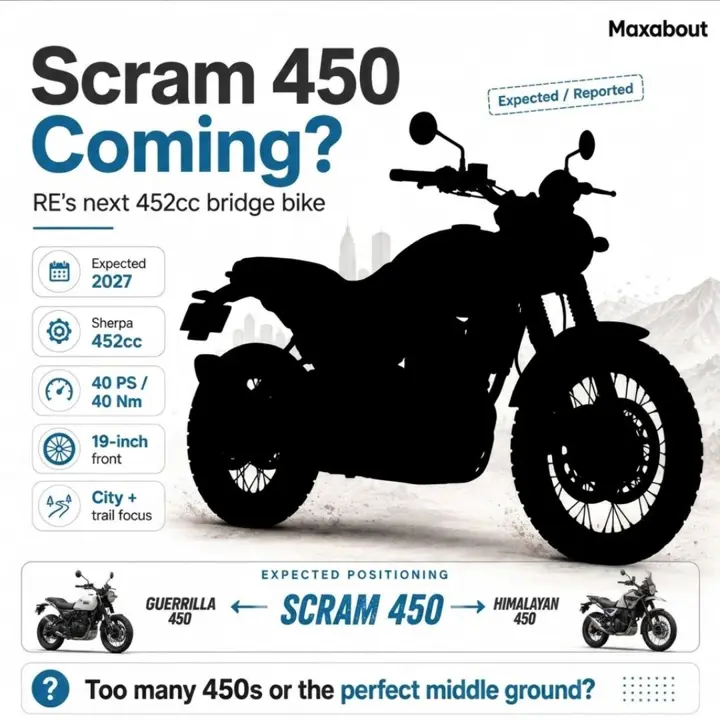 The distinction in positioning matters here. The Himalayan 450 is built for adventure touring — long-distance capability, serious off-road hardware, panniers, windscreen, the full package. It is genuinely capable on mountain roads and extended highway runs. But that bulk and purpose-built design make it feel like more than many city riders actually need.
That is precisely the gap a Scram 450 would fill. Think lighter framing, a more upright and accessible riding position, scrambler aesthetics, and enough off-road competence for weekend trails — without the full ADV commitment. The Scram 411 proved this formula works exceptionally well for Indian riders who want versatility and personality in a single motorcycle.
Royal Enfield understands its audience. Most buyers are not expedition riders. They commute through Bengaluru traffic, occasionally escape to Coorg or Kasol on weekends, and want a motorcycle that feels alive doing both. The Scram 450 appears designed for exactly that rider — capable, characterful, and not unnecessarily complicated.
Expected Positioning and Target Audience for the Scram 450
Picture this: a young software professional in Pune, parking a sharp-looking scrambler outside a cafe on a Saturday morning, then pointing that same bike toward the Sahyadri ghats by afternoon. That is precisely the rider Royal Enfield is building the Scram 450 for. Not the hardcore adventurer chasing Ladakh passes, but someone who wants genuine capability wrapped inside an approachable, stylish package.
This distinction matters. The Himalayan 450 already handles serious off-road intent — longer travel suspension, upright touring ergonomics, proper ADV positioning. The Scram 450 is expected to sit differently. Think lighter feel, more nimble handling through city traffic, less intimidating for someone upgrading from a 200cc or 250cc machine. It fills a gap between casual street riding and committed adventure touring without forcing riders to choose one extreme.
On pricing, expectations point toward a ₹2.5 lakh to ₹3 lakh on-road range, depending on variants. That positions it meaningfully above entry-level 200cc options while remaining far more accessible than a KTM 390 Adventure. It is a considered purchase, not an impulsive one — which suits its target buyer perfectly.
Royal Enfield also understands something most manufacturers underestimate. Emotional connection sells motorcycles in India. The thumper character, the heritage styling, the community — these carry genuine weight among buyers in their mid-twenties to mid-thirties. The Scram 450 looks built to leverage exactly that feeling.
The Sherpa 450 Engine: Why It Makes the Scram 450 Such a Promising Prospect
Any conversation about the Scram 450 has to start here. The Sherpa 450 engine — already doing real work inside the Himalayan 450 — has earned a genuinely strong reputation among riders and reviewers. Not through marketing, but through consistent real-world feedback.
What riders consistently highlight is the smoothness of the power delivery. This is not an engine that demands constant gear changes or punishes you in slow-moving traffic. The torque arrives early and builds progressively — exactly what you want when you are navigating broken roads outside Pune or crawling through Bengaluru's evening gridlock.
Heat management has also drawn positive observations. Liquid cooling keeps things composed even during prolonged low-speed running, which matters enormously in Indian urban conditions. From what reviewers have noted, the engine does not become unpleasant to sit behind on a congested stretch.
Now imagine that same mechanical foundation retuned for a scrambler orientation — potentially softer suspension travel, a more upright and aggressive riding geometry, and a slightly lighter overall package. The character could shift meaningfully. More playful, more flickable, more suited to mixed-surface riding without losing that refined, accessible power character.
The 450cc displacement is genuinely well-positioned. It offers noticeably more capability than Royal Enfield's 350cc platforms while stopping well short of the mechanical complexity and running costs that come with larger displacement competitors. That middle ground is not accidental — it is where most serious riders in India actually live.
Final specifications remain unconfirmed, of course. But the foundation already exists and is already proven.
How the Scram 450 Could Stack Up Against Its Likely Rivals
The competitive landscape the Scram 450 enters will be interesting. A few names come up immediately when you think about this segment — the KTM 390 Adventure, the Honda CB500X, and potentially the Yezdi Scrambler, depending on where that model stands by 2027.
The 390 Adventure is probably the most direct comparison. It offers sharper outright performance and more aggressive electronics. Riders who prioritize those things will likely still choose KTM. But Royal Enfield's strength has never really been about winning spec sheet battles. It is about the ownership experience beyond the purchase day — and that is where things get genuinely interesting.
Service network reach is a real differentiator. In smaller cities and towns across India, finding a KTM-trained mechanic is not always straightforward. Royal Enfield dealerships exist in places where rivals simply do not. For riders in Tier 2 and Tier 3 markets, that accessibility matters enormously.
The Honda CB500X sits in a higher price bracket, making direct comparison somewhat unfair. The Scram 450 would likely undercut it considerably while offering a more characterful riding experience for everyday Indian conditions.
Internally, Royal Enfield will need to manage differentiation carefully. The Himalayan 450 targets serious off-road touring, while the Scram 450 appears aimed at urban riders who want scrambler personality with genuine weekend capability — a different buyer profile entirely.
Practical Considerations for Indian Riders: City Use, Touring, and Ownership Costs
All the positioning talk means little if the bike doesn't actually work for how Indian riders live. So let me bring this down to earth a bit.
In city riding — think Mumbai's stop-start traffic or Bengaluru's perpetual gridlock — a scrambler format actually has some genuine advantages. The upright ergonomics reduce fatigue considerably. From what the Himalayan 450 has demonstrated in real-world urban use, the Sherco-derived engine handles low-speed lugging reasonably well without constant clutch-slipping drama. The Scram 450 should inherit that temperament.
Fuel efficiency is worth discussing honestly. Based on observed Himalayan 450 real-world returns, expect somewhere between 28 to 35 km per litre depending heavily on riding style and conditions. Highway cruising at relaxed speeds pushes you toward the higher end. City riding with frequent stops drops it noticeably. For a 450cc adventure-oriented machine, that's genuinely competitive.
Where Royal Enfield quietly wins every single argument is service network reach. Rivals from KTM or Triumph simply cannot match the sheer density of authorised service points across tier-2 and tier-3 towns. If you're riding through Madikeri toward Coorg or taking a long route through smaller Rajasthan towns, that network coverage genuinely matters. It's a practical advantage that numbers on a specification sheet can never capture.
Pillion comfort remains a legitimate concern. Scramblers traditionally prioritise solo riding dynamics, and seat design often reflects that. Royal Enfield will need to balance the scrambler aesthetic against Indian riding realities — most riders here carry pillions regularly, and a compromised rear seat would genuinely hurt ownership satisfaction. Insurance and maintenance costs should track closely with the Himalayan 450, which owners have generally found reasonable.
What Royal Enfield Needs to Get Right for the Scram 450 to Succeed
Let's be honest about this. Royal Enfield has the platform, the heritage, and clearly the intent. But good intentions don't sell motorcycles — execution does. And there are a few areas where the brand simply cannot afford to get this wrong.
Pricing is the most critical variable. From what industry observers have noted, if the Scram 450 lands too close to the Himalayan 450's price point, buyers will naturally gravitate toward the more capable adventure tourer. The Scram needs meaningful separation — enough to justify its distinct positioning without feeling like a compromised product sold at a slight discount.
Then there's styling. The Scram 411's design genuinely divided opinion, and that's putting it diplomatically. A scrambler needs to look the part — purposeful, a little rugged, genuinely attractive. Getting the visual identity right matters enormously in a segment where rivals are raising the aesthetic bar considerably.
Electronics should be non-negotiable at this price bracket. Dual-channel ABS and traction control must come standard. Offering them as optional additions in 2027 would be a significant misstep.
Quality consistency remains Royal Enfield's most persistent challenge. Early ownership electrical issues on older models damaged confidence that took years to rebuild. The brand has demonstrably improved, but the 450 platform still needs more long-term validation. Fortunately, a 2027 launch gives real time to observe how Himalayan 450 owners fare across two-plus years — and that real-world data will shape buyer confidence in the Scram more than any marketing campaign ever could.
Should You Wait for the Scram 450 or Buy Something Now?
Honestly, two years is a long time. If you need a motorcycle today — for a daily commute, an upcoming trip, or simply because the itch has become unbearable — waiting until 2027 for a bike that hasn't even been officially confirmed makes very little practical sense.
For riders who want something in this space right now, the options are reasonable. The Himalayan 450 itself remains the most obvious choice — capable, well-priced, and increasingly proven. If the scrambler aesthetic matters less than the riding experience, it delivers most of what the Scram 450 would likely offer. The Yezdi Scrambler is another consideration, though its long-term reliability story is still being written. And if budget flexibility exists, the BMW G 310 GS occupies adjacent territory with stronger service confidence in larger cities.
But here's the case for waiting. If you're specifically drawn to the scrambler format — that upright, stripped-back character — nothing in the current mid-size segment quite nails it. The Scram 450 could genuinely fill that gap. And if Himalayan 450 long-term ownership continues trending positively through 2025 and 2026, confidence in the shared platform will be well-earned by launch time.
Royal Enfield has the platform, the brand recognition, and a clear understanding of what Indian riders actually want. The potential is real. But potential means nothing without execution — and that's the part only time will reveal.
Explore the story
Related news


Share your view and join the discussion.
Earn reward points for every comment and get a chance to win ₹1,000 in our weekly lucky draw. Sign in with Google in one tap.
Start the conversation
No one has commented on this article yet. Be the first to share your view.
Want to read more automotive news?
Stay updated with the latest car launches, reviews, and industry insights.
Browse All News