
Royal Enfield Himalayan 750 Spotted Testing With Touring Kit
Something interesting has been making rounds in the adventure riding community lately. Spy shots of what appears to be a Royal Enfield Himalayan test mule — significantly larger than the current 450 — have been circulating online, and observers have been quick to point out details that suggest this ...
Editorial Team
Something interesting has been making rounds in the adventure riding community lately. Spy shots of what appears to be a Royal Enfield Himalayan test mule — significantly larger than the current 450 — have been circulating online, and observers have been quick to point out details that suggest this isn't just a refreshed version of the existing model.
What's caught attention is the touring-spec equipment visible on the test bike. From what's been noted in various sightings, the mule appears to carry a more substantial frame, wider stance, and factory-fitted luggage mounting points — the kind of setup that signals Royal Enfield is thinking seriously about long-distance capability from the ground up, not as an afterthought.
This matters because the Himalayan 450 has genuinely impressed riders since its launch. It addressed real complaints about the older 411cc motor and brought a more composed, confidence-inspiring package to the table. A 750cc step-up, if that's where this is heading, would represent a different category entirely — moving closer to globally competitive mid-displacement adventure tourers.
Adventure touring has grown steadily as a segment in India. Riders are increasingly planning serious routes — Ladakh, Spiti, the Northeast — and looking for machines that can handle both Bangalore traffic and high-altitude passes without compromise. That appetite makes this development worth watching carefully.
Decoding the Touring Kit: What Was Spotted on the Test Mule
The test mule images circulating online are grainy in places, but there's enough detail to work with. What observers noticed wasn't a bare prototype — this machine appeared to be wearing a fairly complete touring setup, which makes the sighting more interesting than a typical early-stage test run.
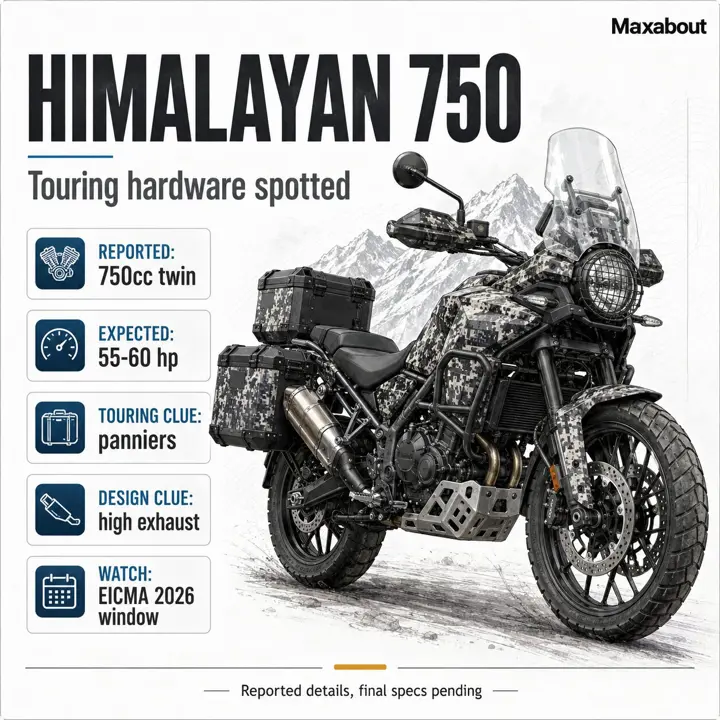 The most immediately visible addition was what looked like dedicated pannier mounting hardware — not aftermarket racks bolted on as an afterthought, but what appeared to be purpose-built frame-integrated mounting points. That distinction matters. Integrated systems typically handle load distribution better on rough terrain, which anyone who has pushed a loaded bike through Spiti's boulder fields would appreciate immediately.
The windscreen setup also caught attention. It appeared taller and more substantially braced than the standard Himalayan's unit — the kind of screen designed for genuine highway comfort rather than light wind deflection. Whether it offers adjustability isn't confirmed, but the proportions suggest serious intent.
Handlebar positioning looked slightly revised too — possibly a wider sweep, though this is speculative based on test images alone. Ergonomic changes at the bar level can significantly affect long-distance fatigue.
Compared visually to what something like the KTM 390 Adventure offers from the factory, this setup looks more touring-focused out of the box — which, if confirmed, would be a meaningful differentiator in that price conversation.
Why a 750cc Engine Makes Sense for Indian Highway Touring
Here is where the practical argument gets genuinely interesting. The current Himalayan 452's engine is a capable unit — nobody disputes that. But sustained two-up riding with full luggage across something like NH44 or the Manali-Leh corridor is a different conversation entirely.
At highway speeds, loaded touring demands a certain effortlessness. You want the engine working comfortably at 80-90 kmph, not straining. A 750cc parallel-twin in this application would likely produce somewhere in the region of 70-75 Nm of torque — that is a meaningful step up — and that torque character matters enormously when you are climbing into Spiti Valley with a pillion and 30kg of luggage distributed across panniers.
The Ghats present a different but equally valid case. Those long, relentless gradients through Coorg or the Kasara Ghat stretch punish smaller engines in ways flat highway testing simply does not reveal.
From what similar displacement touring bikes suggest, fuel efficiency in the 25-30 kmpl range seems realistic for a 750cc adventure motorcycle ridden sensibly. That is acceptable for touring, where fuel stops can be planned around the route anyway.
The 450 does its job well for solo riding. But for serious loaded touring, more displacement genuinely earns its place.
How the Himalayan 750 Could Stack Up Against Rivals in India
The adventure tourer segment around the ₹4-6 lakh mark is genuinely competitive right now. The KTM 390 Adventure and BMW G 310 GS have built loyal followings among riders who want capable hardware with reasonable ownership costs. If the Himalayan 750 lands anywhere near ₹4.5-5.5 lakh, Royal Enfield will need to make a compelling argument — not just on displacement, but on overall touring readiness.
The KTM asks a lot from its rider. It is an enthusiast's machine — sharp, demanding, and frankly not everyone's idea of a relaxed two-week mountain tour. The BMW G 310 GS, while refined, carries that premium badge pricing without always delivering the ground clearance or luggage compatibility that serious touring riders expect. This is where the Himalayan 750 could find real breathing room.
Then there is the Triumph Tiger Sport 660 sitting higher up, closer to ₹8-9 lakh. That bike is in a different conversation entirely — more road-focused, more urban in character despite the name. The 750 likely won't chase that positioning.
What Royal Enfield genuinely has, and competitors simply cannot match, is its service network in smaller towns and remote regions. Riding through Spiti, the Northeast, or Rajasthan's interior means passing through places where KTM authorised service is a distant memory. An RE mechanic, or at least someone familiar with the platform, is almost always nearby. For touring riders, that practical reality matters far more than spec-sheet victories.
To justify a premium over the Himalayan 450, the 750 needs to feel like a genuinely different machine — not just a larger number on paper.
The Touring Kit Question: Factory Fitted or Aftermarket Add-On?
Here is where things get genuinely interesting. The test mule images show what appears to be pannier mounts, a larger windscreen, and possibly a crash guard setup — but the real question is whether Royal Enfield is testing the motorcycle itself or testing how accessories integrate with it. Those are two very different things, and the distinction matters enormously for buyers.
Royal Enfield already has a reasonably developed accessories ecosystem. From official panniers to handlebar risers, they have been quietly building this out over recent years. Whether the Himalayan 750 arrives with a factory touring package — everything bolted on, priced together — is something worth thinking about carefully.
Triumph has done this well with the Tiger range in India. BMW does it even more comprehensively with the GS Adventure variants. Both brands offer touring-ready configurations straight from the dealership, which genuinely simplifies the buying decision. Could Royal Enfield do something similar at a far more accessible price point? From what industry observers suggest, there is appetite within the company to move in this direction.
An official touring variant would make strong commercial sense. Riders planning serious long-distance travel often want one coherent package rather than hunting down compatible accessories post-purchase. If Royal Enfield gets that pricing and fitment quality right, it could be a compelling proposition.
Real World Touring Concerns Indian Riders Should Think About
Step back from the excitement for a moment. A touring-equipped Himalayan 750 sounds genuinely compelling on paper, but there are practical questions worth sitting with before getting carried away.
Pricing is the first reality check. If positioned above the Himalayan 450, expect something in the ₹3 to ₹4.5 lakh range. That is a significant jump from the current 450's bracket. For many riders, that money starts competing with used adventure bikes from other segments. Royal Enfield will need to justify that premium convincingly.
Then there is the service network concern. A new 750 platform means fresh engine architecture, and remote touring areas — think Spiti, Arunachal, or Ladakh — often have mechanics familiar only with older Royal Enfield platforms. Spare parts availability mid-trip is a genuine worry, not a minor footnote. From what experienced touring riders consistently report, being stranded 200 kilometres from the nearest town with an unfamiliar engine is a nightmare scenario.
Urban usability matters too. Not every owner lives near mountain passes. Someone commuting through Bangalore or Pune traffic daily needs an engine that is refined, heat-manageable, and not punishing in stop-start conditions.
And Indian touring itself presents challenges no spec sheet addresses — sudden cattle crossings, fuel deserts in remote northeastern regions, and road surfaces that transition from smooth highway to broken gravel within metres. The 750 platform would need substantial low-end torque, robust suspension travel, and genuine heat tolerance to handle these realities seriously.
What Royal Enfield Needs to Get Right With the Himalayan 750
A bigger engine alone won't make this motorcycle great. Royal Enfield needs to get several fundamental things right, and honestly, their track record is mixed enough that enthusiasm here should come with clear eyes.
Suspension is the starting point. The current Himalayan's suspension setup has drawn criticism for feeling underdamped on fast broken roads — the kind you encounter constantly between Manali and Leh, or on any serious run through the Western Ghats. The 750 needs longer travel, better-quality internals, and damping that actually handles corrugated dirt tracks without the front end feeling vague. This is non-negotiable for a motorcycle positioning itself as a serious adventure tourer.
Electronics expectations are also reasonable now. Traction control, cornering ABS, and multiple ride modes are no longer premium luxuries — they're category standards. Royal Enfield has shown willingness to add electronics on the Shotgun and newer platforms, so this feels achievable. What matters is whether the calibration feels natural rather than intrusive.
Ergonomics remain genuinely tricky. Seat height needs thoughtful engineering — tall enough for proper off-road clearance, yet accessible for riders around 5'6", which covers a substantial portion of Indian buyers. A adjustable seat option would be the smartest solution Royal Enfield could offer.
Fuel tank capacity should realistically target 20 litres minimum. Remote touring across Rajasthan or the Northeast demands range confidence that smaller tanks simply cannot provide.
Then there's build quality — the conversation nobody wants to have but everyone should. Fit and finish has historically been Royal Enfield's weakest area. The Himalayan 450 showed genuine improvement, and the 750 must continue that trajectory rather than regress under cost pressures.
If testing sightings continue through mid-2025, a late 2025 or early 2026 launch seems plausible. Watch for official homologation filings and spec confirmations — those will reveal whether Royal Enfield built something genuinely capable, or simply a displacement upgrade wearing adventure clothing.
No comments yet
Be the first to share your thoughts!
Want to read more automotive news?
Stay updated with the latest car launches, reviews, and industry insights.
Browse All News