
Royal Enfield GT-R750 Race Debut: What It Means
Something shifted in the two-wheeler world recently, and if you follow Royal Enfield even casually, you probably felt it too. The GT-R750's race debut wasn't just another motorsport headline — it felt like a statement. A brand that millions of Indians associate with unhurried weekend rides and class...
Editorial Team
Something shifted in the two-wheeler world recently, and if you follow Royal Enfield even casually, you probably felt it too. The GT-R750's race debut wasn't just another motorsport headline — it felt like a statement. A brand that millions of Indians associate with unhurried weekend rides and classic styling suddenly showed up at a racetrack, seriously, with a purpose-built machine designed to compete.
That's worth pausing on for a moment.
Royal Enfield has always carried a certain image — dependable, characterful, deeply emotional. But fast? Technically ambitious? That conversation never really happened. The GT-R750 changes that. From what industry observers and motorsport journalists have reported, this isn't a showpiece exercise. Royal Enfield appears to be genuinely pushing their engineering capabilities into competitive territory.
For Indian enthusiasts specifically, this hits differently. Watching a homegrown brand — one born out of Chennai, with roots going back further than most — throw its hat into serious racing circles carries real pride. The reaction across the two-wheeler community has been a mix of excitement, curiosity, and honestly, a few healthy questions about whether the performance credentials will hold up under scrutiny.
This article looks at exactly that — what the debut actually revealed, what it signals about Royal Enfield's direction, and whether the excitement is genuinely justified.
What Is the GT-R750 and What Makes It Race-Ready?
The GT-R750 is not a modified road bike with a race sticker slapped on. That distinction matters. This is a purpose-built racing motorcycle developed specifically for circuit competition, sitting in an entirely different category from anything Royal Enfield currently sells at a showroom.
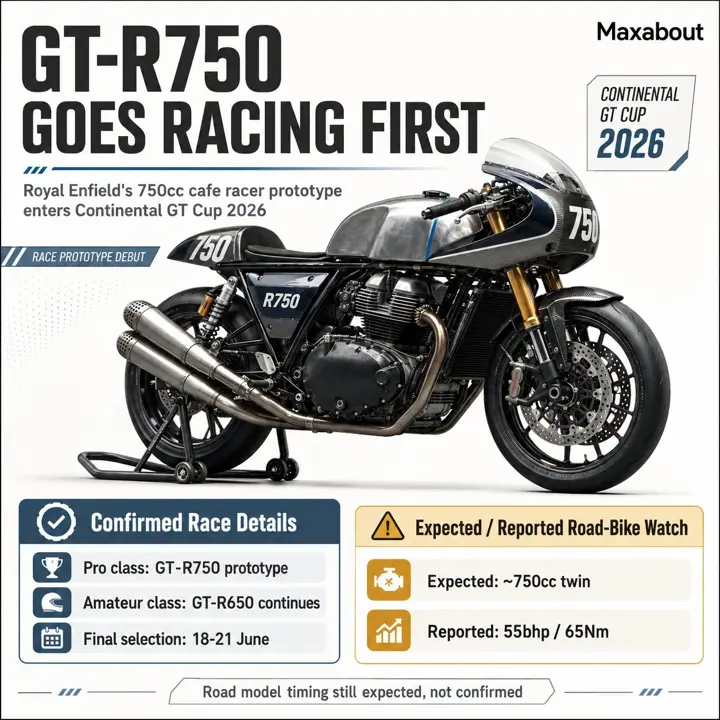 At its heart is a 750cc parallel-twin engine — a deliberate step up from the 648cc unit powering the Interceptor 650 and Continental GT 650. That displacement choice is significant. The 750cc class is a globally recognised racing category, giving Royal Enfield a competitive platform that aligns with established international racing regulations rather than an arbitrary internal decision.
The chassis construction moves well beyond what street-focused RE bikes require. Where the Interceptor 650 uses a steel double-cradle frame tuned for comfort across Indian roads, the GT-R750 employs a race-spec trellis frame engineered for rigidity, precise load transfer, and high-speed cornering stability — conditions that Indian highways simply never demand.
Based on official announcements, the motorcycle also features fully adjustable suspension at both ends, race-compound tyres, and a focused aerodynamic profile. There is no provision for road legality — no mirrors, no lighting, no unnecessary weight. Every component exists to serve lap times.
Think of it this way: if the Continental GT 650 is a capable enthusiast's companion, the GT-R750 is the engineering department's answer to a completely different question.
How Did the Race Debut Actually Go? A Breakdown of Performance
Race debuts rarely go exactly to script. The GT-R750's first competitive outing was no different — promising in patches, instructive in others, and honest enough in its results to give a realistic picture of where Royal Enfield actually stands as a motorsport contender.
Based on available race reports and official announcements, the GT-R750 competed in a controlled, production-based racing format. The circuit itself was technically demanding — the kind that exposes both outright power limitations and chassis behavior under sustained load. Early sessions reportedly showed the bike handling confidently through medium-speed corners, which aligned with the engineering emphasis on chassis rigidity and suspension tuning.
Where things got complicated was on longer straights. Against more established competition, the GT-R750 showed a measurable top-speed deficit. Rival machines with deeper motorsport development histories simply pulled away in those sections. Finishing positions reflected this honestly — competitive within certain segments of the race, less so in overall classification.
Reliability, however, deserves a specific mention. From what observers reported, the bike completed its race distance without mechanical incidents. For a debut outing, that matters considerably. Many first-generation race machines fail before they finish.
The honest assessment? The GT-R750 is not an immediate frontrunner. But it demonstrated genuine structural competence. Think of this debut less as a victory lap and more as a credible first statement — one that needs several development rounds before it translates into podium results.
Royal Enfield's Motorsport Journey: From Rookie to Contender?
To understand what the GT-R750 debut actually means, you need to step back and look at where Royal Enfield started motorsport-wise. Honestly, it wasn't glamorous. For years, RE's racing involvement was largely limited to organised one-make cups in India — controlled environments where identical machines kept competition fair but hardly tested engineering boundaries.
The Continental GT Cup was arguably their first serious attempt at building a racing culture. It gave young Indian riders a structured platform, but more importantly, it gave Royal Enfield's engineers real feedback loops. Lap times, tyre wear, mechanical stress under competitive conditions — data you simply cannot replicate on a test track.
That foundation mattered. It wasn't just about spectacle. It was curriculum. RE was learning how to build racing infrastructure — logistics, technical support, rider coaching — from the ground up.
International ambitions came gradually. Their association with events like the Isle of Man TT, primarily through the historic Madras Motor Cycle Club participation angle, signalled growing confidence. But participation and genuine competitiveness are very different things, and RE has always been honest enough to acknowledge that gap.
The GT-R750 represents something more deliberate. From what industry observers have noted, RE invested significantly in dedicated motorsport partnerships and technical collaboration to develop this machine — not badge-engineering an existing platform, but building racing intent from scratch. That shift in approach is worth recognising, even while remaining realistic about how far they still sit behind manufacturers with decades of accumulated racing knowledge.
What This Means for Royal Enfield's Road Bikes in India
There's an old saying in motorsport — racing improves the breed. It sounds like marketing speak until you actually trace how it works in practice. The stress a race engine endures in a single lap exceeds what most road bikes experience in months of daily use. Engineers learn fast under those conditions. They fix things or they fail publicly.
For Indian RE owners, that process genuinely matters. The 650 twins already have a strong reputation for reliability, but thermal management on hot Delhi afternoons or sustained highway runs on the Mumbai-Pune expressway still draws occasional criticism. A racing program that pushes the engine hard under controlled, documented conditions gives RE's engineers real data to work with — data that eventually feeds back into production tolerances, cooling efficiency, and long-term durability.
Suspension and braking tend to benefit most visibly. What gets developed for a race circuit often appears in revised road bike setups within two to three model cycles. If RE is serious about a higher-displacement model beyond 650cc — and the GT-R750's architecture suggests that conversation is happening internally — then buyers watching the next-generation 650 twins should look for tighter suspension calibration and improved braking confidence as early indicators that racing lessons are filtering through.
It won't happen overnight. But this program gives RE something they lacked before — a genuine technical pressure test.
Indian Riders React: Excitement, Skepticism, and Fair Questions
The riding community's response has been anything but uniform. Walk into any RE owners' group online right now and you'll find two very distinct camps — and honestly, both have reasonable points.
The enthusiastic side sees this as a genuine milestone. An Indian brand, with real heritage, lining up against European and Japanese machinery on a world stage. That matters emotionally. Riders who've defended RE against "it's just a retro brand" criticism for years feel this validates something they always believed about the company's ambitions.
But the skeptics are asking sharper questions, and they deserve straight answers.
Is this a genuine racing program or an expensive marketing exercise? That's the most common concern I've seen raised. RE has the resources to fund a few impressive race appearances, generate global press, and quietly shelve the program two seasons later. It wouldn't be the first manufacturer to do exactly that.
Then there's the younger performance crowd — riders currently eyeing KTM's Duke lineup or Kawasaki's Z series — who remain unconvinced. For them, one race debut changes nothing until lap times become genuinely competitive.
The fairest question is the simplest one: will any of this reach the showroom floor? That's ultimately how RE wins this argument.
How Does Royal Enfield Stack Up Against Racing Rivals?
Honestly, the gap is significant — and being honest about that matters here.
Look at what KTM has built over decades. Their racing DNA runs from MotoGP wildcards to Dakar dominance to accessible track-ready machines like the RC series. When KTM launches a performance product, the motorsport credibility is already banked. Riders don't need convincing. Royal Enfield is essentially starting that credibility-building process now, which puts them years behind manufacturers who treated racing as infrastructure, not a campaign.
Kawasaki's Supersport presence tells a similar story. Consistent season-over-season development, genuine rider development programs, technical data feeding directly into production engineering. That loop — racetrack to showroom — is what makes a racing program meaningful rather than decorative.
From what industry observers have noted, RE's strongest advantage is timing within their own growth story. The GT-R750 arrives as the brand genuinely attempts a performance repositioning. But one debut season proves nothing. What RE needs is multi-season commitment, measurable lap time progression, and transparent communication about technical development.
The realistic assessment? Royal Enfield is at the starting line of building a racing identity — not approaching the finish of one.
Final Thoughts: A Promising Start, But the Real Test Is What Comes Next
So where does this leave us? The GT-R750's debut was meaningful without being definitive. It showed intent, generated genuine excitement, and proved Royal Enfield is willing to put real resources behind a racing program. That matters. But excitement is not a podium finish, and intent is not consistency.
My honest read? It is far too early to call this a transformation. It is a credible first step — nothing more, nothing less.
What I would watch over the next season or two is simple. Lap time improvements across rounds, not just a strong debut. Transparent updates from the engineering team about where development is heading. And critically, how RE responds when things go wrong — because in racing, they always do at some point.
For Indian motorcycle fans, this program deserves patient attention rather than immediate judgment. One race tells you the starting point. Several seasons tell you the story.
If Royal Enfield maintains this commitment through setbacks and keeps pushing measurable progress, that will confirm something genuinely exciting is happening. Until then, stay curious, stay skeptical, and keep watching.
What do you think — is the GT-R750 program the real deal? Drop your thoughts below.
Explore the story
Related news

Share your view and join the discussion.
Earn reward points for every comment and get a chance to win ₹1,000 in our weekly lucky draw. Sign in with Google in one tap.
Start the conversation
No one has commented on this article yet. Be the first to share your view.
Want to read more automotive news?
Stay updated with the latest car launches, reviews, and industry insights.
Browse All News