
Royal Enfield FY2027 Plan: 5 New Bikes + 13 Updates
Royal Enfield is at an interesting crossroads right now. The brand has spent decades being the go-to choice for riders who want something more than a commuter but don't want to stretch into full-blown superbike territory. And lately, that position has started to feel both stronger and more vulnerabl...
Editorial Team
Royal Enfield is at an interesting crossroads right now. The brand has spent decades being the go-to choice for riders who want something more than a commuter but don't want to stretch into full-blown superbike territory. And lately, that position has started to feel both stronger and more vulnerable at the same time.
The Bullet 350's revival was genuinely smart — it brought back old loyalists while pulling in newer riders. The Himalayan 450 showed that RE could actually push engineering boundaries when it wanted to. These weren't just updates. They were signals that the brand was taking itself more seriously.
Now comes something bigger. Royal Enfield has outlined an ambitious FY2027 roadmap — five completely new motorcycles, plus 13 updates across existing models. That's a serious volume of product activity for any manufacturer, let alone one that historically moved at its own unhurried pace.
Why does this matter? Because the mid-size segment in India isn't the quiet space it used to be. Bajaj is pushing hard with the Triumph partnership. Honda is getting more aggressive. And global players are watching the segment closely. From what industry observers are noting, RE clearly recognizes the pressure.
This plan reads like a direct, calculated response.
Breaking Down the FY2027 Plan: 5 New Bikes and 13 Updates Explained
So what exactly is Royal Enfield committing to here? Based on official announcements and industry reports, the broad outline involves five entirely new motorcycles alongside thirteen product updates spread across their existing lineup. That distinction matters more than it might initially seem.
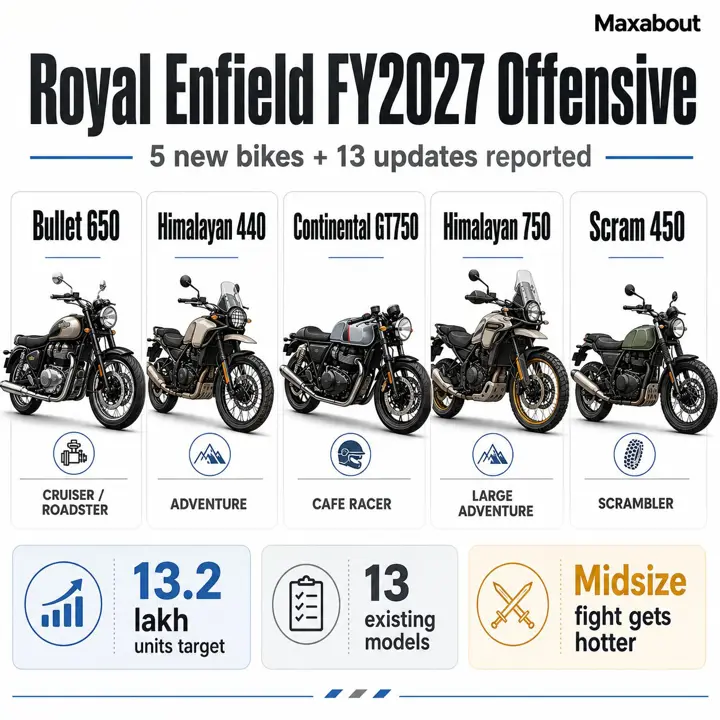 A genuinely new motorcycle typically means a new platform, new engine architecture, or at minimum a ground-up rethink of the riding experience. Updates are a different story. From what industry sources suggest, those thirteen refreshes could range from additional colour options and new instrument clusters right through to more meaningful mechanical refinements — revised suspension tuning, updated braking hardware, or compliance-driven engine adjustments.
Historically, Royal Enfield's launch pace was measured and deliberate. One or two significant introductions per year was considered busy. Eighteen product movements in a single financial year represents a genuine structural shift in how the company is operating.
From what has been officially confirmed, the new models are expected to address segments where RE currently has limited presence — potentially including smaller displacement options and more performance-focused platforms. The updates, meanwhile, appear designed to keep existing models competitive without requiring buyers to wait for full replacements.
The scale here is worth sitting with for a moment. This isn't incremental progress.
The 5 New Motorcycles: What Segments Could Royal Enfield Be Targeting?
Five entirely new motorcycles is a significant commitment. The natural question is — where exactly are they going with this?
Royal Enfield's recent launches give us some useful clues. The Himalayan 450 and the Guerrilla 450 both signal a clear shift toward performance-oriented, more technically sophisticated platforms. The 450cc Sherpa engine is genuinely capable hardware, and RE seems aware that riders are expecting more from them than they did five years ago. These two models feel like the foundation of something larger rather than isolated experiments.
Looking at genuine gaps in their current lineup, a proper mid-size cruiser stands out immediately. The Super Meteor 650 covers the upper end reasonably well, but there's a noticeable space around the 350–450cc cruiser bracket that RE hasn't addressed with any real conviction. Indian riding communities have been vocal about this for years — riders who want that relaxed, low-slung posture without committing to a 650cc price point.
Then there's the street naked segment. The Guerrilla is a step in that direction, but riders consistently ask for something sharper — more aggressive ergonomics, a sportier attitude. Whether RE goes there remains to be seen.
The electric segment also feels inevitable. From what industry observers have noted, RE's electric roadmap is progressing quietly behind the scenes.
In my view, the five new models likely spread across these spaces deliberately — no single bet, but a broader attempt to hold ground across multiple growing segments simultaneously.
What This Means for Real Riders Across India
All of this product expansion sounds impressive on paper. But what does it actually mean for someone navigating Bangalore's outer ring road every morning, or planning a weekend run on the Mumbai-Pune expressway?
Honestly, more models cut both ways. More choice means better fit — a daily commuter in Chennai doesn't need the same machine as a tourer heading toward Spiti. If RE's lineup becomes genuinely more segmented, riders stop making compromises they shouldn't have to make.
For weekend enthusiasts doing the occasional Coorg or Lonavala run, a refreshed middleweight with sharper handling could finally feel purpose-built rather than adapted. That matters on ghat roads where confidence counts.
Long-distance tourers, meanwhile, will watch the Himalayan updates most closely. From what reviewers consistently note, the current platform is capable but leaves room for improvement in wind protection and long-haul comfort.
The practical concern, though, is service network readiness. Thirteen updates across existing platforms means more variant-specific parts. New platforms mean new training requirements for mechanics. RE's dealership infrastructure in smaller towns is already stretched — pushing eighteen changes through that system simultaneously is a genuine operational challenge worth watching.
More options are welcome. Whether the support system keeps pace is the real question.
Royal Enfield's Competition Problem: Will FY2027 Be Enough?
Let's be honest — Royal Enfield has had it relatively comfortable for years. But from what I can see in market trends, that comfort is starting to look fragile.
The Bajaj-Triumph partnership changed something real. The Speed 400 arrived with proper fit, finish, and a globally trusted badge — at a price that directly challenged RE's mid-range. Honda's growing confidence in the 300–500cc space adds another credible threat. KTM continues attracting younger, performance-oriented riders. In my view, RE is now fighting a multi-front battle it hasn't faced before.
So does five new bikes plus thirteen updates answer that pressure? Partially. It signals awareness. But awareness and execution are very different things.
RE's genuine strengths remain significant — the service network reaching smaller towns, a community culture that no competitor has replicated, and brand loyalty that runs surprisingly deep. These aren't small advantages.
But valid criticisms persist. Quality control inconsistencies still appear in owner feedback. Feature parity with rivals lags noticeably. And the premium pricing perception creates a difficult middle ground — too expensive to feel accessible, not premium enough to silence doubters.
In my view, this FY2027 plan looks more reactive than visionary — a response to competitive pressure rather than a bold leap ahead. That's not necessarily fatal. But it does mean execution has to be near-perfect. Right now, that's an open question.
Quality, Reliability, and the RE Ownership Reality in India
Execution being an open question brings us to something Indian buyers have debated for years — Royal Enfield's build quality and reliability record. Let's be honest about this without turning it into a brand-bashing exercise.
The older UCE-platform bikes had a well-documented reputation. Vibrations at highway speeds, electrical gremlins, oil seeps, and inconsistent fit-and-finish were widely reported across owner communities. That reputation stuck, fairly or unfairly.
The newer platforms tell a more encouraging story. The J-series engine powering the Meteor, Hunter, and Classic 350 is noticeably smoother and more refined. The 450 platform on the Himalayan has drawn genuinely positive reliability feedback from early adopters. These are real improvements, and they deserve acknowledgment.
But here's where the FY2027 plan introduces a legitimate concern. Scaling five new models simultaneously while managing thirteen updates is an enormous manufacturing and quality control challenge. From what industry observers have noted, even well-resourced manufacturers struggle when product pipelines expand too aggressively too quickly.
Indian buyers have specific, reasonable worries — long-distance vibrations on expressways, electrical reliability in monsoon conditions, and service quality consistency outside major cities like Pune, Hyderabad, or Lucknow. These aren't imagined problems. They appear repeatedly in real owner feedback.
Whether RE's quality infrastructure can absorb this expansion without regression — that remains the critical unanswered question.
Electric and the Future: Does RE's FY2027 Plan Address the EV Question?
Royal Enfield has been quietly vocal about electric ambitions. The Flying Flea concept generated genuine excitement — a retro-styled electric motorcycle that felt authentically RE in its design language. But concepts and production timelines are very different conversations.
From what official announcements suggest, FY2027's focus remains heavily petrol-oriented. Five new bikes, thirteen updates — and electric development appears to be running on a separate, longer track. Whether that's strategic patience or hesitation is worth questioning.
The practical challenges are real. Highway range anxiety isn't imaginary for someone planning a Manali or Ladakh run. Charging infrastructure outside Delhi, Bengaluru, or Mumbai remains genuinely unreliable. Revolt and other EV players have found urban commuter segments more workable — not the touring, open-road identity that RE has built everything around.
There's also the brand question. A significant portion of RE's loyal following connects emotionally with that distinctive engine character. An electric RE would need to offer something equally compelling — not just silence.
In my view, RE moving cautiously here is probably correct. Rushing an electric motorcycle that disappoints on range or reliability could damage brand trust far more than arriving late. Getting it right matters more than getting there first.
Should Indian Riders Get Excited or Wait and Watch?
Honestly? Both. The FY2027 plan is genuinely ambitious — five new motorcycles plus thirteen updates across existing models is not something you see from a manufacturer unless there's serious intent behind it. Royal Enfield clearly understands that standing still right now means falling behind.
But execution is everything. Announcements are easy. Delivering refined, reliable motorcycles on schedule is where RE has sometimes struggled in the past. Cautious optimism is the right starting point here.
If you're actively shopping for a Royal Enfield today, the timing question is worth thinking through carefully. Buying just before a major product refresh almost always has resale value consequences. A current Meteor or Himalayan purchased six months before an updated version arrives will take a noticeable hit when you eventually sell. That's just how the market works.
From what I've observed, the smarter move is waiting — unless you genuinely need the motorcycle right now, or a current model's pricing makes the deal too good to ignore.
Royal Enfield has the brand strength, the distribution network, and clearly the product ambition to stay relevant well into this decade. Whether FY2027 becomes a defining moment depends entirely on what actually reaches showrooms. The potential is real. The proof will follow.
What's your read on this? Are you excited about what's coming, or taking a wait-and-see approach? Drop your thoughts below.
Explore the story
Related news

Share your view and join the discussion.
Earn reward points for every comment and get a chance to win ₹1,000 in our weekly lucky draw. Sign in with Google in one tap.
Start the conversation
No one has commented on this article yet. Be the first to share your view.
Want to read more automotive news?
Stay updated with the latest car launches, reviews, and industry insights.
Browse All News