
Range Rover Sport SV Launched at ₹2.05 Crore in India
Land Rover has quietly raised the bar in India's ultra-luxury SUV space. The Range Rover Sport SV has arrived at ₹2.05 crore (ex-showroom), and this is not simply a better-equipped version of the standard Sport. It is a fundamentally different machine.To understand why, you need to know what SV actu...
Editorial Team
Land Rover has quietly raised the bar in India's ultra-luxury SUV space. The Range Rover Sport SV has arrived at ₹2.05 crore (ex-showroom), and this is not simply a better-equipped version of the standard Sport. It is a fundamentally different machine.
To understand why, you need to know what SV actually means. It stands for Special Vehicle Operations — Land Rover's in-house division that handles their most extreme, most exclusive builds. Think of it as the engineering team that gets called in when the regular lineup is not enough. The standard Range Rover Sport is already a capable, polished SUV. The SV takes that foundation and pushes it into genuinely supercar-adjacent territory.
At this price, it competes with the likes of Porsche Cayenne Turbo GT and Lamborghini Urus at the performance end of the spectrum. The buyer Land Rover is targeting here is not someone shopping for a practical family SUV. This is for someone who wants the commanding presence of a Range Rover combined with performance figures that feel almost absurd for a vehicle this size.
From what industry observers have noted, interest in this segment has grown steadily in metros like Mumbai and Delhi. And honestly, at ₹2.05 crore, it makes a very specific kind of statement.
What Does the SV Badge Actually Mean on a Range Rover Sport
Not every Range Rover Sport earns those two letters. The SV designation comes from Special Vehicle Operations — Land Rover's in-house skunkworks division based in Coventry. Think of it as the part of the company where engineers and craftspeople are given permission to push well past what the standard production line allows. It is not a trim level. It is a fundamentally different product.
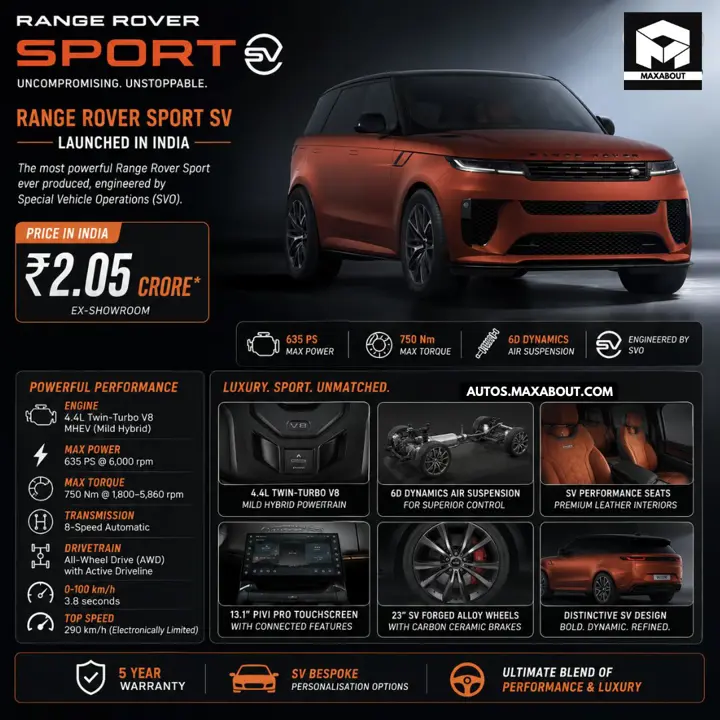 The heart of the difference is under the bonnet. Where a standard Sport HSE or Dynamic in India runs a mild-hybrid petrol or diesel setup, the Sport SV carries a 4.4-litre twin-turbocharged V8 producing around 635 bhp and 750 Nm of torque. The 0-100 kmph sprint takes approximately 3.6 seconds. For context, that is supercar territory wrapped inside a full-size luxury SUV body. The engineering required to manage that power through an all-wheel-drive system, while keeping the ride composed, is genuinely complex work.
Visually, the SV is not a subtle upgrade either. It gets unique bodywork with wider tracks, 23-inch forged alloy wheels, and exclusive exterior detailing that separates it immediately from lesser Sport variants. The body surfacing is sharper and more sculpted.
Inside, SVO's craftspeople hand-finish elements that standard production simply cannot replicate at scale. The materials, stitching quality, and surface textures are noticeably elevated. That combination — bespoke engineering plus handcrafted interior work — is precisely why the price sits so far above the regular Sport lineup.
Performance Numbers and What They Mean on Indian Roads
The SV's 4.4-litre twin-turbocharged V8 produces 635 horsepower and 750 Nm of torque. Those figures look impressive on paper, but understanding what they actually mean in everyday Indian driving conditions tells a more interesting story.
That torque arrives early and builds progressively — which, counterintuitively, makes this engine genuinely pleasant in dense city traffic. In Mumbai's Bandra-Worli corridor or Delhi's Lutyen's zone, where you're rarely moving above 40 kmph, the V8 barely breathes. It feels almost lazily composed, never stressed. From what reviewers consistently report, the eight-speed automatic gearbox in this application is exceptionally smooth at low speeds — exactly what matters when you're crawling through Connaught Place.
On open stretches like the Delhi-Jaipur Expressway, the character transforms completely. The mid-range punch is relentless — triple-digit speeds arrive with minimal drama and considerable urgency. That's the V8's real personality.
The air suspension deserves equal attention. Over broken surfaces — and Indian roads will find broken surfaces regardless of the route — it adapts continuously, absorbing impacts that would unsettle lesser SUVs. The Terrain Response system adds genuine capability beyond tarmac, though honestly, most buyers at ₹2.05 crore will rarely explore that.
And that's perfectly fine. This is primarily a luxury statement, occasionally a chauffeur-driven executive car, and sometimes a powerful highway cruiser. It performs every one of those roles with quiet, unhurried confidence.
Interior, Technology, and the SV-Exclusive Features That Justify the Price
Step inside and the conversation changes entirely. If the driving experience is about capability, the cabin is about making a statement without saying a word. The Range Rover Sport SV's interior isn't just a step up from the standard Sport — it's a genuinely different proposition in terms of materials, finishing, and the sense of occasion it creates the moment you close the door.
The SV-specific upholstery options are where buyers at this price point will spend considerable time customising. Semi-aniline leather, contrast stitching, and exclusive colour combinations that simply aren't available on lower variants. The material quality is immediately apparent — surfaces feel substantial, tactile, and carefully assembled rather than just visually impressive.
For many Indian buyers at ₹2 crore-plus, the rear seat matters more than the driver's seat. From what reviews suggest, the rear experience here is genuinely executive-grade — generous legroom, reclining backrests, individual climate controls, and the kind of ambient lighting that makes evening commutes through Bengaluru or Delhi feel oddly civilised despite the traffic outside.
The Meridian audio system is exceptional by any standard. The Pivi Pro infotainment responds quickly, the interface is logical, and the head-up display reduces the need to glance away from challenging city roads. The 360-degree camera system proves genuinely useful in tight Mumbai parking situations — more practical than it sounds at this price.
Buyers spending ₹2 crore expect technology that works invisibly and effortlessly. By most accounts, Land Rover largely delivers exactly that.
Who Is Actually Buying the Range Rover Sport SV in India
Let's be honest — this is not a car for someone stretching their budget. The buyer walking into a Land Rover dealership for the Sport SV almost certainly has a Porsche, a Mercedes, or something equally serious already sitting in the garage. This is a considered addition, not a first purchase.
We're talking about ultra-high-net-worth individuals — successful entrepreneurs, promoters of listed companies, senior professionals in finance and tech, and old-money families in cities like Delhi, Mumbai, Hyderabad, and Bangalore. These are people for whom ₹2 crore is a meaningful but entirely manageable decision.
What's interesting is why they choose the Range Rover badge over, say, a Lamborghini Urus or a Porsche Cayenne Turbo GT. The Urus screams for attention. The Cayenne Turbo GT signals performance knowledge. The Range Rover Sport SV does something different — it communicates quiet authority. On Indian roads, where SUV presence is genuinely respected, that combination of British heritage, imposing road stance, and off-road credibility carries real social weight.
There's also a practicality argument. This buyer wants something that handles a wedding in Udaipur, a weekend drive on the Delhi-Chandigarh expressway, and valet parking at a five-star hotel — all without compromise. The Sport SV, from what most observers note, genuinely covers all three.
Ownership Costs, Service, and the Practical Realities of Running a ₹2 Crore SUV in India
Let's be honest about something: the ₹2.05 crore sticker price is genuinely just the beginning. By the time you've factored in registration and road tax, you're looking at a significantly heavier outlay. Road tax varies by state, but in markets like Maharashtra or Karnataka, it can add another 18–20% on vehicles at this price point. That's potentially ₹35–40 lakh on top, before the car even moves.
Insurance for a vehicle valued this high is another real consideration. Comprehensive coverage from a reputable insurer could run anywhere between ₹3–5 lakh annually, depending on the add-ons and the insurer's assessment. Some owners in this segment opt for higher deductibles to manage premiums, but that's a trade-off worth thinking through carefully.
Then there's servicing. Land Rover's network in India has improved meaningfully over the past few years, with authorized service centers now present in major metros like Mumbai, Delhi, Bengaluru, Hyderabad, and Chennai. But if you're based in a tier-2 city, the reality is less comfortable. Getting specialized work done often means transporting the vehicle to the nearest authorized center, which adds both cost and inconvenience.
Annual service costs for a vehicle like this — based on owner community feedback and industry reports — typically range between ₹1.5–2.5 lakh per year under normal usage. Parts availability has improved, but lead times for specific components can still stretch longer than what German rivals offer, and that's a fair criticism worth acknowledging.
Land Rover's reliability reputation in India has historically been a mixed story. Early ownership experiences reported by communities suggest the brand has made progress, but it hasn't fully shaken off concerns around electrical gremlins and software-related issues that occasionally surface. For a ₹2 crore purchase, that matters.
Range Rover Sport SV vs. the Competition at This Price Point
At ₹2.05 crore, the Range Rover Sport SV isn't operating in isolation. The Porsche Cayenne Turbo GT and BMW X5 M Competition are genuine alternatives, and buyers seriously considering one will almost certainly cross-shop the others.
Here's where honesty matters. The Cayenne Turbo GT and X5 M Competition are better driver's cars. Porsche's chassis tuning is in a different league when it comes to precision and feedback on a twisting road. The X5 M delivers a similar story — raw, linear performance with German engineering confidence built in over decades. Their service networks in India are also more established, with wider reach and, historically, fewer ownership headaches. That's a real advantage.
The Lamborghini Urus sits slightly higher in price, but inevitably draws comparisons at this aspiration level. It's more theatrical, more exotic, and frankly louder about what it is. If pure drama is the goal, the Urus wins that conversation.
Where the Range Rover Sport SV pushes back hard is on genuine versatility. Neither the Cayenne Turbo GT nor the X5 M can match its off-road capability — not even close. The Terrain Response system, ground clearance, and air suspension tuning mean this vehicle actually earns its SUV badge beyond city roads.
Then there's the supercharged V8. That sound, that character — it's something the increasingly turbocharged, electrified competition is quietly losing. For buyers who care about that emotional layer, the Sport SV delivers something distinctly irreplaceable right now.
Final Thoughts: Is the Range Rover Sport SV Worth ₹2.05 Crore in India?
Here's the honest truth: at ₹2.05 crore, you are not making a purely rational decision. And that is absolutely fine. Some purchases are about more than spreadsheets and depreciation curves.
The Sport SV earns genuine respect on its merits — the V8's character, the SV division's obsessive attention to craftsmanship, and that rare ability to feel equally at home on a Gurugram expressway or a broken mountain trail near Manali. Few vehicles at any price point manage that combination convincingly.
But the concerns are real. Land Rover's reliability record in India has historically been patchy, the service network outside major metros remains thin, and running costs will be considerable. These are not small footnotes.
From what industry ownership data consistently suggests, buyers in this segment typically have multiple vehicles. This is not someone's only car. In that context, the Sport SV makes complete sense as a passionate, emotionally driven choice.
For the right buyer — someone financially comfortable absorbing its demands — this is genuinely special machinery. For everyone else, better options exist at lower prices.
But when that supercharged V8 fires up? Rational thinking tends to exit the conversation entirely.
Explore the story
Related news
Share your view and join the discussion.
Earn reward points for every comment and get a chance to win ₹1,000 in our weekly lucky draw. Sign in with Google in one tap.
Start the conversation
No one has commented on this article yet. Be the first to share your view.
Want to read more automotive news?
Stay updated with the latest car launches, reviews, and industry insights.
Browse All News